Constraints on the Compact Object Mass in the Eclipsing HMXB XMMU J013236.7+303228 in M33
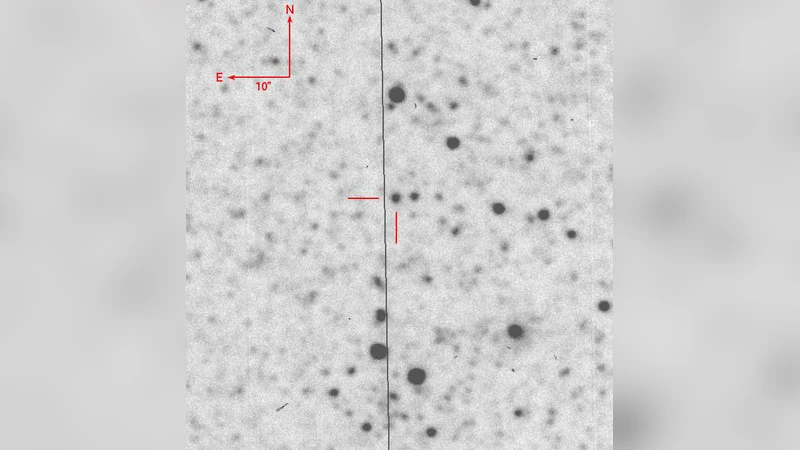
We present optical spectroscopic measurements of the eclipsing High Mass X-ray Binary XMMU J013236.7+303228 in M33. Based on spectra taken at multiple epochs of the 1.73d binary orbital period we determine physical as well as orbital parameters for the donor star. We find the donor to be a B1.5IV sub-giant with effective temperature T=22,000-23,000 K. From the luminosity, temperature and known distance to M33 we derive a radius of R = 8.9 \pm 0.5 R_sun. From the radial–velocity measurements, we determine a velocity semi-amplitude of K_opt = 63 \pm 12 km/sec. Using the physical properties of the B-star determined from the optical spectrum, we estimate the star’s mass to be M_opt = 11 \pm 1 M_sun. Based on the X-ray spectrum, the compact companion is likely a neutron star, although no pulsations have yet been detected. Using the spectroscopically derived B-star mass we find the neutron star companion mass to be M_X = 2.0 \pm 0.4 M_sun, consistent with the neutron star mass in the HMXB Vela X-1, but heavier than the canonical value of 1.4 M_sun found for many millisecond pulsars. We attempt to use as an additional constraint that the B star radius inferred from temperature, flux, and distance, should equate the Roche radius, since the system accretes by Roche lobe overflow. This leads to substantially larger masses, but from trying to apply the technique to known systems, we find that the masses are consistently overestimated. Attempting to account for that in our uncertainties, we derive M_X = 2.2^{+0.8}_{-0.6} M_sun and M_opt =13 \pm 4 M_sun. We conclude that precise constraints require detailed modeling of the shape of the Roche surface.
💡 Research Summary
The paper presents a detailed optical spectroscopic study of the eclipsing high‑mass X‑ray binary (HMXB) XMMU J013236.7+303228 located in the nearby galaxy M33. The authors obtained spectra at several orbital phases covering the 1.73‑day period and used them to determine the physical and orbital parameters of the donor star. Spectral classification, based on line ratios and model‑atmosphere fitting, identifies the donor as a B1.5 IV sub‑giant with an effective temperature of 22,000–23,000 K. Combining this temperature with the known distance to M33 (≈840 kpc) and the observed flux yields a luminosity that translates into a stellar radius of 8.9 ± 0.5 R⊙. From evolutionary tracks appropriate for a B‑type sub‑giant, the authors infer a donor mass of 11 ± 1 M⊙.
Radial‑velocity measurements of the optical component give a semi‑amplitude K_opt = 63 ± 12 km s⁻¹. Using the orbital period and assuming an inclination close to 90° (as required for the observed X‑ray eclipse), the mass function is calculated, leading to a compact‑object mass of M_X = 2.0 ± 0.4 M⊙. The X‑ray spectrum is consistent with a neutron star (NS) accretor, although no pulsations have been detected to date. This NS mass is comparable to that of Vela X‑1 and exceeds the canonical 1.4 M⊙ often quoted for millisecond pulsars, suggesting a relatively massive neutron star.
The authors also explore an additional constraint: because the system is thought to accrete via Roche‑lobe overflow, the donor’s radius derived from temperature, flux, and distance should match the Roche‑lobe radius. Imposing this condition forces the masses to larger values (M_X ≈ 2.2 M⊙ with asymmetric uncertainties, M_opt ≈ 13 ± 4 M⊙). However, when the same technique is applied to well‑studied binaries, it systematically overestimates the masses. The discrepancy is attributed to the simplifications inherent in treating the Roche surface as spherical and neglecting the donor’s tidal distortion, rotation, and temperature gradients across its surface.
Consequently, the authors adopt the spectroscopically derived donor mass as the more reliable basis, while acknowledging that the Roche‑lobe constraint introduces a significant systematic uncertainty. They conclude that precise mass determinations for such systems require detailed three‑dimensional modeling of the Roche geometry, including the effects of stellar deformation, gravity darkening, and irradiation by the X‑ray source.
The study’s main contributions are: (1) a robust spectroscopic classification and physical characterization of the donor star in an extragalactic HMXB; (2) a dynamical measurement of the neutron‑star mass that places it at the high end of the known NS mass distribution; and (3) a critical assessment of the limitations of Roche‑lobe‑based mass constraints, highlighting the need for sophisticated modeling. These results have implications for neutron‑star equation‑of‑state studies, binary evolution scenarios involving Roche‑lobe overflow, and the broader effort to map the mass spectrum of compact objects in external galaxies.