4MOST - 4-metre Multi-Object Spectroscopic Telescope
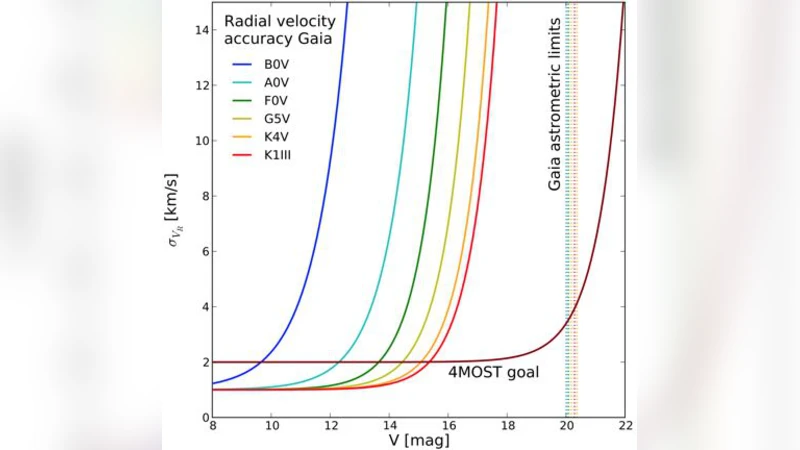
The 4MOST consortium is currently halfway through a Conceptual Design study for ESO with the aim to develop a wide-field (>3 square degree, goal >5 square degree), high-multiplex (>1500 fibres, goal 3000 fibres) spectroscopic survey facility for an ESO 4m-class telescope (VISTA). 4MOST will run permanently on the telescope to perform a 5 year public survey yielding more than 20 million spectra at resolution R5000 ({\lambda}=390-1000 nm) and more than 2 million spectra at R20,000 (395-456.5 nm & 587-673 nm). The 4MOST design is especially intended to complement three key all-sky, space-based observatories of prime European interest: Gaia, eROSITA and Euclid. Initial design and performance estimates for the wide-field corrector concepts are presented. We consider two fibre positioner concepts, a well-known Phi-Theta system and a new R-Theta concept with a large patrol area. The spectrographs are fixed configuration two-arm spectrographs, with dedicated spectrographs for the high- and low-resolution. A full facility simulator is being developed to guide trade-off decisions regarding the optimal field-of-view, number of fibres needed, and the relative fraction of high-to-low resolution fibres. Mock catalogues with template spectra from seven Design Reference Surveys are simulated to verify the science requirements of 4MOST. The 4MOST consortium aims to deliver the full 4MOST facility by the end of 2018 and start delivering high-level data products for both consortium and ESO community targets a year later with yearly increments.
💡 Research Summary
The paper presents the conceptual design of 4MOST, a dedicated multi‑object spectroscopic facility permanently mounted on the ESO VISTA 4‑metre telescope. Its primary scientific ambition is to complement the three flagship European space missions—Gaia, eROSITA and Euclid—by delivering massive spectroscopic follow‑up data. To achieve this, 4MOST is designed for a very wide field of view (≥ 3 deg², goal ≥ 5 deg²) and a high multiplex capability (≥ 1500 fibres, goal 3000). The instrument simultaneously operates two fixed‑configuration, dual‑arm spectrographs: a low‑resolution mode (R ≈ 5 000) covering 390–1000 nm and a high‑resolution mode (R ≈ 20 000) split into two windows (395–456.5 nm and 587–673 nm). Over a five‑year public survey the system is expected to collect more than 20 million low‑resolution spectra and over 2 million high‑resolution spectra.
Two fibre‑positioner concepts are examined. The conventional Φ‑Theta robot is a proven technology with well‑understood performance, while the novel R‑Theta concept offers a larger patrol area, reducing fibre‑collision risk and improving allocation efficiency for densely populated fields. Both concepts are evaluated through a comprehensive facility simulator that models trade‑offs among field size, fibre count, and the ratio of high‑ to low‑resolution fibres.
The paper details the optical design of the spectrographs, emphasizing high throughput, stable wavelength calibration, and the ability to meet the stringent signal‑to‑noise requirements of the Design Reference Surveys (DRS). Seven DRS mock catalogues, each with representative template spectra, are used to verify that the instrument meets the scientific requirements for stellar chemistry (Gaia synergy), X‑ray source identification (eROSITA synergy), and precise red‑shift measurements for galaxies and clusters (Euclid synergy).
A timeline is outlined: the full 4MOST facility is slated for delivery by the end of 2018, with the first high‑level data products released to both consortium members and the broader ESO community in 2019, followed by yearly incremental releases. The authors conclude that 4MOST will provide an unprecedented combination of wide‑field coverage, high multiplexing, and dual‑resolution spectroscopy, enabling transformative science across Galactic archaeology, extragalactic astrophysics, and cosmology, and establishing a vital ground‑based complement to the next generation of space‑based surveys.