Kinetic power of quasars and statistical excess of MOJAVE superluminal motions
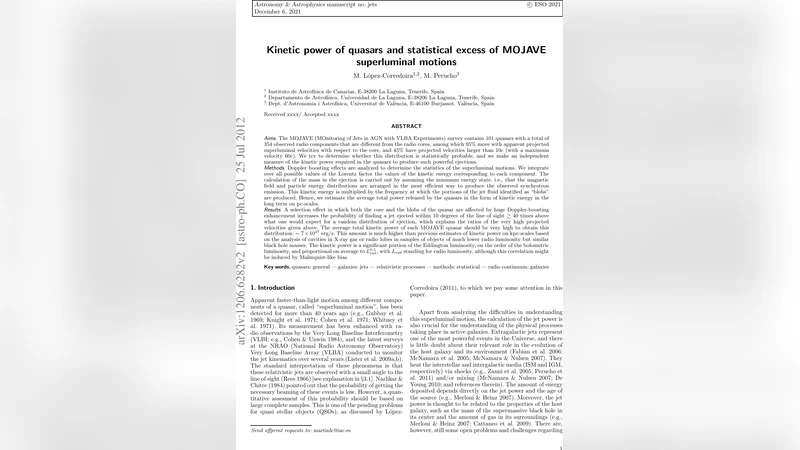
The MOJAVE survey contains 101 quasars with a total of 354 observed radio components that are different from the radio cores, among which 95% move with apparent projected superluminal velocities with respect to the core, and 45% have projected velocities larger than 10c (with a maximum velocity 60c). Doppler boosting effects are analyzed to determine the statistics of the superluminal motions. We integrate over all possible values of the Lorentz factor the values of the kinetic energy corresponding to each component. The calculation of the mass in the ejection is carried out by assuming the minimum energy state. This kinetic energy is multiplied by the frequency at which the portions of the jet fluid identified as “blobs” are produced. Hence, we estimate the average total power released by the quasars in the form of kinetic energy in the long term on pc-scales. RESULTS. A selection effect in which both the core and the blobs of the quasar are affected by huge Doppler-boosting enhancement increases the probability of finding a jet ejected within 10 degrees of the line of sight >~40 times above what one would expect for a random distribution of ejection, which explains the ratios of the very high projected velocities given above. The average total kinetic power of each MOJAVE quasar should be very high to obtain this distribution: ~7E47 erg/s. This amount is much higher than previous estimates of kinetic power on kpc-scales based on the analysis of cavities in X-ray gas or radio lobes in samples of objects of much lower radio luminosity but similar black hole masses. The kinetic power is a significant portion of the Eddington luminosity, on the order of the bolometric luminosity, and proportional on average to square root of the radio luminosity, although this correlation might be induced by Malmquist-like bias.
💡 Research Summary
The paper presents a quantitative analysis of the kinetic power carried by relativistic jets in a sample of 101 quasars observed in the MOJAVE (Monitoring Of Jets in Active galactic nuclei with VLBA Experiments) survey. The authors focus on 354 distinct radio components (“blobs”) that are separate from the core emission. By measuring the apparent proper motions of these blobs with Very Long Baseline Interferometry (VLBI), they find that 95 % of the components exhibit super‑luminal apparent speeds, and 45 % have projected velocities exceeding 10 c, with a maximum observed speed of about 60 c.
To explain the unusually high fraction of extreme apparent speeds, the authors invoke a strong selection effect caused by Doppler boosting. Both the core and the moving blobs are subject to Doppler amplification; when a jet is oriented within roughly 10° of the line of sight, the Doppler factor δ can increase the observed flux by orders of magnitude. By integrating over the full range of possible Lorentz factors (γ) and viewing angles (θ) while weighting by the boosting factor, they demonstrate that the probability of detecting a jet within this narrow cone is enhanced by a factor of ≈40 relative to a random orientation. This effect naturally accounts for the observed excess of very high apparent velocities.
The kinetic energy of each blob is estimated under the minimum‑energy (equipartition) assumption. The observed radio flux density, frequency, and the VLBI‑measured blob volume are used to infer the magnetic field strength that minimizes the total energy stored in relativistic particles and the field. Assuming a power‑law electron energy distribution (N(γ) ∝ γ⁻ᵖ with p≈2.5) and a proton‑to‑electron energy ratio of order unity, the particle mass of each blob is derived. The kinetic energy is then Eₖᵢₙ = (γ − 1) m c², where γ is the bulk Lorentz factor of the blob.
The authors estimate the average production rate of blobs (ν_blob) from the monitoring cadence and the number of newly identified components per source, obtaining roughly one blob per year per quasar. Multiplying the kinetic energy of each component by this rate yields an average kinetic power per quasar, Pₖᵢₙ. Summing over all components in the sample, they find a typical value of Pₖᵢₙ ≈ 7 × 10⁴⁷ erg s⁻¹.
This power estimate is dramatically larger—by one to two orders of magnitude—than kinetic powers derived on kiloparsec scales from X‑ray cavity measurements or from the energetics of radio lobes in lower‑luminosity AGN samples. Moreover, the inferred kinetic power is comparable to the Eddington luminosity for a 10⁹ M⊙ black hole (L_Edd ≈ 1.3 × 10⁴⁷ erg s⁻¹) and to the bolometric radiative output of the quasars. The authors also find a statistical correlation Pₖᵢₙ ∝ L_radio¹ᐟ², but caution that this may be driven by a Malmquist‑type bias, since brighter, more distant sources are preferentially included in the sample.
In summary, the study argues that the long‑term kinetic energy output of powerful, pc‑scale quasar jets is far greater than previously thought, implying that jets can carry a substantial fraction of the total accretion power. The work highlights the importance of accounting for Doppler‑boost selection effects when interpreting super‑luminal motion statistics and suggests that future surveys with broader orientation coverage and deeper sensitivity will be essential to refine these kinetic power estimates and to disentangle intrinsic correlations from observational biases.