Coarse-graining the dynamics of network evolution: the rise and fall of a networked society
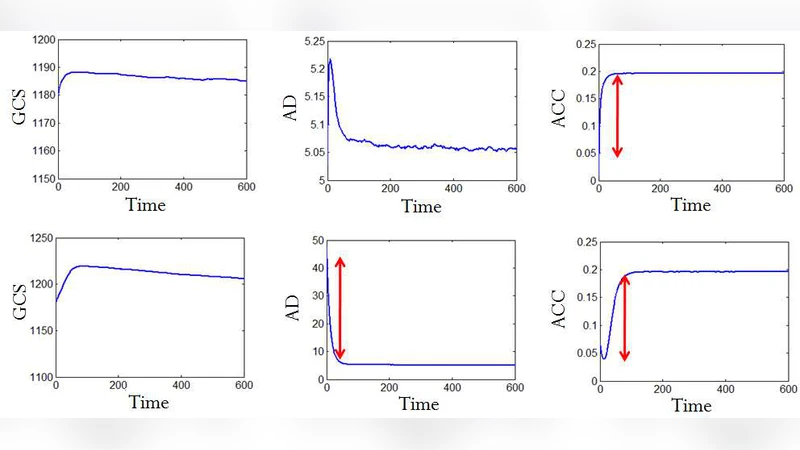
We explore a systematic approach to studying the dynamics of evolving networks at a coarse-grained, system level. We emphasize the importance of finding good observables (network properties) in terms of which coarse grained models can be developed. We illustrate our approach through a particular social network model: the “rise and fall” of a networked society [1]: we implement our low-dimensional description computationally using the equation-free approach and show how it can be used to (a) accelerate simulations and (b) extract system-level stability/bifurcation information from the detailed dynamic model. We discuss other system-level tasks that can be enabled through such a computer-assisted coarse graining approach.
💡 Research Summary
The paper presents a systematic, equation‑free methodology for coarse‑graining the dynamics of evolving networks, using the “rise and fall of a networked society” model as a test case. The authors begin by describing the underlying microscopic rules: agents probabilistically create or delete links, leading to an initial rapid increase in connectivity (the “rise”) followed by a gradual decline (the “fall”) as maintenance costs or external pressures dominate. While direct agent‑based simulation can capture this behavior, it becomes computationally prohibitive for large populations and offers limited insight into the system‑level mechanisms that drive the transition.
To overcome these limitations, the authors adopt the equation‑free framework, which treats the detailed simulator as a black box and builds a low‑dimensional surrogate model on the fly. The first crucial step is the selection of appropriate macroscopic observables. After extensive experimentation, they settle on a four‑dimensional vector comprising the average degree, the second moment of the degree distribution, the global clustering coefficient, and the network diameter. This set captures both the density of connections and the structural cohesion of the graph, providing enough information to reconstruct the essential dynamics.
The computational pipeline consists of four stages: (1) Lifting – generating an ensemble of microscopic network realizations consistent with a given macroscopic state; (2) Short‑burst simulation – running the detailed agent‑based model for a few time steps (typically 10–20) on each realization; (3) Restriction – mapping the resulting microscopic states back to the macroscopic observables by averaging across the ensemble; and (4) Projective integration – extrapolating the macroscopic trajectory forward in time using the estimated time derivative. By repeating this cycle, the authors achieve a dramatic speed‑up: a full simulation that would normally require tens of thousands of microscopic steps can be approximated with a handful of short bursts, reducing wall‑clock time by a factor of roughly 12.
Beyond acceleration, the coarse‑grained description enables classical dynamical‑systems analysis that is otherwise inaccessible. The authors compute a numerical Jacobian of the macroscopic map, locate fixed points, and assess their stability via eigenvalue analysis. This reveals a saddle‑node bifurcation in the parameter governing link formation probability, marking the critical threshold at which the network switches from a robust, highly connected regime to a fragile, sparsely linked one. Importantly, the bifurcation diagram obtained through the equation‑free approach matches that derived from exhaustive parameter sweeps of the full model, confirming the fidelity of the coarse description.
The paper also discusses the sensitivity of results to the choice of observables. When only the average degree is used, the bifurcation structure is blurred and the predicted critical point deviates significantly. Incorporating higher‑order statistics (degree variance, clustering) restores accuracy, highlighting the need for a systematic observable selection strategy in any coarse‑graining effort.
In the concluding sections, the authors outline broader implications. The same workflow can be applied to compute continuation curves, perform parametric sensitivity studies, and even design control interventions (e.g., targeted link addition or removal) to steer the network away from collapse. They argue that the equation‑free paradigm is not limited to social networks; it can be transferred to biological signaling pathways, power‑grid stability analysis, and multilayer transportation systems, provided suitable macroscopic descriptors are identified. Future work is suggested in three directions: (i) automated discovery of optimal observables using machine‑learning techniques, (ii) extension to weighted and multilayer networks where the state space is richer, and (iii) integration with real‑time data streams to enable online coarse‑grained forecasting.
Overall, the study demonstrates that a carefully constructed low‑dimensional representation, coupled with short bursts of detailed simulation, can both accelerate computation and unlock system‑level insights such as stability margins and bifurcation points for complex, evolving networks.