Gravity vs radiation model: on the importance of scale and heterogeneity in commuting flows
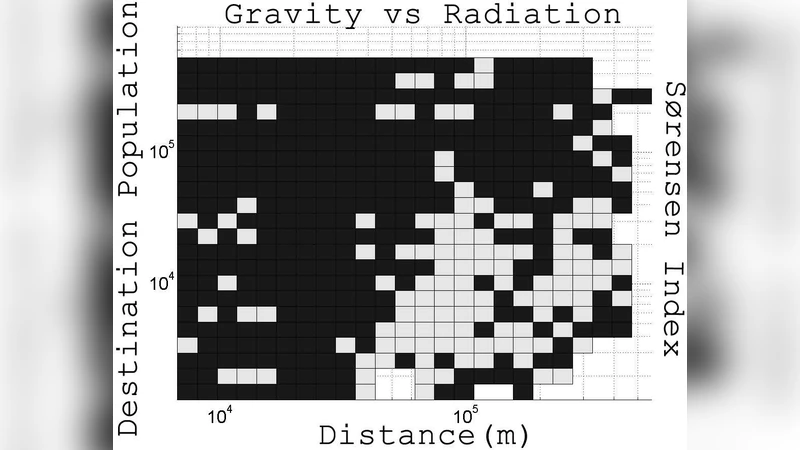
We test the recently introduced radiation model against the gravity model for the system composed of England and Wales, both for commuting patterns and for public transportation flows. The analysis is performed both at macroscopic scales, i.e. at the national scale, and at microscopic scales, i.e. at the city level. It is shown that the thermodynamic limit assumption for the original radiation model significantly underestimates the commuting flows for large cities. We then generalize the radiation model, introducing the correct normalisation factor for finite systems. We show that even if the gravity model has a better overall performance the parameter-free radiation model gives competitive results, especially for large scales.
💡 Research Summary
The paper conducts a systematic comparison between the classic gravity model and the recently proposed radiation model for describing human commuting and public‑transport flows, using detailed data from England and Wales. The authors first point out that the original radiation model assumes a “thermodynamic limit” in which the total population of the system is effectively infinite. In real‑world settings, especially in large metropolitan areas where a single origin can contain a substantial fraction of the total population, this assumption leads to a systematic under‑estimation of flows. To address this, the authors derive a finite‑size correction that introduces an explicit normalisation factor depending on the total system population N and the origin population m_i. The corrected radiation model takes the form
T_{ij}=m_i ·