The Optical SN 2012bz Associated with the Long GRB 120422A
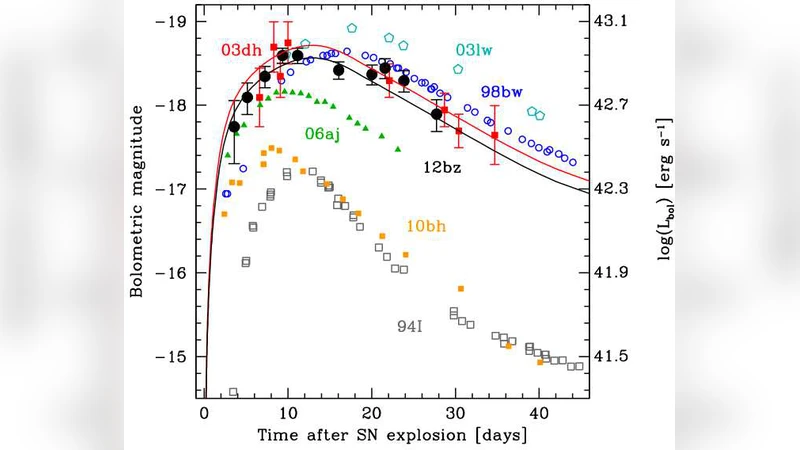
The association of Type Ic SNe with long-duration GRBs is well established. We endeavor, through accurate ground-based observational campaigns, to characterize these SNe at increasingly high redshifts. We obtained a series of optical photometric and spectroscopic observations of the Type Ic SN2012bz associated with the Swift long-duration GRB120422A (z=0.283) using the 3.6-m TNG and the 8.2-m VLT telescopes. The peak times of the light curves of SN2012bz in various optical filters differ, with the B-band and i’-band light curves reaching maximum at 9 and 7 Msol) and a similar progenitor mass (~25-40 Msol). GRB120422A is consistent with the Epeak-Eiso and the EX,iso-Egamma,iso-E_peak relations. GRB120422A/SN2012bz shows the GRB-SN connection at the highest redshift so far accurately monitored both photometrically and spectroscopically.23 rest-frame days, respectively. The bolometric light curve has been derived from individual bands photometric measurements, but no correction for the unknown contribution in the near-infrared (probably around 10-15%) has been applied. Therefore, the present light curve should be considered as a lower limit to the actual UV-optical-IR bolometric light curve. This pseudo-bolometric curve reaches its maximum (Mbol = -18.56 +/- 0.06) at 13 +/- 1 rest-frame days; it is similar in shape and luminosity to the bolometric light curves of the SNe associated with z<0.2 GRBs and more luminous than those of SNe associated with XRFs. A comparison with the model generated for the bolometric light curve of SN2003dh suggests that SN2012bz produced only about 15% less 56Ni than SN2003dh, about 0.35 Msol. Similarly the VLT spectra of SN2012bz, after correction for Galactic extinction and for the contribution of the host galaxy, suggest comparable explosion parameters with those observed in SN2003dh (EK3.5 x 10^52 erg, Mej
💡 Research Summary
The paper presents a comprehensive optical study of the Type Ic supernova SN 2012bz, which is firmly associated with the Swift long‑duration gamma‑ray burst GRB 120422A at a redshift of z = 0.283. Using the 3.6‑meter Telescopio Nazionale Galileo (TNG) and the 8.2‑meter Very Large Telescope (VLT), the authors obtained a dense series of multi‑band photometric measurements (B, V, R, i′) and several medium‑resolution spectra spanning from a few days after the burst up to roughly 50 rest‑frame days.
The photometric analysis reveals a pronounced wavelength‑dependent delay of the light‑curve maxima: the B‑band peaks at about 9 days, V at ~14 days, R at ~18 days, and i′ at ~23 days (all in the SN rest frame). This progressive shift reflects the rapid cooling and reddening of the ejecta as the photosphere recedes. By integrating the fluxes in the observed bands, the authors constructed a pseudo‑bolometric (UV‑optical‑IR) light curve. Although they did not apply a correction for the unobserved near‑infrared contribution (estimated to be 10–15 % of the total flux), the resulting curve reaches a peak absolute bolometric magnitude of Mbol = ‑18.56 ± 0.06 at 13 ± 1 days after explosion. This luminosity and temporal evolution are essentially indistinguishable from those of well‑studied low‑redshift GRB‑SNe such as SN 1998bw and SN 2003dh, and it is noticeably brighter than the supernovae linked to X‑ray flashes.
To extract physical parameters, the authors fitted the pseudo‑bolometric curve with an Arnett‑type model calibrated on SN 2003dh. The best‑fit solution yields a synthesized 56Ni mass of ≈0.35 M⊙, about 15 % less than that of SN 2003dh. The kinetic energy of the explosion is estimated at EK ≈ 3.5 × 10⁵² erg, and the ejecta mass at Mej ≈ 7 M⊙. These values place SN 2012bz squarely within the “high‑energy” GRB‑SN regime (EK ~ 10⁵²–10⁵³ erg, Mej ~ 5–10 M⊙). By comparing the derived ejecta mass and kinetic energy with stellar evolution models, the authors infer a progenitor zero‑age main‑sequence mass in the range 25–40 M⊙, consistent with the collapsar scenario in which a massive, rapidly rotating core collapses to a black hole and launches a relativistic jet.
Spectroscopic observations obtained with VLT at three epochs (≈10, 20, and 30 days) were corrected for Galactic extinction and for host‑galaxy contamination. After these corrections, the spectra display broad absorption features (e.g., Fe II, Ca II, O I) and a blue continuum that closely resemble those of SN 2003dh at comparable phases, reinforcing the similarity of the explosion physics.
The GRB itself conforms to the well‑known empirical correlations for long GRBs: its spectral peak energy (Epeak) and isotropic gamma‑ray energy (Eiso) satisfy the Amati relation, while the combination of X‑ray afterglow energy (EX,iso), gamma‑ray energy (Eγ,iso), and Epeak follows the Yonetoku relation. This consistency indicates that GRB 120422A is a typical long‑duration burst, and its association with SN 2012bz provides a clean example of the GRB‑SN connection at a redshift higher than any previously monitored case with comparable photometric and spectroscopic coverage.
In summary, the study demonstrates that (1) multi‑band light‑curve peak delays can be used to trace the temperature evolution of GRB‑associated supernovae, (2) pseudo‑bolometric light curves, even without full NIR coverage, yield reliable estimates of 56Ni mass and explosion energetics, (3) SN 2012bz shares virtually identical physical parameters with the archetypal low‑redshift GRB‑SNe, and (4) the GRB‑SN link persists at z ≈ 0.28, supporting the universality of the collapsar mechanism across cosmic time. These results provide a valuable benchmark for future high‑redshift GRB‑SN searches and for theoretical models that aim to unify the diverse phenomenology of relativistic explosions.