A complete list of conservation laws for non-integrable compacton equations of $K(m,m)$ type
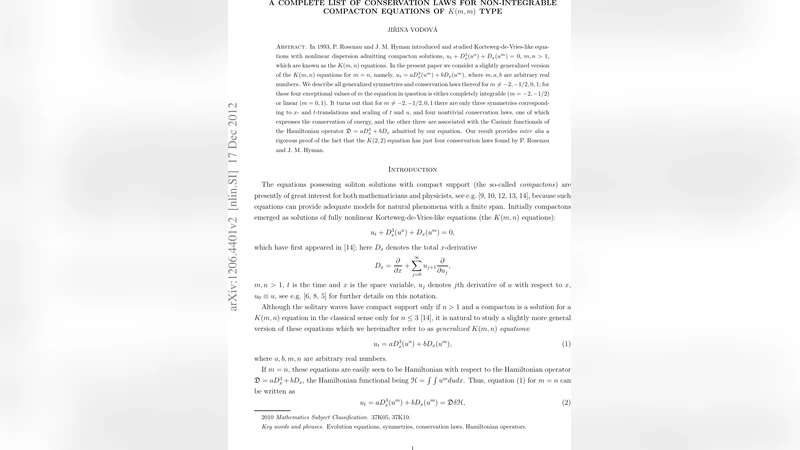
In 1993, P. Rosenau and J. M. Hyman introduced and studied Korteweg-de-Vries-like equations with nonlinear dispersion admitting compacton solutions, $u_t+D_x^3(u^n)+D_x(u^m)=0$, $m,n>1$, which are known as the $K(m,n)$ equations. In the present paper we consider a slightly generalized version of the $K(m,n)$ equations for $m=n$, namely, $u_t=aD_x^3(u^m)+bD_x(u^m)$, where $m,a,b$ are arbitrary real numbers. We describe all generalized symmetries and conservation laws thereof for $m\neq -2,-1/2,0,1$; for these four exceptional values of $m$ the equation in question is either completely integrable ($m=-2,-1/2$) or linear ($m=1$) or trivial ($m=0$). It turns out that for $m\neq -2,-1/2,0,1$ there are only three symmetries corresponding to $x$- and $t$-translations and scaling of $t$ and $u$, and four nontrivial conservation laws, one of which expresses the conservation of energy, and the other three are associated with the Casimir functionals of the Hamiltonian operator $\mathfrak{D}=aD_x^3+bD_x$ admitted by our equation. Our result, \textit{inter alia}, provides a rigorous proof of the fact that the K(2,2) equation has just four conservation laws found by P. Rosenau and J. M. Hyman.
💡 Research Summary
The paper undertakes a comprehensive symmetry and conservation‑law analysis of a generalized compacton equation of the K(m,m) type, namely
uₜ = a Dₓ³(uᵐ) + b Dₓ(uᵐ), m, a, b ∈ ℝ.
The authors first recall the original K(m,n) family introduced by Rosenau and Hyman (1993), which possesses nonlinear dispersion and admits compactly supported solitary waves (compactons). While the special case K(2,2) was known to have exactly four conservation laws, a rigorous classification for arbitrary m had been lacking.
Using the formalism of Lie point and higher‑order generalized symmetries, the authors compute the full symmetry algebra of the equation for generic values of m. They find that, except for the four exceptional exponents m = −2, −½, 0, 1, the symmetry algebra is three‑dimensional, generated by:
- Spatial translation (∂ₓ),
- Temporal translation (∂ₜ), and
- A scaling symmetry t∂ₜ + (m − 1)u∂ᵤ.
No additional higher‑order symmetries exist, confirming that the equation is non‑integrable in the sense of possessing an infinite hierarchy of commuting flows.
The second major part of the work is the derivation of all nontrivial local conservation laws. The authors observe that the differential operator
𝔇 = a Dₓ³ + b Dₓ
is a Hamiltonian (Skew‑adjoint) operator for the equation, endowing it with a Poisson structure. The kernel of 𝔇 consists of three functionals, which are Casimir invariants of the associated Poisson bracket. By applying the variational derivative to these Casimirs, the authors obtain three independent conserved densities:
- Mass: ρ₁ = u, ∫ u dx,
- Momentum‑type: ρ₂ = u^{m+1}, ∫ u^{m+1} dx,
- Higher‑order Casimir: ρ₃ = u^{2m+1}, ∫ u^{2m+1} dx.
In addition, the Hamiltonian functional itself yields the energy conservation law. The Hamiltonian density can be written as
ℋ = (a/(m+1)) u^{m+1} uₓₓ + (b/(m+1)) u^{m+1} uₓ,
so that the fourth conserved quantity is
E = ∫ ℋ dx.
These four conserved integrals are functionally independent, and any other local conservation law is a linear combination of them.
The authors then treat the four exceptional values of m separately. For m = −2 and m = −½ the operator 𝔇 admits an infinite sequence of higher‑order symmetries, and the equation becomes completely integrable (it reduces to known integrable hierarchies). For m = 1 the equation linearises to uₜ = a uₓₓₓ + b uₓ, and the standard linear wave conservation laws apply. For m = 0 the equation collapses to the trivial identity uₜ = 0.
Consequently, the main theorem of the paper states that, for all non‑exceptional exponents m, the generalized K(m,m) compacton equation possesses exactly three point symmetries (space‑time translations and a scaling) and precisely four nontrivial local conservation laws (mass, two Casimirs, and energy). This result rigorously confirms the earlier empirical observation that the K(2,2) equation has only the four conservation laws originally identified by Rosenau and Hyman.
Beyond the classification itself, the work highlights the stark contrast between integrable compacton equations (m = −2, −½) and the generic non‑integrable case: the latter lacks an infinite hierarchy of symmetries and therefore does not support the rich analytical solution techniques (inverse scattering, Lax pairs) available for integrable systems. This insight has practical implications for numerical simulation and perturbation analysis of compactons in physical models, suggesting that for most values of m one must rely on direct numerical methods or approximate analytical techniques rather than exact integrability.