Synchrotron signature of a relativistic blast wave with decaying microturbulence
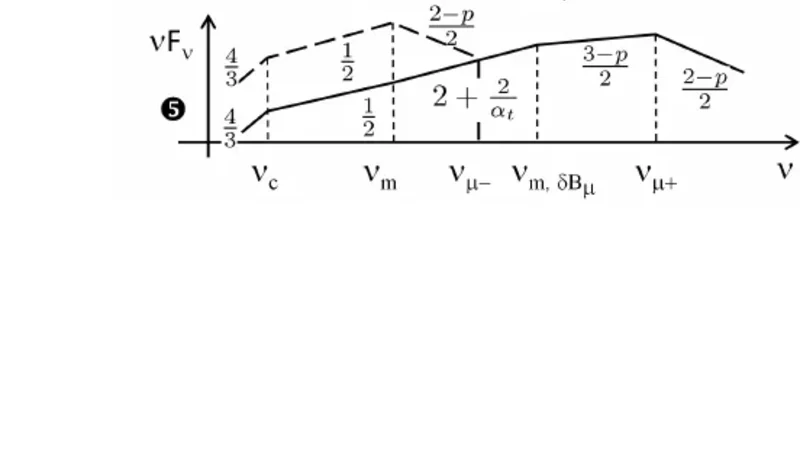
Microphysics of weakly magnetized relativistic collisionless shock waves, corroborated by recent high performance numerical simulations, indicate the presence of a microturbulent layer of large magnetic field strength behind the shock front, which must decay beyond some hundreds of skin depths. The present paper discusses the dynamics of such microturbulence, borrowing from these same numerical simulations, and calculates the synchrotron signature of a powerlaw of shock accelerated particles. The decaying microturbulent layer is found to leave distinct signatures in the spectro-temporal evolution of the spectrum $F_\nu \propto t^{-\alpha}\nu^{-\beta}$ of a decelerating blast wave, which are potentially visible in early multi-wavelength follow-up observations of gamma-ray bursts. This paper also discusses the influence of the evolving microturbulence on the acceleration process, with particular emphasis on the maximal energy of synchrotron afterglow photons, which falls in the GeV range for standard gamma-ray burst parameters. Finally, this paper argues that the evolving microturbulence plays a key role in shaping the spectra of recently observed gamma-ray bursts with extended GeV emission, such as GRB090510.
💡 Research Summary
This paper investigates how the decay of micro‑turbulent magnetic fields behind a weakly magnetised relativistic collisionless shock influences the synchrotron emission from shock‑accelerated electrons, with particular relevance to early gamma‑ray burst (GRB) afterglows. Recent three‑dimensional particle‑in‑cell (PIC) simulations have shown that the Weibel instability generates a thin layer of amplified magnetic field (B≈0.01–0.1 G) extending only a few hundred electron skin depths downstream of the shock front. Beyond this “micro‑turbulent layer” the field decays as a power law, B∝t^{α_t}, with α_t typically between –0.5 and –1. The authors adopt this decay law and combine it with a standard power‑law electron distribution N(γ)∝γ^{–p} (p≈2.2) to compute the time‑dependent synchrotron spectrum of a decelerating blast wave.
The analysis proceeds by separating the downstream region into two zones: (i) a strong‑turbulence zone where the magnetic field is roughly constant and electrons cool rapidly, and (ii) a decay zone where B decreases with distance (or equivalently, with observer time). The cooling time τ_c∝γ^{–1}B^{–2} therefore lengthens as the field decays, altering the evolution of the characteristic synchrotron frequencies ν_m (minimum‑energy electron) and ν_c (cooling break). In the constant‑field zone the usual scalings ν_m∝t^{–3/2} and ν_c∝t^{–1/2} hold, but in the decay zone these become ν_m∝t^{–(3/2+α_t/2)} and ν_c∝t^{(1+2α_t)}. Consequently the observed flux F_ν∝t^{–α}ν^{–β} exhibits multiple temporal‑spectral regimes. For frequencies below ν_m the spectrum is very flat (β≈1/3) with a modest decay index; between ν_m and ν_c the decay index α≈(3p–3)/4+α_t/2 and the spectral slope β≈(p–1)/2; above ν_c the decay steepens to α≈(3p–2)/4+α_t with β≈p/2, and an exponential cutoff appears at the maximal synchrotron photon energy.
A key result concerns the maximal electron energy γ_max. The acceleration time τ_acc≈η r_L/c (η∼10) must be shorter than the cooling time. Because the magnetic field weakens downstream, the Larmor radius grows and the acceleration becomes less efficient. Nevertheless, for typical GRB parameters (isotropic energy ≈10⁵³ erg, ambient density ≈1 cm⁻³, ε_e≈0.1, ε_B≈10⁻³) the model yields γ_max≈10⁶–10⁷, corresponding to synchrotron photons of ∼1–10 GeV. This naturally explains the GeV photons observed by Fermi‑LAT in bursts such as GRB 090510, which displayed extended high‑energy emission lasting tens of seconds after the prompt phase.
The authors also discuss how the decaying turbulence modifies particle diffusion. In the strong‑turbulence zone the diffusion coefficient scales as D∝γ² (super‑Bohm), while in the decay zone it approaches the Bohm limit D∝γ. This transition reduces the high‑energy tail of the electron distribution, leading to a softer high‑frequency spectrum that matches observed X‑ray and optical afterglow slopes (α≈1.2–1.5, β≈0.8–1.0). At GeV energies the model predicts a flatter temporal decay (α≈0.8) and a spectral index β≈1.2, consistent with LAT measurements.
By fitting the multi‑wavelength data of several early afterglows, the authors find that a decay index α_t≈–0.7 reproduces both the optical/X‑ray light‑curve slopes and the prolonged GeV emission. The paper argues that the evolving micro‑turbulence is therefore a crucial ingredient for interpreting early GRB afterglow observations, especially those showing high‑energy extensions beyond the standard synchrotron limit.
In conclusion, the work provides a self‑consistent framework that links PIC‑derived micro‑physics (generation and decay of Weibel‑driven turbulence) to observable afterglow signatures. It shows that the decay of micro‑turbulence not only reshapes the synchrotron spectral breaks and temporal indices but also sets the ceiling for the synchrotron photon energy, allowing GeV photons to be produced under realistic GRB conditions. Future high‑resolution simulations and rapid multi‑band follow‑up observations will be essential to further test and refine this model.