XMM-Newton view of Swift J1834.9-0846 and its Magnetar Wind Nebula
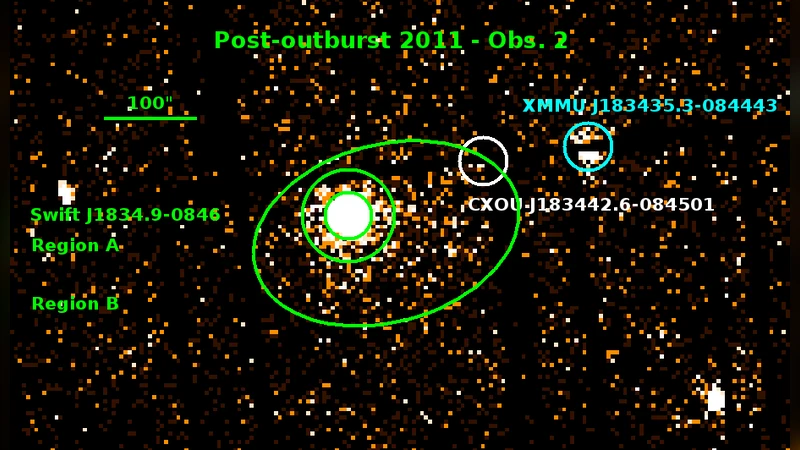
We report on the analysis of two XMM-Newton observations of the recently discovered soft gamma repeater Swift J1834.9-0846, taken in September 2005 and one month after the source went into outburst on 2011 August 7. We performed timing and spectral analyses on the point source as well as on the extended emission. We find that the source period is consistent with an extrapolation of the Chandra ephemeris reported earlier and the spectral properties remained constant. The source luminosity decreased to a level of 1.6x10^34 erg s^-1 following a decay trend of $\propto t^{-0.5}$. Our spatial analysis of the source environment revealed the presence of two extended emission regions around the source. The first (Region A) is a symmetric ring around the point source, starting at 25arcsec and extending to ~50arcsec. We argue that Region A is a dust scattering halo. The second (Region B) has an asymmetrical shape extending between 50arcsec and 150arcsec, and is detected both in the pre- and post-outburst data. We argue that this region is a possible magnetar wind nebula (MWN). The X-ray efficiency of the MWN with respect to the rotation energy loss is substantially higher than those of rotation powered pulsars: $\eta_{\rm X}\equiv L_{\rm MWN,0.5-8 keV}/\dot{E}_{\rm rot}\approx0.7$. The higher efficiency points to a different energy source for the MWN of Swift J1834.9-0846, most likely bursting activity of the magnetar, powered by its high magnetic field, B=1.4x10^14 G.
💡 Research Summary
The authors present a comprehensive analysis of two XMM‑Newton observations of the soft gamma‑ray repeater Swift J1834.9‑0846, obtained before the source’s outburst (September 2005) and roughly one month after the outburst that began on 2011 August 7. Using the EPIC‑pn and MOS cameras, they performed timing, spectral, and spatial studies of both the point‑like magnetar and its surrounding diffuse emission.
Timing analysis confirms a spin period of ≈2.48 s that matches the extrapolation of the Chandra ephemeris reported earlier, indicating that the rotation rate has not changed dramatically across the outburst. Spectral fitting with an absorbed power‑law model yields a column density of $N_{\rm H}\sim1.2\times10^{23}\ {\rm cm^{-2}}$ and a photon index $\Gamma\sim3.5$, with essentially identical values in the pre‑ and post‑outburst data. This stability suggests that the X‑ray emission remains dominated by a non‑thermal magnetospheric component throughout the event.
The 0.5–10 keV X‑ray luminosity follows a decay law $L\propto t^{-0.5}$, decreasing from $\sim5\times10^{34}$ erg s⁻¹ shortly after the burst to $1.6\times10^{34}$ erg s⁻¹ one month later. The decay slope is consistent with typical magnetar cooling curves, yet the absolute luminosity remains comparable to the rotational energy loss $\dot{E}_{\rm rot}\approx2\times10^{34}$ erg s⁻¹, implying a relatively high conversion efficiency.
Spatially, the authors identify two distinct extended components. Region A appears as a symmetric ring surrounding the point source, extending from 25″ to about 50″. Its radial profile and energy‑dependent size are consistent with a dust‑scattering halo, and modeling confirms that the halo parameters match the measured $N_{\rm H}$ and a plausible interstellar dust distribution along the line of sight.
Region B is an asymmetric, larger‑scale structure spanning roughly 50″–150″ from the magnetar. It is present in both the 2005 and 2011 datasets, showing a surface‑brightness distribution and a slightly harder spectrum than the central source. The authors argue that Region B is best interpreted as a magnetar wind nebula (MWN). Its 0.5–8 keV luminosity is $L_{\rm MWN}\approx1.4\times10^{34}$ erg s⁻¹, which yields an X‑ray efficiency $\eta_{\rm X}=L_{\rm MWN}/\dot{E}{\rm rot}\approx0.7$. This efficiency is orders of magnitude higher than that of rotation‑powered pulsar wind nebulae (typically $\eta{\rm X}\sim10^{-4}$–$10^{-2}$), indicating that the nebular power cannot be supplied solely by spin‑down energy.
The authors therefore propose that the MWN is energized primarily by the magnetar’s magnetic activity—bursts and outbursts driven by the decay of its ultra‑strong field ($B\approx1.4\times10^{14}$ G). The release of magnetic energy can accelerate particles and inflate a relativistic bubble, producing the observed X‑ray nebula. They also discuss the possible influence of the surrounding supernova remnant, concluding that the morphology of Region B is more naturally explained by an internally driven wind rather than external pressure gradients.
In summary, the paper demonstrates that Swift J1834.9‑0846 exhibits a stable magnetospheric X‑ray spectrum, a predictable post‑outburst luminosity decay, a classic dust‑scattering halo, and, most intriguingly, a candidate magnetar wind nebula with an unusually high X‑ray efficiency. These findings provide strong evidence that magnetars can channel magnetic‑field energy into surrounding nebulae, expanding our understanding of how highly magnetized neutron stars interact with their environments beyond the traditional rotation‑powered paradigm.
Comments & Academic Discussion
Loading comments...
Leave a Comment