Response of a circumbinary accretion disc to black hole mass loss
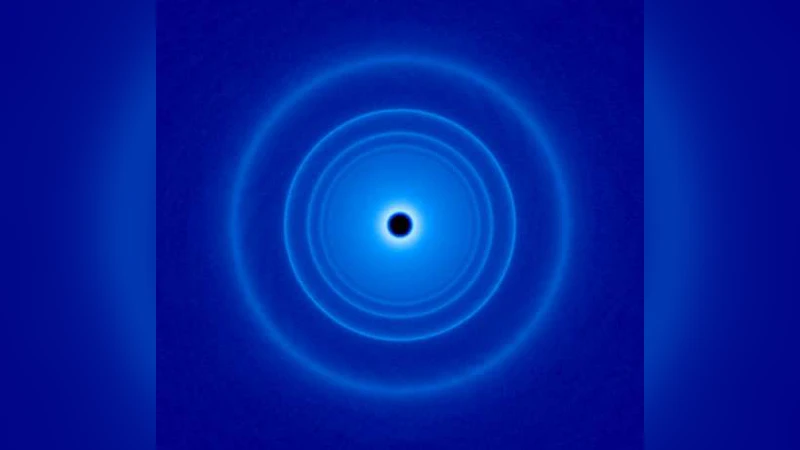
We investigate the evolution of the surface density of a circumbinary accretion disc after the mass loss induced by the merger of two supermassive black holes. We first introduce an analytical model, under the assumption of a disc composed of test particles, to derive the surface density evolution of the disc following the mass loss. The model predicts the formation of sharp density peaks in the disc; the model also allows us to compute the typical timescale for the formation of these peaks. To test and validate the model, we run numerical simulations of the process using the Smoothed Particle Hydrodynamics (SPH) code PHANTOM, taking fluid effects into account. We find good agreement in the shape and position of the peaks between the model and the simulations. In a fluid disc, however, the epicyclic oscillations induced by the mass loss can dissipate, and only some of the predicted peaks form in the simulation. To quantify how fast this dissipation proceeds, we introduce an appropriate parameter, and we show that it is effective in explaining the differences between the analytical, collisionless model and a real fluid disc.
💡 Research Summary
The paper investigates how a circumbinary accretion disc responds when the central super‑massive black‑hole (SMBH) binary merges and loses a few percent of its total mass. The authors approach the problem in two complementary ways: an analytical, collision‑less model that treats the disc as a collection of test particles, and three‑dimensional Smoothed Particle Hydrodynamics (SPH) simulations using the PHANTOM code that incorporate fluid effects such as pressure, viscosity, and shock heating.
In the analytical model the instantaneous mass loss reduces the gravitational potential, but each fluid element initially retains its Keplerian orbital angular momentum. Consequently the element finds itself on an eccentric orbit whose semi‑major axis is larger than its original radius. The element then executes epicyclic oscillations about its new guiding centre with a frequency (\kappa) that differs from the original orbital frequency (\Omega). Because the epicyclic phase varies with radius, neighbouring rings gradually fall out of phase. When the phase difference reaches (\pi) the radial trajectories intersect, producing a sharp increase in surface density—a “density peak.” The authors derive an expression for the characteristic time to the first peak, \