Deterministic ants in labirynth -- information gained by map sharing
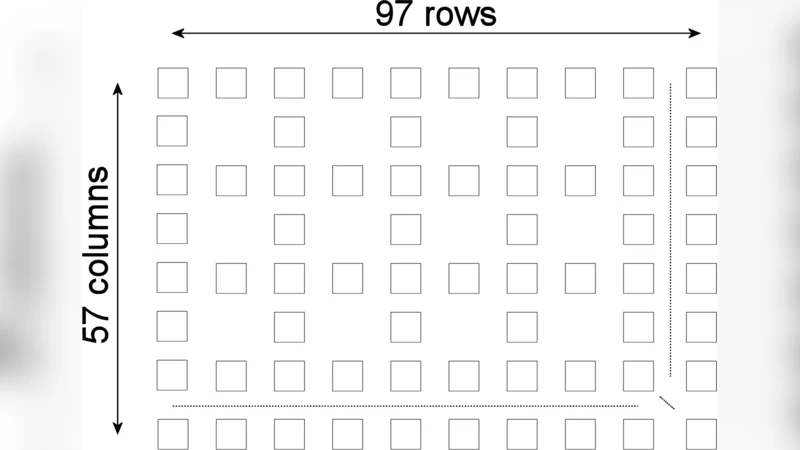
A few of ant robots are dropped to a labirynth, formed by a square lattice with a small number of nodes removed. Ants move according to a deterministic algorithm designed to explore all corridors. Each ant remembers the shape of corridors which she has visited. Once two ants met, they share the information acquired. We evaluate how the time of getting a complete information by an ant depends on the number of ants, and how the length known by an ant depends on time. Numerical results are presented in the form of scaling relations.
💡 Research Summary
The paper investigates how a small swarm of deterministic “ant” robots can efficiently explore a partially damaged square‑lattice maze by sharing the maps they build individually. The maze is modeled as an L × L grid in which a fraction p of nodes (and their incident edges) are removed at random, creating a network of corridors with dead‑ends and loops. Each ant follows a right‑hand rule‑based deterministic exploration algorithm: it always tries to turn right relative to its current heading, proceeds along unvisited corridors, and records every visited edge and junction in a local hash‑based map. When two ants occupy the same junction at the same time, a “meeting event” occurs; the ants exchange their entire local maps, merge them (removing duplicates), and continue exploration using the combined knowledge. The merge operation costs O(E) time where E is the number of edges in the maze, and each ant’s memory consumption is also O(E).
The authors conduct extensive Monte‑Carlo simulations for L = 100 with two defect densities (p = 0.05 and p = 0.10). The number of ants N is varied over {1, 2, 4, 8, 16, 32, 64}. For each (p, N) pair, 10⁴ independent runs are performed, measuring three key quantities: (1) the “full‑information time” T_full, defined as the earliest time at which at least one ant possesses a complete map of the maze; (2) the average known path length L(t) for a typical ant as a function of elapsed time t; and (3) statistics of meeting events (frequency, spatial distribution).
The results reveal clear scaling laws. First, T_full decreases algebraically with N: a log‑log plot shows a straight line, and the data fit T_full ∝ N^{‑α}. The exponent α depends on the defect density: for p = 0.05, α ≈ 0.80, while for p = 0.10 it drops to α ≈ 0.60. Thus, adding more ants speeds up information propagation, but the benefit diminishes as the maze becomes more fragmented because bottlenecks limit the flow of maps. Second, L(t) grows linearly at early times (L ≈ v t, where v is the average speed of an ant), then exhibits sudden jumps at each meeting event. The size of a jump is proportional to the size of the partner’s sub‑map, leading to a piecewise growth that can be described by L(t) ∝ t^{β} with β ≈ 0.9 before saturation. After a few meetings, L(t) approaches a logarithmic‑linear regime and finally saturates when the ant’s map becomes complete. Third, the number of meetings scales roughly linearly with N, and meetings tend to cluster around the geometric centre of the maze and near regions with a high concentration of removed nodes, where many corridors converge.
The deterministic nature of the algorithm dramatically reduces the variance of T_full compared with a purely random walk, but the authors note a potential “information isolation” problem: if the initial placement of ants is highly uneven, a subset of ants may explore a large isolated sub‑graph while others remain confined to a small region, delaying the first meeting. To mitigate this, the paper recommends a uniform random seeding of initial positions.
From a computational perspective, the algorithm is attractive because it requires only local sensing and peer‑to‑peer communication; no central controller or global broadcast is needed. Memory usage grows linearly with the size of the maze, and the merge operation, though O(E), is performed only at meetings, which are relatively infrequent for moderate N.
In the discussion, the authors argue that the observed scaling relations are likely to hold for more general graph topologies beyond regular grids, suggesting that the approach could be applied to large‑scale robotic exploration of disaster sites, underground tunnels, or planetary surfaces where communication bandwidth is limited. They also acknowledge limitations: the current model assumes instantaneous, error‑free map exchange, whereas real robots would face bandwidth constraints, packet loss, and asynchronous updates. Future work is proposed to incorporate limited‑bandwidth communication, partial map sharing, and dynamic obstacles.
In conclusion, the study demonstrates that a modest number of deterministic ant‑like robots, equipped with simple local memory and the ability to exchange maps upon encounter, can achieve rapid, scalable exploration of complex mazes. The algebraic reduction of full‑information time with swarm size and the characteristic jumps in known path length provide quantitative design guidelines for engineers developing distributed exploration systems.
Comments & Academic Discussion
Loading comments...
Leave a Comment