GRB 100219A with X-shooter - abundances in a galaxy at z = 4.7
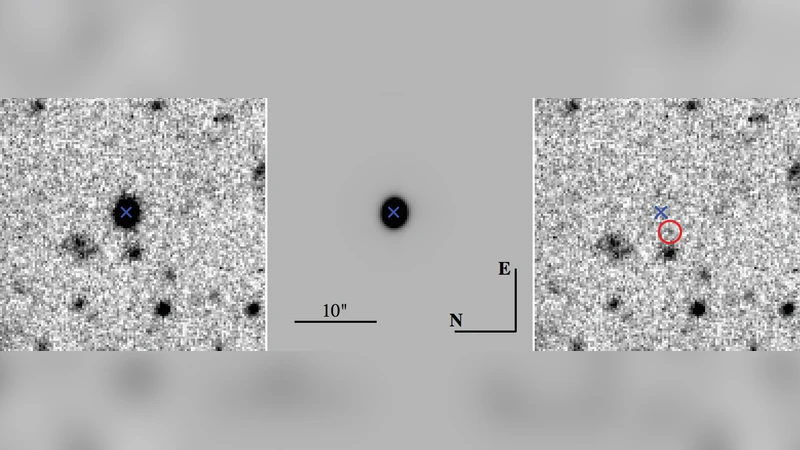
Abundances of galaxies at redshifts z > 4 are difficult to obtain from damped Ly {\alpha} (DLA) systems in the sightlines of quasars (QSOs) due to the Ly {\alpha} forest blanketing and the low number of high-redshift quasars detected. Gamma-ray bursts (GRBs) with their higher luminosity are well suited to study galaxies out to the formation of the first stars at z > 10. Its large wavelength coverage makes the X-shooter spectrograph an excellent tool to study the interstellar medium (ISM) of high redshift galaxies, in particular if the redshift is not known beforehand. Here we determine the properties of a GRB host at z = 4.66723 from a number of resonant low- and high ionization and fine-structure absorption lines. This is one of the highest redshifts where a detailed analysis with medium-resolution data has been possible. We detect one intervening system at z = 2.18. The velocity components of the absorption lines are fitted with Voigt-profiles and we determine a metallicity of [M/H] = -1.0 \pm 0.1 using S. The absorption lines show a complicated kinematic structure which could point to a merger in progress. Si II* together with the restframe UV energy release determined from GROND data gives us the distance of 0.3 to 1 kpc of the absorbing material from the GRB. We measure a low extinction of AV = 0.24 \pm 0.06 mag using X-ray spectral information and the flux calibrated X-shooter spectrum. GRB-DLAs have a shallower evolution of metallicity with redshift than QSO absorbers and no evolution in HI column density or ionization fraction. GRB hosts at high redshift might continue the trend towards lower metallicities in the LZ-relation with redshift, but the sample is still too small to draw a definite conclusion. While the detection of GRBs at z > 4 with current satellites is still difficult, they are very important for our understanding of the early epochs of star- and galaxy-formation.
💡 Research Summary
The paper presents a comprehensive spectroscopic study of the gamma‑ray burst GRB 100219A and its host galaxy at a redshift of z = 4.66723, using the X‑shooter spectrograph on the Very Large Telescope. X‑shooter’s simultaneous coverage from the ultraviolet (300 nm) to the near‑infrared (2.5 µm) enables the detection of a rich set of absorption features even when the redshift is not known a priori. The authors obtained medium‑resolution (R ≈ 6000–10000) spectra within a few hours after the burst, complemented by contemporaneous multi‑band photometry from the GROND instrument and X‑ray data from Swift‑XRT.
After standard reduction, the authors identified numerous low‑ionisation lines (S II, Si II, Fe II, Zn II, etc.), high‑ionisation lines (C IV, Si IV), and fine‑structure transitions (Si II*). They fitted the profiles with multi‑component Voigt models, revealing five distinct velocity components spanning roughly –30 to +170 km s⁻¹. The total neutral hydrogen column density is log N(H I) = 21.6 ± 0.1 cm⁻², placing the system firmly in the damped Lyman‑α (DLA) regime.
Metallicity is derived primarily from the unsaturated S II triplet, yielding