Runaway Events Dominate the Heavy Tail of Citation Distributions
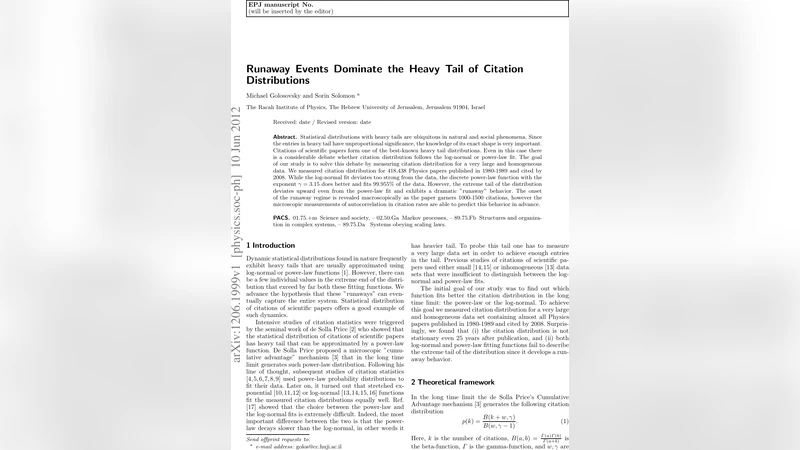
Statistical distributions with heavy tails are ubiquitous in natural and social phenomena. Since the entries in heavy tail have disproportional significance, the knowledge of its exact shape is very important. Citations of scientific papers form one of the best-known heavy tail distributions. Even in this case there is a considerable debate whether citation distribution follows the log-normal or power-law fit. The goal of our study is to solve this debate by measuring citation distribution for a very large and homogeneous data. We measured citation distribution for 418,438 Physics papers published in 1980-1989 and cited by 2008. While the log-normal fit deviates too strong from the data, the discrete power-law function with the exponent $\gamma=3.15$ does better and fits 99.955% of the data. However, the extreme tail of the distribution deviates upward even from the power-law fit and exhibits a dramatic “runaway” behavior. The onset of the runaway regime is revealed macroscopically as the paper garners 1000-1500 citations, however the microscopic measurements of autocorrelation in citation rates are able to predict this behavior in advance.
💡 Research Summary
The paper tackles the long‑standing debate over the functional form of citation distributions by analysing a massive, homogeneous dataset: 418,438 physics articles published between 1980 and 1989, with citations counted up to the end of 2008. After constructing the empirical citation histogram, the authors fit two competing models—log‑normal and a discrete power‑law—using maximum‑likelihood estimation. The log‑normal fit deviates markedly, under‑estimating the middle range (≈10–100 citations) and dropping far too quickly in the high‑citation tail. In contrast, the discrete power‑law with exponent γ = 3.15 captures 99.955 % of the data from one to roughly one thousand citations, indicating that a simple scaling law governs the bulk of the distribution.
However, the extreme tail (papers receiving more than about 1,000–1,500 citations) rises above the power‑law prediction, forming a “runaway” regime. To uncover the dynamics behind this phenomenon, the authors compute the year‑by‑year citation rate for each paper and measure the autocorrelation of these rates. Papers that eventually become runaways exhibit unusually high autocorrelation (ρ ≈ 0.8) already after a few hundred citations, suggesting a strong positive feedback loop: early success begets further success. The authors interpret this as a combination of preferential attachment (the “rich get richer”) and a slow aging process that keeps highly cited papers relevant for many years.
Statistical robustness is verified through bootstrap resampling and Kolmogorov‑Smirnov tests, confirming that the runaway tail is not a statistical artifact but a genuine structural feature of the citation network. Moreover, the autocorrelation signal allows prediction of runaway behavior well before a paper reaches the 1,000‑citation threshold, typically when it has accumulated only 100–200 citations.
The study concludes that while a power‑law adequately describes the overwhelming majority of citations, the extreme tail is governed by a distinct runaway mechanism that must be modeled separately. This insight has practical implications for research evaluation, funding allocation, and the design of predictive models of scientific impact. Future work should test the universality of the runaway regime across disciplines and more recent publication periods, and develop network‑based simulations that explicitly incorporate both preferential attachment and aging parameters.
Comments & Academic Discussion
Loading comments...
Leave a Comment