A new connection between the opening angle and the large-scale morphology of extragalactic radio sources
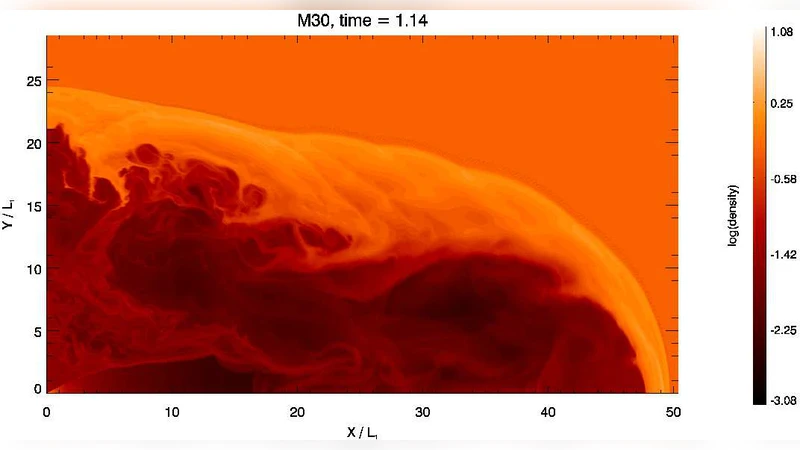
In the case of an initially conical jet, we study the relation between jet collimation by the external pressure and large-scale morphology. We first consider the important length-scales in the problem, and then carry out axisymmetric hydrodynamic simulations that include, for certain parameters, all these length-scales. We find three important scales related to the collimation region: (i) where the sideways ram-pressure equals the external pressure, (ii) where the jet density equals the ambient density, and (iii) where the forward ram-pressure falls below the ambient pressure. These scales are set by the external Mach-number and opening angle of the jet. We demonstrate that the relative magnitudes of these scales determine the collimation, Mach-number, density and morphology of the large scale jet. Based on analysis of the shock structure, we reproduce successfully the morphology of Fanaroff-Riley (FR) class I and II radio sources. Within the framework of the model, an FR I radio source must have a large intrinsic opening angle. Entrainment of ambient gas might also be important. We also show that all FR I sources with radio lobes or similar features must have had an earlier FR II phase.
💡 Research Summary
The paper investigates how the opening angle of an initially conical relativistic jet and the external pressure of the surrounding medium together determine the large‑scale morphology of extragalactic radio sources. The authors first identify three characteristic length scales that govern the collimation region: (i) the distance at which the jet’s sideways ram pressure equals the ambient pressure (L₁), (ii) the distance where the jet density matches the ambient density (L₂), and (iii) the distance where the forward ram pressure drops below the ambient pressure (L₃). These scales are functions of the external Mach number (Mₑ) and the jet’s intrinsic opening angle (θ₀).
Using axisymmetric hydrodynamic simulations that resolve all three scales for a range of θ₀ and Mₑ values, the study demonstrates that the relative ordering of L₁, L₂, and L₃ dictates the jet’s subsequent evolution. When θ₀ is small and Mₑ is high, the ordering L₁ < L₂ < L₃ prevails. The jet remains highly collimated, maintains a strong forward shock, and terminates in a bright hotspot with a well‑defined radio lobe—features characteristic of Fanaroff‑Riley class II (FR II) sources. Conversely, a large opening angle combined with a low external Mach number yields L₂ < L₁ < L₃. In this regime the jet quickly entrains ambient gas, its density falls dramatically, and the forward shock weakens, eliminating a distinct hotspot. The flow expands laterally, producing the diffuse, edge‑darkened appearance of FR I sources. A third possible ordering, where L₃ lies innermost, leads to rapid deceleration of the forward shock and the formation of radio “relic” structures.
The analysis of shock structures in the simulations reproduces the observed morphologies of both FR I and FR II objects. Importantly, the model predicts that every FR I must have originated from an FR II‑like phase: an initially narrow, high‑Mach jet that later widens (or is forced to widen by entrainment) and transitions to the FR I regime. This evolutionary link is consistent with observations of FR I sources that retain faint relic hotspots or lobes.
The paper also highlights the role of the external environment. A low ambient Mach number compresses the collimation region, bringing L₁ and L₂ closer together and promoting early collimation, while a high Mach number delays collimation, allowing the jet to expand over larger distances before forming shocks. Thus, both the jet’s intrinsic geometry (θ₀) and the surrounding medium’s dynamical state (Mₑ) are essential parameters for predicting whether a radio galaxy will develop an FR I or FR II morphology.
In summary, the study provides a physically grounded framework that connects jet opening angle, external pressure, and key dynamical length scales to the large‑scale radio morphology of active galaxies. It reframes the classic FR I/FR II dichotomy as a continuum of evolutionary pathways driven by jet‑environment interaction rather than solely by jet power.