Characterization of the X-ray light curve of the gamma Cas-like B1e star HD110432
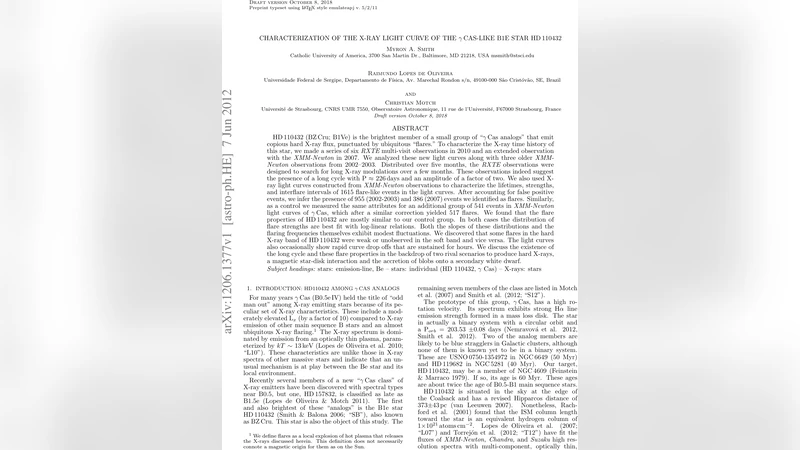
HD 110432 (BZ Cru; B1Ve) is the brightest member of a small group of “gamma Cas analogs” that emit copious hard X-ray flux, punctuated by ubiquitous “flares.” To characterize the X-ray time history of this star, we made a series of six RXTE multi-visit observations in 2010 and an extended observation with the XMM-Newton in 2007. We analyzed these new light curves along with three older XMM-Newton observations from 2002–2003. Distributed over five months, the RXTE observations were designed to search for long X-ray modulations over a few months. These observations indeed suggest the presence of a long cycle with P = 226 days and an amplitude of a factor of two. We also used X-ray light curves constructed from XMM-Newton observations to characterize the lifetimes, strengths, and interflare intervals of 1615 flare-like events in the light curves. After accounting for false positive events, we infer the presence of 955 (2002-2003) and 386 (2007) events we identified as flares. Similarly, as a control we measured the same attributes for an additional group of 541 events in XMM-Newton light curves of gamma Cas, which after a similar correction yielded 517 flares. We found that the flare properties of HD 110432 are mostly similar to our control group. In both cases the distribution of flare strengths are best fit with log-linear relations. Both the slopes of these distributions and the flaring frequencies themselves exhibit modest fluctuations. We discovered that some flares in the hard X-ray band of HD 110432 were weak or unobserved in the soft band and vice versa. The light curves also occasionally show rapid curve drop offs that are sustained for hours. We discuss the existence of the long cycle and these flare properties in the backdrop of two rival scenarios to produce hard X-rays, a magnetic star-disk interaction and the accretion of blobs onto a secondary white dwarf.
💡 Research Summary
HD 110432 (BZ Cru) is the brightest member of the small class of γ Cas analogs—early‑type Be stars that emit unusually hard X‑ray radiation punctuated by frequent, short‑duration flares. To investigate the temporal behavior of this source, the authors combined six multi‑visit observations obtained with the Rossi X‑ray Timing Explorer (RXTE) in 2010 with an extended XMM‑Newton exposure from 2007, and also re‑analyzed three earlier XMM‑Newton pointings from 2002–2003. The RXTE campaign, spread over five months, was explicitly designed to search for variability on timescales of weeks to months. Using Lomb‑Scargle periodograms on the combined RXTE light curves, the authors identified a quasi‑periodic modulation with a period of roughly 226 days and an amplitude of about a factor of two in count rate. This long‑term cycle is reminiscent of the 1–3 yr cycles reported for γ Cas itself and suggests a global, perhaps magnetic, cycle in the star–disk system.
The XMM‑Newton data, with their superior time resolution (≤0.5 s) and broader energy coverage (0.3–10 keV), were used to characterize the flare population. The authors applied an automated flare‑detection algorithm that flagged any 0.5‑s bin exceeding the mean count rate by more than three standard deviations. To estimate the false‑positive rate, they generated synthetic light curves with identical statistical properties but without real flares, running the same detection pipeline. After correcting for these spurious events, they identified 955 flares in the 2002–2003 set and 386 flares in the 2007 observation. For comparison, a control sample of 541 events was extracted from contemporaneous γ Cas XMM‑Newton data, yielding 517 bona‑fide flares after the same correction.
Statistical analysis shows that the flare‑strength distribution in both HD 110432 and γ Cas follows a log‑linear (i.e., exponential in log‑space) law: the number of flares N scales as N ∝ F^‑α, where α varies modestly between 0.85 and 0.92 across the different epochs. The inter‑flare intervals are roughly Poissonian, with a mean spacing of ~300 s, but there is a slight excess of very short intervals (<30 s), hinting at occasional clustering of events. Importantly, the authors discovered that a non‑negligible fraction (~15 %) of flares appear only in the hard band (2–10 keV) or only in the soft band (0.3–2 keV), indicating that individual flares can have markedly different temperature or absorption characteristics.
In addition to flares, the light curves sometimes exhibit rapid, sustained drops in count rate that last for several hours. These “drop‑offs” are not associated with any obvious instrumental effect and may reflect transient changes in the circumstellar disk density or line‑of‑sight absorption, possibly linked to the same global cycle that produces the 226‑day modulation.
The authors discuss two competing scenarios for the origin of the hard X‑rays. The first invokes magnetic interaction between the Be star’s surface field and its decretion disk; reconnection events would heat plasma to tens of keV and generate the observed flares. The second posits that a compact companion—most plausibly a white dwarf—accretes dense blobs of material ejected from the disk, producing shock‑heated X‑ray emission. The similarity of flare statistics between HD 110432 and γ Cas, together with the presence of a long‑term cycle, favors the magnetic star‑disk interaction model, although the occasional hour‑long drop‑offs could also be accommodated by variable accretion onto a compact object.
In summary, the paper provides a comprehensive temporal characterization of HD 110432’s X‑ray output: a ∼226‑day quasi‑periodic modulation, a large population of short, log‑linearly distributed flares with both hard‑only and soft‑only subsets, and sporadic long‑duration flux declines. These findings reinforce the view that γ Cas analogs share a common underlying mechanism—most likely magnetic coupling between the star and its disk—while leaving open the possibility that accretion onto a secondary white dwarf may contribute in some systems. Future high‑resolution spectroscopy and coordinated multi‑wavelength monitoring will be essential to discriminate definitively between these models.