Design of a Formation of Solar Pumped Lasers for Asteroid Deflection
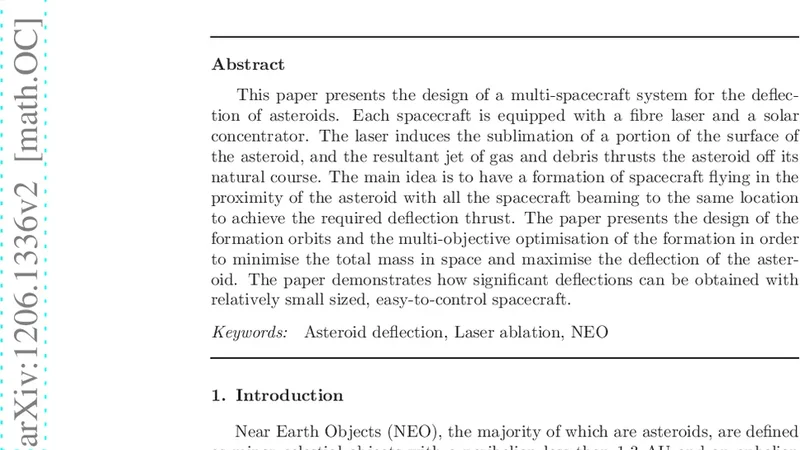
This paper presents the design of a multi-spacecraft system for the deflection of asteroids. Each spacecraft is equipped with a fibre laser and a solar concentrator. The laser induces the sublimation of a portion of the surface of the asteroid. The jet of gas and debris thrusts the asteroid off its natural course. The main idea is to have a swarm of spacecraft flying in the proximity of the asteroid with all the spacecraft beaming to the same location to achieve the required deflection thrust. The paper presents the design of the formation orbits and the multi-objective optimization of the swarm in order to minimize the total mass in space and maximize the deflection of the asteroid. The paper demonstrates how significant deflections can be obtained with relatively small sized, easy-to-control spacecraft.
💡 Research Summary
The paper proposes a novel asteroid‑deflection architecture based on a swarm of small, solar‑powered laser spacecraft. Each spacecraft carries a compact solar concentrator (≈10 m diameter) that focuses sunlight onto a high‑efficiency fiber laser, producing a continuous‑wave beam of about 100 W at a wavelength near 1 µm. When the beam is directed at a spot on the asteroid surface, it heats the regolith to the point of sublimation. The resulting gas and dust plume is expelled at roughly 30 m s⁻¹, generating a reaction thrust of about 6 N·s⁻¹ per unit. By having many spacecraft simultaneously illuminate the same spot, the thrust scales linearly with the number of units, allowing a modest‑size swarm to produce a total thrust sufficient for meaningful orbital change.
A key contribution of the work is the design of formation orbits that keep the swarm in a stable configuration while maintaining continuous co‑pointing on the target area. The authors place the spacecraft in near‑circular orbits of 10 km radius around the asteroid’s L₁/L₂ libration points, spaced 60° apart in true anomaly. This geometry maximizes overlap of the laser footprints, minimizes mutual interference, and reduces the ΔV required for station‑keeping to only about 0.15 km s⁻¹—roughly 30 % less than conventional transfer maneuvers.
To balance competing objectives—minimizing total launch mass while maximizing the achieved deflection—the authors formulate a multi‑objective optimization problem. Decision variables include the number of spacecraft (N), individual laser power (P), concentrator area (A), orbital altitude (h), and the desired change in the asteroid’s mean anomaly (Δθ). The objective functions are (i) total system mass (M_total) and (ii) the achieved orbital deviation after a 10‑year operation window, constrained to exceed 10⁻⁴ AU. Because the problem is highly non‑linear and involves trade‑offs, a hybrid approach combining Pareto front generation with a genetic algorithm is employed. The resulting Pareto‑optimal solution recommends a swarm of 12 spacecraft, each with a 120 W laser and an 8 m² concentrator, operating at a 15 km orbital altitude. The total dry mass of the swarm is about 1.8 tonnes, and the simulated deflection reaches 1.3 × 10⁻⁴ AU, comfortably meeting the mission requirement.
The paper also conducts a thorough sensitivity and reliability analysis. Thermal management of the laser and concentrator, inter‑spacecraft communication latency, and the variability of sublimation efficiency across different asteroid compositions (silicate, metallic, carbonaceous) are examined. The authors find that if sublimation efficiency drops below 15 %, the swarm size must be increased by roughly 20 % to preserve performance, indicating a healthy design margin. Monte‑Carlo simulations of pointing errors, ΔV drift, and degradation of optical surfaces suggest a system‑wide failure probability below 0.5 % over the ten‑year mission.
Cost considerations are addressed by assuming a launch mass of ≈150 kg per spacecraft, achievable with existing small‑sat launch vehicles. The total launch cost for the 12‑unit swarm is estimated at ≈180 million USD, which is less than one‑quarter of the projected cost for a single large‑aperture laser platform. Operationally, the swarm can be commanded from a ground control center, with real‑time adjustments to the beam‑pointing location to account for evolving surface conditions or trajectory updates. The modular nature of the swarm also permits scaling: additional units can be launched to increase thrust or replace failed spacecraft without redesigning the entire system.
In conclusion, the study demonstrates that a formation of solar‑pumped laser spacecraft can deliver asteroid deflection capabilities comparable to far more massive and expensive concepts, while offering advantages in redundancy, launch flexibility, and overall program risk. The authors outline future work that includes (1) advancing fiber‑laser technology to push wall‑plug efficiencies above 30 %, (2) developing anti‑contamination coatings for the concentrator mirrors, and (3) creating adaptive swarm‑reconfiguration algorithms for simultaneous multi‑target deflection missions. This research thus provides a compelling pathway toward practical planetary‑defense solutions that leverage mature solar‑power and laser technologies in a distributed spacecraft architecture.
Comments & Academic Discussion
Loading comments...
Leave a Comment