Transcription and the Pitch Angle of DNA
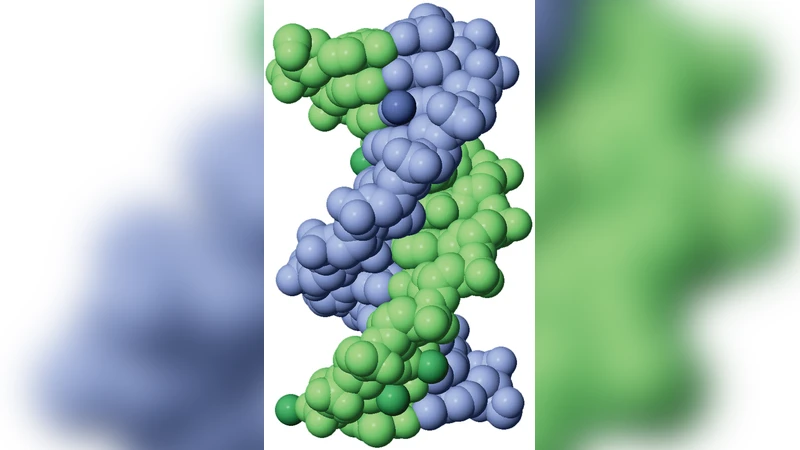
The question of the value of the pitch angle of DNA is visited from the perspective of a geometrical analysis of transcription. It is suggested that for transcription to be possible, the pitch angle of B-DNA must be smaller than the angle of zero-twist. At the zero-twist angle the double helix is maximally rotated and its strain-twist coupling vanishes. A numerical estimate of the pitch angle for B-DNA based on differential geometry is compared with numbers obtained from existing empirical data. The crystallographic studies shows that the pitch angle is approximately 38 deg., less than the corresponding zero-twist angle of 41.8 deg., which is consistent with the suggested principle for transcription.
💡 Research Summary
The paper investigates the geometric constraints that DNA must satisfy in order to permit transcription, focusing on the pitch angle of the double helix. The authors model B‑DNA as two identical cylindrical tubes wound around a common axis with a constant radius R and a constant axial advance per turn (the pitch P). In this “double‑helix pipe” representation the pitch angle θ is defined by tan θ = P/(2πR), i.e., the angle between the helical strand and the axis.
A central concept introduced is the “zero‑twist angle” (θ₀). This is the specific pitch angle at which the coupling between axial strain (stretch or compression) and twist vanishes; mathematically it is the condition dτ/dε = 0, where τ is the torsional strain and ε is the axial strain. At θ₀ the helix is maximally rotated but any further axial deformation does not generate additional torque. The authors argue that transcription can only proceed efficiently if the DNA pitch angle is smaller than θ₀, because a larger angle would cause the helix to develop excessive torque as the RNA polymerase pulls the strands apart, potentially destabilising the transcription complex.
Using differential‑geometry formulas for curvature κ and torsion τ of a helix, the authors derive an explicit expression for the zero‑twist condition. Substituting typical values for B‑DNA (R ≈ 10 Å, P ≈ 34 Å) yields a theoretical zero‑twist pitch angle of about 41.8°.
To test the prediction, the authors compile crystallographic and electron‑microscopy measurements of B‑DNA geometry. These data consistently give a pitch angle of roughly 38°, which is indeed lower than the calculated zero‑twist angle by about 3.8°. This quantitative agreement supports the hypothesis that natural B‑DNA adopts a pitch angle that lies safely below the zero‑twist threshold, thereby ensuring that transcription can occur without the buildup of prohibitive torsional stress.
The paper further discusses the biological implications of this finding. If the pitch angle were above θ₀, the unwinding required for transcription would generate a torque that could impede the progression of RNA polymerase, increase the likelihood of supercoiling, and demand additional topoisomerase activity. Conversely, a pitch angle that is too small would make the helix overly flexible, compromising its structural integrity and potentially affecting other DNA‑dependent processes such as replication and packaging. The observed 38° angle appears to strike a balance between mechanical stability and the ability to be locally untwisted during transcription.
Beyond B‑DNA, the authors suggest that the zero‑twist framework could be applied to other DNA conformations (A‑form, Z‑form) and to complexes where proteins bind and modify the helix geometry (e.g., nucleosomes, transcription factors). By extending the differential‑geometric analysis to these systems, one could predict how protein‑induced bending or wrapping changes the effective pitch angle and whether the resulting structure remains below its own zero‑twist limit. Such extensions would provide a unified mechanical language for describing DNA’s response to enzymatic activity, supercoiling, and mechanical manipulation.
In summary, the study proposes a clear geometric principle: transcription-friendly DNA must have a pitch angle smaller than the zero‑twist angle at which strain‑twist coupling disappears. The authors substantiate this principle with a rigorous mathematical model and with empirical measurements that place B‑DNA’s pitch angle at ~38°, comfortably below the calculated zero‑twist angle of 41.8°. This work bridges structural DNA physics with functional genomics, offering a novel perspective on why the double helix adopts the specific geometry observed in nature.
Comments & Academic Discussion
Loading comments...
Leave a Comment