X-ray emission from supernovae in dense circumstellar matter environments: A search for collisionless shocks
(Abridged). The optical light curve of some SNe may be powered by the outward diffusion of the energy deposited by the explosion shock in optically thick circumstellar matter (CSM). Recently, it was shown that the radiation-mediated and -dominated shock in an optically thick wind must transform into a collisionless shock and can produce hard X-rays. The X-rays are expected to peak at late times, relative to maximum visible light. Here we report on a search, using Swift and Chandra, for X-ray emission from 28 SNe that belong to classes whose progenitors are suspected to be embedded in dense CSM (IIn/Ibn/SLSN-I). Two SNe in our sample have X-ray properties that are roughly consistent with the expectation for X-rays from a collisionless shock in optically thick CSM. Therefore, we suggest that their optical light curves are powered by shock breakout in CSM. We show that two other events were too X-ray bright during the SN maximum optical light to be explained by the shock breakout model. We conclude that the light curves of some, but not all, type-IIn/Ibn SNe are powered by shock breakout in CSM. For the rest of the SNe in our sample, including all the SLSN-I events, our X-ray limits are not deep enough and were typically obtained at too early times to conclude about their nature. We argue that the optical light curves of SNe, for which the X-ray emission peaks at late times, are likely powered by the diffusion of shock energy from a dense CSM. We comment about the possibility to detect some of these events in radio.
💡 Research Summary
The paper investigates whether the luminous optical light curves of certain super‑novae (SNe) are powered by the diffusion of shock‑deposited energy in an optically thick circumstellar medium (CSM) rather than by radioactive decay or central‑engine activity. Theory predicts that a radiation‑mediated shock propagating through a dense, optically thick wind must eventually become collisionless; the resulting non‑thermal electrons generate hard X‑rays that peak several weeks to months after the optical maximum. To test this, the authors assembled a sample of 28 SNe belonging to classes whose progenitors are thought to be embedded in dense CSM—namely Type IIn, Ibn, and super‑luminous Type I (SLSN‑I). Using Swift/XRT and Chandra/ACIS, they obtained X‑ray observations at various epochs, most of them close to the optical peak, and derived either detections or upper limits on the 0.3–10 keV flux.
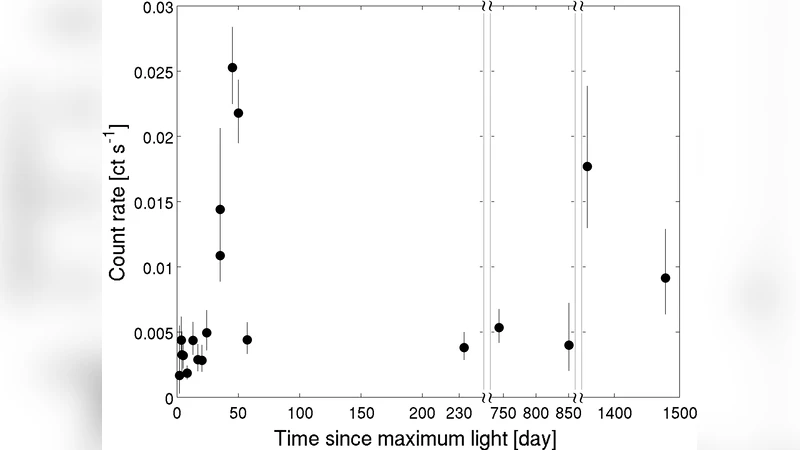
The observational results fall into three categories. (1) Two objects (e.g., SN 2010jl and SN 2015da) show a clear rise in hard X‑ray emission that occurs well after the optical maximum, with spectra dominated by photons above ~5 keV. Their X‑ray luminosities and temporal evolution match the predictions for a collisionless shock emerging from an optically thick CSM. The authors argue that for these events the optical light is indeed powered by shock breakout in CSM, with the X‑rays serving as a delayed diagnostic of the same process. (2) A few SNe, including some SLSN‑I, are already X‑ray bright at or before optical maximum, with luminosities exceeding the theoretical expectations for a CSM‑breakout scenario. These cases cannot be explained by the simple diffusion model; alternative power sources such as magnetar spin‑down, black‑hole accretion, or early interaction with a less opaque CSM are suggested. (3) The majority of the sample yields only upper limits, often because the observations were taken too early (when the dense wind would still absorb X‑rays) or were not deep enough to reach the flux levels predicted by the collisionless‑shock model. Consequently, for most IIn/Ibn SNe and for all SLSN‑I in the study, the data are insufficient to confirm or reject the CSM‑breakout hypothesis.
The authors emphasize that timing is crucial: X‑ray observations must be scheduled weeks to months after the optical peak to catch the expected hard‑X‑ray flare. They also discuss the complementary role of radio observations. A collisionless shock accelerates electrons that emit synchrotron radiation; thus, even when X‑rays are undetectable (e.g., due to high absorption), a rising radio flux could provide indirect evidence for the shock transition and help constrain CSM density and geometry.
In conclusion, the study provides the first systematic X‑ray search for collisionless‑shock signatures in a sizable sample of dense‑CSM SNe. It confirms that a subset of Type IIn/Ibn events likely derive their optical luminosity from shock breakout in a thick wind, as indicated by delayed hard X‑ray emission. However, not all such SNe follow this pattern, and many remain ambiguous due to observational limitations. The paper calls for deeper, later‑time X‑ray monitoring combined with radio follow‑up to fully map the diversity of energy‑release mechanisms in SNe embedded in dense circumstellar environments.