Limits on the event rates of fast radio transients from the V-FASTR experiment
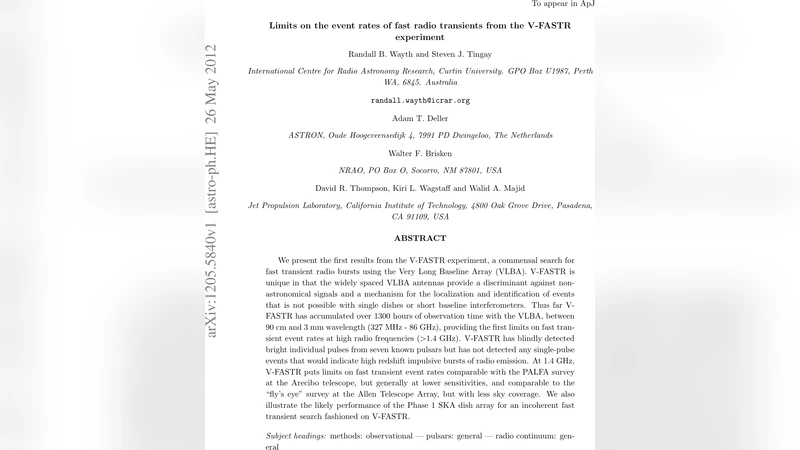
We present the first results from the V-FASTR experiment, a commensal search for fast transient radio bursts using the Very Long Baseline Array (VLBA). V-FASTR is unique in that the widely spaced VLBA antennas provide a discriminant against non-astronomical signals and a mechanism for the localization and identification of events that is not possible with single dishes or short baseline interferometers. Thus far V-FASTR has accumulated over 1300 hours of observation time with the VLBA, between 90 cm and 3 mm wavelength (327 MHz - 86 GHz), providing the first limits on fast transient event rates at high radio frequencies (>1.4 GHz). V-FASTR has blindly detected bright individual pulses from seven known pulsars but has not detected any single-pulse events that would indicate high redshift impulsive bursts of radio emission. At 1.4 GHz, V-FASTR puts limits on fast transient event rates comparable with the PALFA survey at the Arecibo telescope, but generally at lower sensitivities, and comparable to the “fly’s eye” survey at the Allen Telescope Array, but with less sky coverage. We also illustrate the likely performance of the Phase 1 SKA dish array for an incoherent fast transient search fashioned on V-FASTR.
💡 Research Summary
The paper presents the first scientific results from V‑FASTR, a commensal fast‑radio‑transient search conducted with the Very Long Baseline Array (VLBA). By exploiting the widely separated VLBA antennas, V‑FASTR gains a powerful discriminant against terrestrial radio‑frequency interference (RFI) and the ability to localize genuine astronomical bursts—capabilities that single‑dish or short‑baseline interferometers lack. Over the period from 2012 to 2015 the experiment accumulated more than 1 300 hours of on‑source time, covering a broad frequency range from 327 MHz (90 cm) up to 86 GHz (3 mm). This extensive coverage provides the first constraints on fast‑transient event rates at frequencies above the traditional 1.4 GHz window.
The hardware backend digitizes the voltage streams from each of the ten VLBA antennas with 8‑bit sampling at a 2 GHz bandwidth, preserving sub‑millisecond time resolution. An incoherent sum of the power from all antennas is formed in real time; a trigger is generated when any antenna records a >5σ voltage excursion. The trigger is then cross‑checked across all stations; only events that appear simultaneously at multiple, geographically separated antennas survive the RFI veto. Surviving candidates undergo a dispersion‑measure (DM) sweep to test for the characteristic ν⁻² delay expected from extragalactic bursts. This pipeline, validated by blind detections of individual pulses from seven known pulsars, demonstrates both high detection efficiency and robust RFI rejection.
No new single‑pulse events consistent with high‑redshift fast radio bursts (FRBs) were found. Using the non‑detections, the authors compute 95 % confidence upper limits on the sky‑averaged event rate as a function of fluence for each observing band. At 1.4 GHz the derived limit is ≈2 × 10⁴ sky⁻¹ day⁻¹ for fluences above ~1 Jy ms, comparable to the limits set by the PALFA survey at Arecibo, albeit with a lower instantaneous sensitivity and a smaller sky footprint. Compared with the “fly’s eye” survey at the Allen Telescope Array, V‑FASTR achieves similar rate limits but over a narrower field of view; however, V‑FASTR is the first experiment to place such constraints at frequencies up to 86 GHz.
The paper also discusses the principal limitations of the current implementation: modest sky coverage per unit observing time, reduced sensitivity at the highest frequencies due to increased system temperature, and the reliance on incoherent summation which, while preserving a wide field, sacrifices the √N gain in sensitivity that a coherent beamforming approach would provide. The authors outline future improvements, including expanding the number of participating antennas, increasing bandwidth, and incorporating machine‑learning classifiers for real‑time RFI identification.
Finally, the authors project the performance of a Phase 1 Square Kilometre Array (SKA) dish array (≈200 m² K⁻¹ system temperature, 15 m dishes, ~200 elements) if operated with a V‑FASTR‑style incoherent fast‑transient search. Simulations indicate an order‑of‑magnitude improvement in fluence sensitivity and a corresponding reduction of the event‑rate upper limits by roughly one dex, placing the SKA in a regime where it could detect the bulk of the FRB population even at high frequencies.
In summary, V‑FASTR demonstrates that a long‑baseline interferometer can serve as an effective fast‑transient detector, providing stringent new limits on the occurrence of bright, high‑frequency radio bursts and establishing a methodological foundation for future large‑array facilities such as the SKA.