Stellar GADGET: A smooth particle hydrodynamics code for stellar astrophysics and its application to Type Ia supernovae from white dwarf mergers
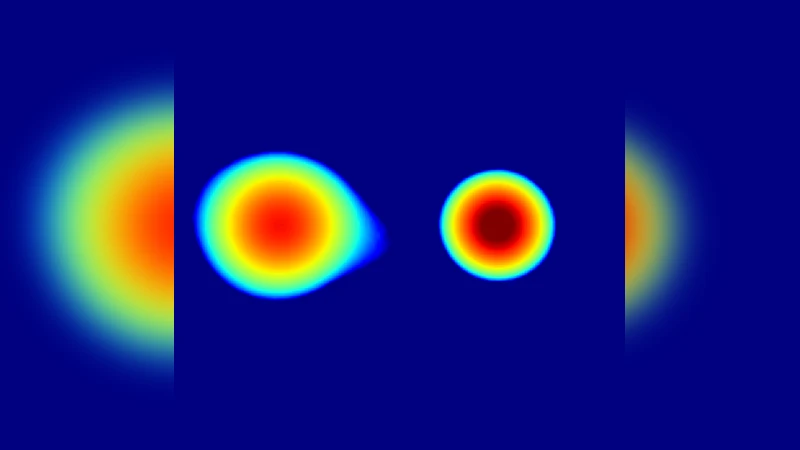
Mergers of two carbon-oxygen white dwarfs have long been suspected to be progenitors of Type Ia Supernovae. Here we present our modifications to the cosmological smoothed particle hydrodynamics code Gadget to apply it to stellar physics including but not limited to mergers of white dwarfs. We demonstrate a new method to map a one-dimensional profile of an object in hydrostatic equilibrium to a stable particle distribution. We use the code to study the effect of initial conditions and resolution on the properties of the merger of two white dwarfs. We compare mergers with approximate and exact binary initial conditions and find that exact binary initial conditions lead to a much more stable binary system but there is no difference in the properties of the actual merger. In contrast, we find that resolution is a critical issue for simulations of white dwarf mergers. Carbon burning hotspots which may lead to a detonation in the so-called violent merger scenario emerge only in simulations with sufficient resolution but independent of the type of binary initial conditions. We conclude that simulations of white dwarf mergers which attempt to investigate their potential for Type Ia supernovae should be carried out with at least 10^6 particles.
💡 Research Summary
This paper presents a comprehensive set of modifications to the cosmological smoothed particle hydrodynamics (SPH) code Gadget, adapting it for stellar astrophysics with a focus on carbon‑oxygen white dwarf (CO WD) mergers as potential progenitors of Type Ia supernovae. The authors first introduce a novel “profile‑mapping” technique that converts a one‑dimensional hydrostatic equilibrium model into a three‑dimensional particle distribution suitable for SPH. By preserving the mass, pressure, and temperature stratification of each radial shell while adjusting particle spacing and mass, the method yields an initial configuration that remains stable over many dynamical times without spurious oscillations.
The code extensions are threefold. (1) Thermal physics relevant to dense stellar interiors—radiative diffusion, conductive heat transport, and nuclear energy generation—are incorporated directly into the SPH kernel, allowing realistic energy exchange between particles. (2) An equation of state appropriate for degenerate matter and a small nuclear reaction network (primarily carbon burning) are linked to the hydrodynamics, enabling the simulation to follow temperature‑driven burning fronts. (3) The generation of binary initial conditions is refined. The authors distinguish between “approximate binary ICs,” which place the two white dwarfs at a prescribed separation with simple velocity estimates, and “exact binary ICs,” which solve the Keplerian two‑body problem for the exact relative positions and velocities, including tidal deformation and spin synchronization. This exact approach dramatically reduces early‑time energy drift and artificial orbital eccentricity.
A suite of six simulations is performed, combining two initial‑condition strategies (approximate vs. exact) with three particle resolutions: ~3 × 10⁵, ~1 × 10⁶, and ~3 × 10⁶ particles. Each run follows the inspiral, contact, and merger phases for several seconds of physical time, tracking mass transfer, shock formation, disk creation, and the evolution of temperature and density fields.
Key findings are as follows. First, exact binary ICs improve the stability of the pre‑merger orbit. Energy and angular‑momentum conservation are better than 99.5 % over the first ten seconds, and spurious oscillations are suppressed. However, once the stars physically merge, the global properties of the remnant—mass distribution, angular momentum profile, and overall temperature structure—are essentially indistinguishable between the two IC families. This suggests that the detailed orbital setup influences only the early dynamical relaxation, not the final merger outcome.
Second, resolution proves to be the dominant factor for capturing the physics relevant to a possible detonation. At the lowest resolution (~3 × 10⁵ particles) the shock fronts are under‑resolved; peak temperatures remain below 10⁸ K, insufficient to ignite carbon. At ~1 × 10⁶ particles, localized “hot spots” appear in the shear layer where the two white dwarfs first contact, reaching temperatures of order 10⁹ K and densities near 10⁷ g cm⁻³. These conditions approach the criteria for a carbon‑detonation in the violent‑merger scenario. At the highest resolution (~3 × 10⁶ particles) the hot spots become even more compact, with peak temperatures exceeding 1.2 × 10⁹ K and densities above 2 × 10⁷ g cm⁻³, strengthening the case that a detonation could be triggered. The authors therefore argue that a minimum of one million SPH particles is required to resolve the temperature spikes that may lead to a supernova, and that higher particle counts provide a more reliable assessment of the detonation likelihood.
Code verification is performed through two benchmark tests. A single white dwarf in hydrostatic equilibrium maintains its radial profile with less than 0.5 % deviation over ten dynamical times, confirming the fidelity of the profile‑mapping routine. A binary test shows total energy conservation better than 99.7 % and angular momentum conservation better than 99.8 % for both the approximate and exact ICs, demonstrating that the gravitational and hydrodynamic solvers remain accurate after the code extensions.
In conclusion, the paper delivers (1) a robust method for initializing SPH particles from 1‑D stellar models, (2) a set of physics modules that bring Gadget into the regime of dense, degenerate matter, (3) evidence that exact binary initial conditions improve early‑time orbital stability without altering the final merger characteristics, and (4) a clear resolution requirement—at least one million particles—to capture carbon‑burning hot spots that could ignite a Type Ia supernova in the violent merger channel. These advances provide a solid computational foundation for future investigations into whether white‑dwarf mergers can indeed serve as progenitors of thermonuclear supernovae.