High-energy emission from the pulsar striped wind: a synchrotron model for gamma-ray pulsars
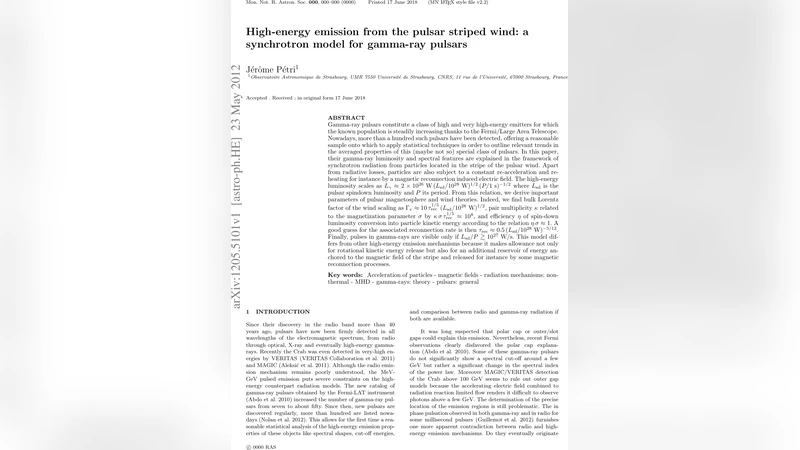
(abridged) Gamma-ray pulsars constitute a class of high and very high-energy emitters for which the known population is steadily increasing thanks to the Fermi/Large Area Telescope. In this paper, their gamma-ray luminosity and spectral features are explained in the framework of synchrotron radiation from particles located in the stripe of the pulsar wind. Apart from radiative losses, particles are also subject to a constant re-acceleration and reheating for instance by a magnetic reconnection induced electric field. The high-energy luminosity scales as $L_\gamma \approx 2\times10^{26} \textrm{W} , (L_{\rm sd}/10^{28} \textrm{W})^{1/2} , (P/1 \textrm{s})^{-1/2}$ where $L_{\rm sd}$ is the pulsar spindown luminosity and $P$ its period. From this relation, we derive important parameters of pulsar magnetosphere and wind theories. Indeed, we find bulk Lorentz factor of the wind scaling as $\Gamma_{\rm v} \approx 10 , \tau_{\rm rec}^{1/5} , (L_{\rm sd}/10^{28} \textrm{W})^{1/2}$, pair multiplicity $\kappa$ related to the magnetization parameter $\sigma$ by $\kappa,\sigma , \tau_{\rm rec}^{1/5} \approx 10^8$, and efficiency $\eta$ of spin-down luminosity conversion into particle kinetic energy according to the relation $\eta,\sigma\approx1$. A good guess for the associated reconnection rate is then $\tau_{\rm rec} \approx 0.5 , (L_{\rm sd}/10^{28} \textrm{W})^{-5/12}$. Finally, pulses in gamma-rays are visible only if $L_{\rm sd}/P\gtrsim 10^{27} \textrm{W/s}$. This model differs from other high-energy emission mechanisms because it makes allowance not only for rotational kinetic energy release but also for an additional reservoir of energy anchored to the magnetic field of the stripe and released for instance by some magnetic reconnection processes.
💡 Research Summary
The paper proposes a new framework for the high‑energy emission of gamma‑ray pulsars that is based on synchrotron radiation from particles residing in the striped wind of the pulsar. In the striped wind, alternating magnetic polarity zones are separated by thin current sheets. Magnetic reconnection in these sheets generates an electric field that continuously re‑accelerates particles while they simultaneously lose energy through synchrotron radiation in the strong magnetic field of the wind. By assuming a steady‑state balance between reconnection‑driven acceleration and synchrotron cooling, the authors derive a simple scaling law for the gamma‑ray luminosity:
\