Ultrarelativistic Bondi--Hoyle Accretion I: Axisymmetry
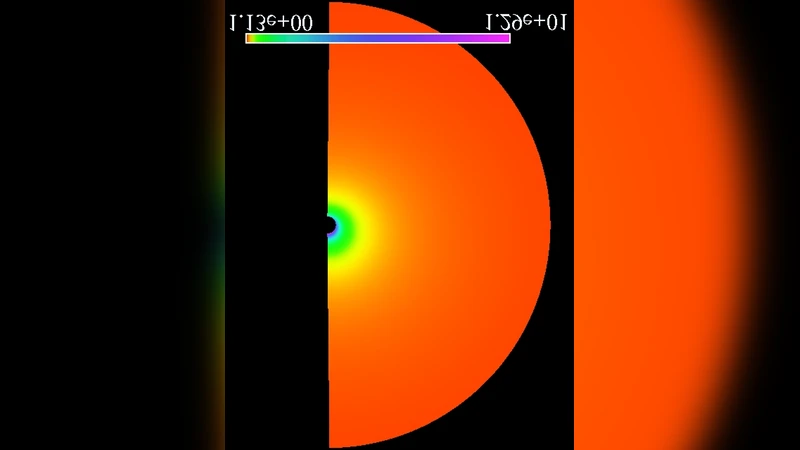
An ultrarelativistic relativistic study of axisymmetric Bondi–Hoyle accretion onto a moving Kerr black hole is presented. The equations of general relativistic hydrodynamics are solved using high resolution shock capturing methods. In this treatment we consider the ultrarelativistic limit wherein one may neglect the baryon rest mass density. This approximation is valid in the regime where the internal energy of the system dominates over the rest mass energy contribution from the baryons. The parameters of interest in this study are the adiabatic constant $\Gamma$, and the asymptotic speed of the fluid, $v_\infty$. We perform our simulations in three different regimes, subsonic, marginally supersonic, and supersonic, but the primary focus of this study is the parameter regime in which the flow is supersonic, that is when $v_\infty \ge c_{s}^{\infty}$. As expected from previous studies the supersonic regimes reveal interesting dynamics, but even more interesting is the presence of a bow shock in marginally supersonic systems. A range of parameter values were investigated to attempt to capture possible deviations from steady state solutions, none were found. To show the steady state behaviour of each of the flows studied we calculate the energy accretion rates on the Schwarzschild radius. Additionally, we also find that the accretion flows are dependent on the location of the computational boundary, that if the computational boundary is located too close to the black hole the calculated flow profiles are marred with numerical artifacts. This is a problem not found in previous relativistic models for ultrarelativistic hydrodynamic systems.
💡 Research Summary
The paper presents the first systematic study of axisymmetric Bondi–Hoyle accretion onto a moving Kerr black hole in the ultrarelativistic limit, where the rest‑mass density of the baryons can be neglected because the internal energy dominates the total energy budget. The authors solve the general‑relativistic hydrodynamic equations with high‑resolution shock‑capturing (HRSC) schemes on a two‑dimensional spherical‑polar grid that resolves the region near the event horizon and extends to a large outer radius. The fluid is characterized by an adiabatic index Γ (ranging from 4/3, appropriate for radiation‑dominated plasma, to 5/3 for a non‑relativistic gas) and an asymptotic inflow speed v∞. Three regimes are explored: subsonic (v∞ < c_s^∞), marginally supersonic (v∞ ≈ c_s^∞), and supersonic (v∞ > c_s^∞).
In the subsonic case the flow is smooth, the black‑hole gravity gently pulls the gas inward, and no shock forms. In the marginally supersonic regime a thin bow‑shaped shock appears in front of the black hole. The shock surface is not perfectly symmetric; its curvature depends on the spin parameter a of the Kerr hole and on Γ. For higher spin the shock is swept backward by frame‑dragging, while a larger Γ (more compressible fluid) makes the shock stand farther from the hole. In the fully supersonic regime the bow shock becomes strong and stationary, confining the accretion column to a narrow region downstream of the hole. The energy accretion rate (\dot{E}) measured at the Schwarzschild radius quickly settles to a constant value, indicating that a steady‑state solution is reached for all tested parameter combinations.
A key methodological finding concerns the placement of the outer computational boundary. When the outer radius is too close to the horizon (≈ 10 M, where M is the black‑hole mass) artificial reflections and spurious pressure oscillations contaminate the solution, distorting both the shock geometry and the measured accretion rates. By moving the boundary outward to ≥ 30 M these numerical artifacts disappear, and the flow converges to the physically expected configuration. This sensitivity to the domain size was not reported in earlier relativistic Bondi–Hoyle studies and highlights the importance of careful grid design for ultrarelativistic simulations.
The authors also quantify how (\dot{E}) varies with the spin a and the adiabatic index Γ. Increasing a enhances frame‑dragging, allowing more fluid to be captured and raising the accretion rate, whereas a Γ close to 4/3 reduces compressibility and slightly lowers (\dot{E}). The dependence is nonlinear, suggesting that simple extensions of the classic Bondi formula are insufficient in the ultrarelativistic, rotating‑black‑hole context.
No evidence of time‑dependent or chaotic behaviour was found; all runs, even those with marginally supersonic inflow, relaxed to a steady configuration after a few dynamical times. The paper therefore confirms that ultrarelativistic Bondi–Hoyle accretion onto a Kerr black hole is fundamentally steady, provided the numerical domain is chosen appropriately.
Overall, the study advances our understanding of high‑energy accretion flows relevant to environments such as the inner regions of active galactic nuclei, gamma‑ray burst progenitors, or the early universe where radiation pressure dominates. It supplies both a physical picture—bow shocks, spin‑dependent shock asymmetry, and steady energy inflow—and practical guidance on how to set up reliable ultrarelativistic hydrodynamic simulations.