A Brightest Cluster Galaxy with an Extremely Large Flat Core
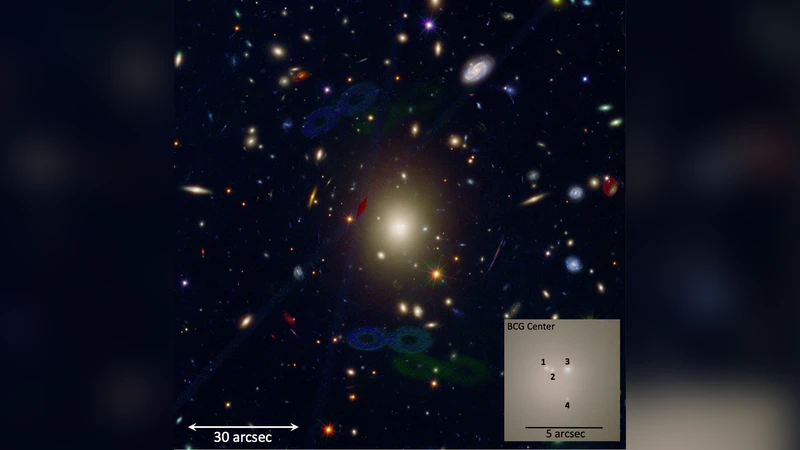
Hubble Space Telescope images of the galaxy cluster Abell 2261, obtained as part of the Cluster Lensing And Supernova survey with Hubble, show that the brightest galaxy in the cluster, A2261-BCG, has the largest core yet detected in any galaxy. The cusp radius of A2261-BCG is 3.2 kpc, twice as big as the next largest core known, and ~3x bigger than those typically seen in the most luminous BCGs. The morphology of the core in A2261-BCG is also unusual, having a flat or even slightly-depressed interior surface brightness profile, rather than the typical shallow cusp. This implies that the galaxy has a core with constant or even centrally decreasing stellar density. Interpretation of the core as an end product of the “scouring” action of a binary supermassive black hole implies a total black hole mass ~1E+10 M_sun from the extrapolation of most relationships between core structure and black hole mass. The core falls 1-sigma above the cusp-radius versus galaxy luminosity relation. Its large size in real terms, and the extremely large black hole mass required to generate it, raise the possibility that the core has been enlarged by additional processes, such as the ejection of the black holes that originally generated the core. The flat central stellar density profile is consistent with this hypothesis. The core is also displaced by 0.7 kpc from the center of the surrounding envelope, consistent with a local dynamical perturbation of the core.
💡 Research Summary
The paper presents a detailed Hubble Space Telescope (HST) imaging study of the brightest cluster galaxy (BCG) in the Abell 2261 galaxy cluster, designated A2261‑BCG, as part of the CLASH (Cluster Lensing And Supernova survey with Hubble) program. The authors discover that this galaxy hosts the largest stellar core ever measured in any galaxy. The core’s “cusp radius” – the radius at which the surface‑brightness profile transitions from a flat inner region to the outer envelope – is 3.2 kpc, roughly twice the size of the next‑largest known core and about three times larger than typical cores in the most luminous BCGs.
A striking morphological feature is that the inner surface‑brightness profile is essentially flat, or even mildly declining, rather than the shallow power‑law cusp (γ≈0.2–0.5) commonly observed in massive ellipticals. This implies a constant or slightly decreasing stellar density toward the very centre, a situation rarely seen in galaxies of this mass.
The authors interpret the core in the context of the “scouring” scenario, wherein a binary supermassive black hole (SMBH) ejects stars from the centre as it hardens, thereby excavating a low‑density core. Using the empirical relations that link core size to SMBH mass (e.g., the M‑BH–r_c relation), they extrapolate that a black hole of order 10¹⁰ M⊙ would be required to produce a 3.2 kpc core. This mass exceeds the most massive black holes measured directly (e.g., M87’s ≈6 × 10⁹ M⊙) and places A2261‑BCG well above the 1‑σ envelope of the cusp‑radius versus galaxy‑luminosity correlation.
Because such an extreme black‑hole mass is statistically unlikely, the paper explores additional mechanisms that could have enlarged the core beyond the standard scouring outcome. One possibility is a gravitational‑wave recoil (“kick”) that expelled the merged SMBH from the centre after binary coalescence. A recoiling black hole would leave behind a depleted stellar region, potentially flattening the density profile and displacing the core relative to the surrounding envelope. Indeed, the authors measure a 0.7 kpc offset between the centre of the flat core and the centroid of the outer stellar envelope, consistent with a recent dynamical perturbation.
Another avenue considered is “core rejuvenation” or heating, where subsequent dynamical processes—such as minor mergers, gas inflow that suppresses central star formation, or dynamical friction acting on remaining massive objects—further expand the low‑density region after the initial scouring event.
The paper therefore concludes that A2261‑BCG’s core is likely the product of a combination of (i) an initial binary‑SMBH scouring episode, (ii) a possible SMBH recoil or ejection that amplified the core size and produced the observed flat density profile, and (iii) later dynamical interactions that maintained or enlarged the core. The authors argue that this system provides a rare laboratory for testing theories of SMBH growth, binary‑black‑hole dynamics, and the interplay between central black holes and their host galaxies.
Future work suggested includes high‑resolution integral‑field spectroscopy to map the stellar kinematics within the core, which would constrain the current black‑hole mass (or its absence) and the velocity dispersion profile. Numerical simulations that incorporate binary‑SMBH hardening, gravitational‑wave recoil, and subsequent minor mergers are needed to reproduce the observed core size, flatness, and offset. Finally, a systematic search for similarly large, flat‑core BCGs in other massive clusters would establish whether A2261‑BCG is an outlier or part of a broader population, thereby refining the statistical relationship between core structure and SMBH mass.