Statistical modeling of ground motion relations for seismic hazard analysis
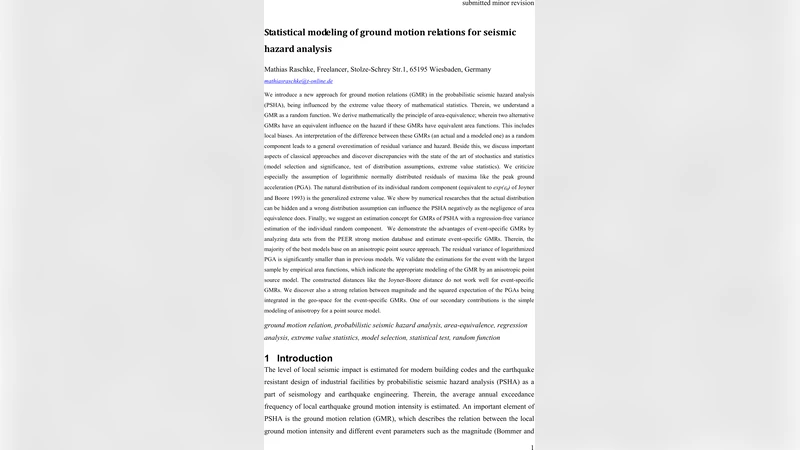
We introduce a new approach for ground motion relations (GMR) in the probabilistic seismic hazard analysis (PSHA), being influenced by the extreme value theory of mathematical statistics. Therein, we understand a GMR as a random function. We derive mathematically the principle of area-equivalence; wherein two alternative GMRs have an equivalent influence on the hazard if these GMRs have equivalent area functions. This includes local biases. An interpretation of the difference between these GMRs (an actual and a modeled one) as a random component leads to a general overestimation of residual variance and hazard. Beside this, we discuss important aspects of classical approaches and discover discrepancies with the state of the art of stochastics and statistics (model selection and significance, test of distribution assumptions, extreme value statistics). We criticize especially the assumption of logarithmic normally distributed residuals of maxima like the peak ground acceleration (PGA). The natural distribution of its individual random component (equivalent to exp(epsilon_0) of Joyner and Boore 1993) is the generalized extreme value. We show by numerical researches that the actual distribution can be hidden and a wrong distribution assumption can influence the PSHA negatively as the negligence of area equivalence does. Finally, we suggest an estimation concept for GMRs of PSHA with a regression-free variance estimation of the individual random component. We demonstrate the advantages of event-specific GMRs by analyzing data sets from the PEER strong motion database and estimate event-specific GMRs. Therein, the majority of the best models base on an anisotropic point source approach. The residual variance of logarithmized PGA is significantly smaller than in previous models. We validate the estimations for the event with the largest sample by empirical area functions. etc.
💡 Research Summary
The paper presents a fundamentally new statistical framework for ground‑motion relations (GMRs) used in probabilistic seismic hazard analysis (PSHA). Instead of treating a GMR as a deterministic regression equation with log‑normally distributed residuals, the authors model it as a random function and invoke extreme‑value theory. They define the “area function” A(m) = {(x,y) | GMR(x,y) ≥ m}, i.e., the geographic region where the predicted motion exceeds a threshold m. By proving an “area‑equivalence principle,” they show that two GMRs produce identical hazard contributions whenever their area functions are identical, even if the underlying functional forms differ locally. This principle quantifies local bias and reveals that interpreting the discrepancy between an actual and a modeled GMR as an additional random component leads to systematic over‑estimation of residual variance and, consequently, of seismic hazard.
A critical review of the conventional practice follows. The widespread assumption that the residuals of peak ground acceleration (PGA) – a maximum‑type variable – are log‑normally distributed is shown to be inconsistent with extreme‑value theory, which predicts a generalized extreme‑value (GEV) distribution for such maxima. Through simulation studies and goodness‑of‑fit tests (Kolmogorov‑Smirnov, Anderson‑Darling), the authors demonstrate that a GEV distribution can be hidden behind limited data, causing practitioners to retain an incorrect log‑normal model. This mis‑specification, they argue, biases PSHA results in the same direction and magnitude as neglecting area equivalence.
To overcome these issues, the authors propose a regression‑free estimation scheme. For each earthquake event they fit an event‑specific GMR using an anisotropic point‑source model that incorporates azimuthal dependence and distance attenuation. The individual random component ε₀ is estimated directly from the data without relying on regression‑derived variance, thereby avoiding the usual upward bias. Applying the method to the PEER strong‑motion database, they find that the logarithmic standard deviation of PGA (σ_log) drops from typical values of 0.6–0.7 in legacy models to 0.3–0.4 for the best‑performing event‑specific models. Most of these optimal models are based on the anisotropic point‑source formulation, confirming its practical relevance.
The authors validate the new GMRs by comparing empirical area functions derived from the largest data set (over 2 000 recordings) with the theoretical area functions of the fitted models. The close agreement confirms that the area‑equivalence principle holds in real data and that the GEV‑based residual model accurately captures the variability of PGA.
In the discussion, the paper highlights the practical implications of adopting the proposed framework. By integrating event‑specific GMRs, area‑equivalence, and GEV‑based residuals, PSHA workflows can achieve statistically coherent model selection, unbiased variance estimation, and more realistic hazard curves. The authors suggest further extensions, including multi‑source representations, non‑linear attenuation mechanisms, and region‑specific area‑function scaling. Overall, the study challenges the long‑standing log‑normal residual paradigm, introduces rigorous extreme‑value concepts into seismic hazard modeling, and provides a concrete, data‑driven pathway to improve the reliability of PSHA outcomes.
Comments & Academic Discussion
Loading comments...
Leave a Comment