Magnetic Fields in Astrophysical Jets: From Launch to Termination
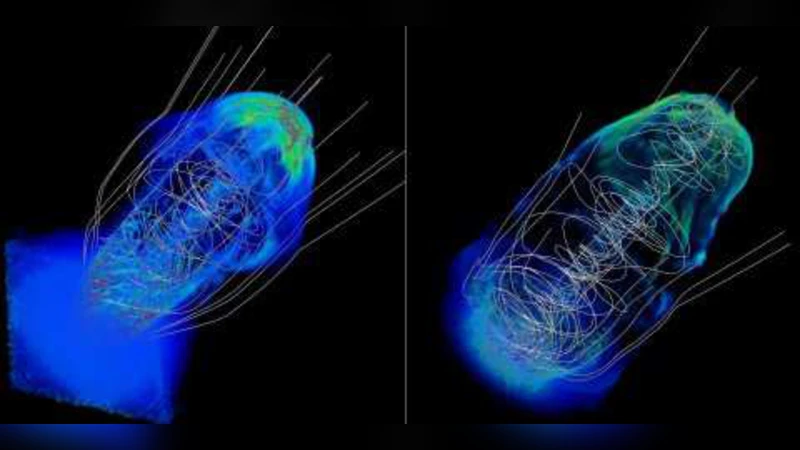
Long-lived, stable jets are observed in a wide variety of systems, from protostars, through Galactic compact objects to active galactic nuclei (AGN). Magnetic fields play a central role in launching, accelerating, and collimating the jets through various media. The termination of jets in molecular clouds or the interstellar medium deposits enormous amounts of mechanical energy and momentum, and their interactions with the external medium, as well, in many cases, as the radiation processes by which they are observed, are intimately connected with the magnetic fields they carry. This review focuses on the properties and structures of magnetic fields in long-lived jets, from their launch from rotating magnetized young stars, black holes, and their accretion discs, to termination and beyond. We compare the results of theory, numerical simulations, and observations of these diverse systems and address similarities and differences between relativistic and non-relativistic jets in protostellar versus AGN systems. On the observational side, we focus primarily on jets driven by AGN because of the strong observational constraints on their magnetic field properties, and we discuss the links between the physics of these jets on all scales.
💡 Research Summary
The review provides a comprehensive synthesis of magnetic‑field physics in long‑lived astrophysical jets, tracing their evolution from launch at rotating, magnetized young stars, black holes and accretion disks, through acceleration and collimation, to termination in the surrounding interstellar or intergalactic medium. The authors begin by outlining the common phenomenology of jets across a vast range of scales—from protostellar outflows to relativistic jets in active galactic nuclei (AGN)—and emphasize that magnetic fields are the primary agent that extracts angular momentum from the central engine, accelerates plasma, and maintains narrow, stable structures over millions of years.
In the launch region, the review contrasts two paradigmatic mechanisms. For non‑relativistic systems, the magneto‑centrifugal “Blandford‑Payne”–type process (often called the magneto‑centrifugal wind) operates in a magnetized disk, where field lines anchored in the rotating disk fling plasma outward once the Alfvén surface is crossed. In relativistic AGN jets, the “Blandford‑Znajek” mechanism extracts rotational energy directly from a spinning black hole via a large‑scale poloidal field threading the horizon. Both mechanisms are supported by state‑of‑the‑art 2D and 3D magnetohydrodynamic (MHD) and general‑relativistic MHD (GRMHD) simulations (e.g., PLUTO, ATHENA++, HARM). The simulations demonstrate that a self‑collimating magnetic “spine‑sheath” structure naturally forms, with toroidal magnetic pressure squeezing the jet radius by factors of ten to a hundred, a process that is largely independent of the jet’s bulk Lorentz factor.
Acceleration and collimation are further mediated by magnetic pressure gradients, reconnection‑driven turbulence, and MHD wave propagation (Alfvén, fast‑magnetosonic). In relativistic jets, the conversion of Poynting flux to kinetic energy proceeds via gradual magnetic dissipation, often through kink instabilities that trigger reconnection and produce the observed high‑energy synchrotron and inverse‑Compton emission. For protostellar jets, the same processes manifest as molecular line broadening and infrared polarization, albeit at lower energies. Observationally, the review highlights that AGN jets now have robust polarization measurements: linear polarization fractions of ~10 % on parsec scales, Faraday rotation measures ranging from a few hundred to >10⁴ rad m⁻², and VLBI imaging of magnetic‑field vectors that directly trace the helical geometry predicted by theory. Recent ALMA polarimetry of protostellar outflows is beginning to reveal comparable, though less resolved, magnetic morphologies.
Termination of jets is treated in detail. When a jet impacts the ambient medium, a bow shock and a cocoon (or radio lobe) develop. The interaction region is prone to Kelvin‑Helmholtz and Rayleigh‑Taylor instabilities; however, a sufficiently strong toroidal field can suppress these modes, preserving jet integrity over kiloparsec to megaparsec scales. The authors discuss how magnetic reconnection in the termination shock accelerates particles to ultra‑high energies, powering the extended radio lobes, X‑ray cavities, and sometimes γ‑ray hotspots observed in powerful radio galaxies. Energy budgets are quantified: AGN jets deposit >10⁵⁸ erg into the intracluster medium over ~10⁷ yr, while protostellar jets inject ~10⁴⁴–10⁴⁶ erg into molecular clouds, influencing star formation feedback.
A key contribution of the review is the identification of a universal scaling: despite differences in mass accretion rates (10⁻⁸–10 M⊙ yr⁻¹), black‑hole spin, and disk magnetic flux, the dimensionless magnetization parameter (σ) and plasma β (ratio of gas to magnetic pressure) occupy a narrow range (β≈0.01–0.1) across all jet classes. This suggests that magnetic fields dominate the dynamics irrespective of relativistic effects, and that a “magnetic dynamo” within the jet continuously regenerates field strength, compensating for losses during propagation.
The conclusion outlines current limitations—insufficient spatial resolution in far‑infrared polarimetry, simplified microphysics in many GRMHD codes, and the challenge of disentangling line‑of‑sight Faraday effects—and proposes future directions: multi‑wavelength, high‑resolution polarimetric campaigns (e.g., ngVLA, SKA, JWST), next‑generation GRMHD simulations incorporating kinetic reconnection physics, and machine‑learning techniques to fuse observational datasets with simulation outputs. Overall, the review convincingly argues that magnetic fields are the unifying thread that governs jet launching, acceleration, collimation, and termination across the entire astrophysical spectrum.