A combined Optical and X-ray Spectra Study for Type 1 AGN. III. Broadband SED Properties
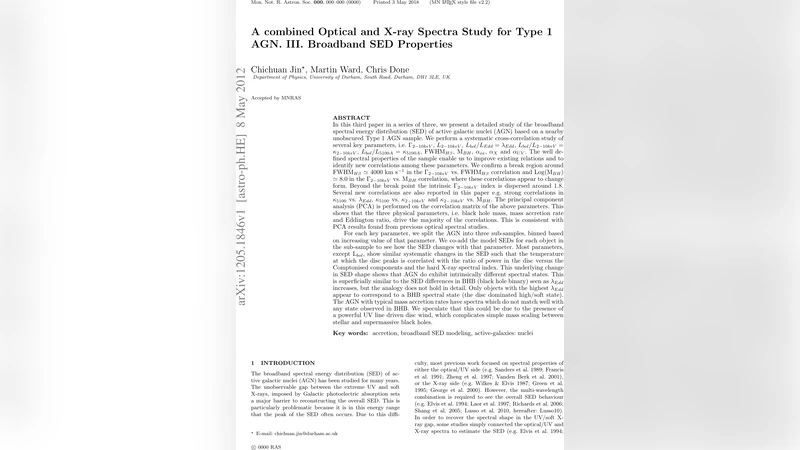
In this third paper in a series of three, we present a detailed study of the AGN broadband SED based on a nearby unobscured Type 1 AGN sample. We perform a systematic cross-correlation study of the following key parameters: $\Gamma_{2-10keV}$, $L_{2-10keV}$, $L_{bol}$, $L_{bol}/L_{Edd}$, $\kappa_{2-10keV}$, $\kappa_{5100A}$, FWHM${H\beta}$, M${BH}$, $\alpha_{ox}$, $\alpha_{X}$ and $\alpha_{UV}$, and identify various strong correlations among these parameters. The principal component analysis (PCA) is performed on the correlation matrix of the above parameters, which shows that the three physical parameters, i.e. black hole mass, mass accretion rate and Eddington ratio, drive the majority of the correlations. This is consistent with PCA results found from previous optical spectral studies. We produce various mean SEDs classified by each of the key parameters. Most parameters, except L${bol}$, show similar systematic changes in the mean SEDs such that the temperature at which the disc peaks is correlated with the ratio of power in the disc versus the Comptonised components and the hard X-ray spectral index. This underlying change in SED shape shows that AGN do exhibit intrinsically different spectral states. This is superficially similar to the SED differences in BHB seen as $\lambda{Edd}$ increases, but the analogy does not hold in detail. Only objects with the highest $\lambda_{Edd}$ appear to correspond to a BHB spectral state (the disc dominated high/soft state). The AGN with typical mass accretion rates have spectra which do not match well with any state observed in BHB. We speculate that this could be due to the presence of a powerful UV line driven disc wind, which complicates simple mass scaling between stellar and supermassive black holes.
💡 Research Summary
This third paper in the series presents a comprehensive analysis of the broadband spectral energy distributions (SEDs) of a well‑defined sample of nearby, unobscured Type 1 active galactic nuclei (AGN). The authors combine high‑quality optical spectra (primarily from the Sloan Digital Sky Survey) with X‑ray data from XMM‑Newton to derive eleven key physical parameters for each source: the 2–10 keV photon index (Γ₂₋₁₀keV), X‑ray luminosity (L₂₋₁₀keV), bolometric luminosity (L_bol), Eddington ratio (λ_Edd = L_bol/L_Edd), bolometric corrections for the X‑ray band (κ₂₋₁₀keV) and the 5100 Å continuum (κ₅₁₀₀Å), the full width at half maximum of Hβ (FWHM_Hβ), black‑hole mass (M_BH), and three spectral slopes (α_ox, α_X, α_UV). By constructing a full correlation matrix among these quantities, the study reveals a network of strong, statistically significant relationships.
Principal component analysis (PCA) applied to the correlation matrix shows that three orthogonal components explain the majority (>80 %) of the variance. The first component is dominated by black‑hole mass, the second by the mass accretion rate (or equivalently L_bol), and the third by the Eddington ratio. This triad of physical drivers reproduces the well‑known “Eigenvector 1” results from earlier optical‑only studies, confirming that the same fundamental parameters govern both line‑based and broadband properties.
To visualize how the SED shape evolves with each parameter, the authors generate mean SEDs for subsamples sorted by narrow bins in each quantity. Except for the absolute bolometric luminosity, all parameters produce systematic trends: as the disc peak temperature rises (indicative of higher accretion rates or lower black‑hole masses), the relative power in the Comptonised hard X‑ray component declines, and the X‑ray photon index steepens. In other words, hotter discs are associated with softer X‑ray spectra and a larger fraction of the total output emerging from the thermal disc. Conversely, broader Hβ lines and larger M_BH shift the SED toward a harder, more X‑ray‑dominated shape.
A central theme of the paper is the comparison with stellar‑mass black‑hole binaries (BHB). By arranging the AGN mean SEDs according to λ_Edd, the authors find that only the highest‑Eddington objects (λ_Edd ≳ 0.1) resemble the disc‑dominated high/soft state of BHBs. The bulk of the sample, with moderate Eddington ratios (0.01 ≲ λ_Edd ≲ 0.1), displays SEDs that do not map cleanly onto any of the canonical BHB states; they occupy an intermediate region where the disc and corona contributions are comparable. This mismatch suggests that simple mass‑scaling arguments—extrapolating BHB phenomenology to supermassive black holes—are insufficient.
The authors propose that a powerful UV line‑driven disc wind, expected to be prominent at high accretion rates, may be responsible for the observed divergence. Such winds can extract angular momentum and energy from the disc surface, alter the vertical structure of the corona, and introduce additional absorption and re‑processing in the UV–X‑ray band. Consequently, the SED of a typical AGN reflects a complex interplay between the thermal disc, the hot corona, and the wind, rather than a straightforward two‑component (disc + corona) model.
In conclusion, the study demonstrates that the broadband SED of Type 1 AGN is primarily governed by three physical parameters—black‑hole mass, mass accretion rate, and Eddington ratio—while secondary effects such as disc winds shape the detailed spectral state. The work underscores the need for multi‑wavelength, high‑resolution observations to disentangle these components and to refine the analogy between AGN and stellar‑mass black‑hole binaries.