Wind braking of magnetars
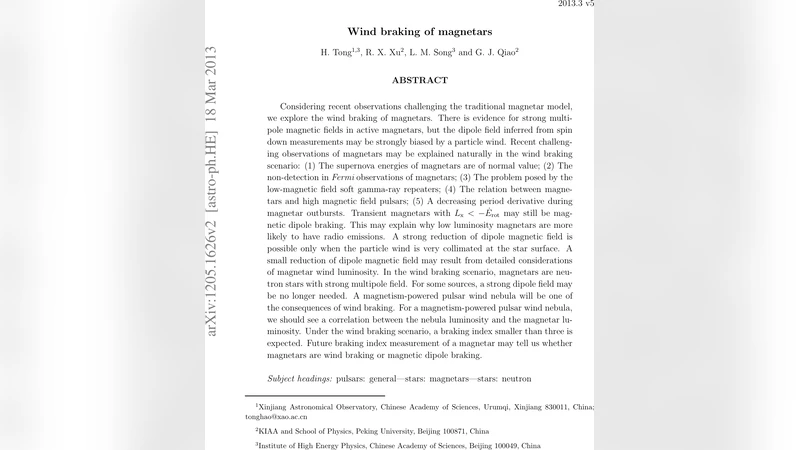
(adapted)Considering recent observations challenging the traditional magnetar model, we explore the wind braking of magnetars. There is evidence for strong multipole magnetic fields in active magnetars, but the dipole field inferred from spin down measurements may be strongly biased by a particle wind. Recent challenging observations of magnetars may be explained naturally in the wind braking scenario: (1) The supernova energies of magnetars are of normal value; (2) The non-detection in Fermi observations of magnetars; (3) The problem posed by the low-magnetic field soft gamma-ray repeaters; (4) The relation between magnetars and high magnetic field pulsars; (5) A decreasing period derivative during magnetar outbursts. Transient magnetars may still be magnetic dipole braking. This may explain why low luminosity magnetars are more likely to have radio emissions. In the wind braking scenario, magnetars are neutron stars with strong multipole field. For some sources, a strong dipole field may be no longer needed. A magnetism-powered pulsar wind nebula and a braking index smaller than three are the two predictions of the wind braking model.
💡 Research Summary
The paper revisits the spin‑down physics of magnetars in light of several recent observations that strain the conventional “high dipole magnetic field” picture. The authors propose that, rather than being braked primarily by vacuum magnetic dipole radiation, magnetars are significantly slowed by a particle wind – a “wind braking” mechanism. In this scenario the neutron star still possesses a very strong multipolar magnetic field that powers its bursting activity, but the large‑scale dipole component inferred from timing measurements can be heavily biased because the outflowing wind exerts an additional torque that dominates over the electromagnetic torque. Consequently, the dipole field derived from the measured period derivative (Ṗ) may be overestimated, and some objects classified as ultra‑magnetized could in fact have moderate dipole fields.
The authors organize their argument around five observational challenges: (1) the kinetic energies of magnetar supernova remnants are comparable to those of ordinary core‑collapse supernovae, contrary to expectations if a very strong dipole field injected extra energy; (2) the lack of GeV–TeV γ‑ray detections of magnetars by the Fermi Large Area Telescope, which would be expected from strong dipole‑driven curvature radiation; (3) the existence of low‑dipole‑field soft gamma‑ray repeaters (e.g., SGR 0418+5729) that still display magnetar‑like bursts; (4) the apparent continuity between high‑magnetic‑field radio pulsars and magnetars in the P–Ṗ diagram; and (5) the observed temporary decrease of Ṗ during magnetar outbursts.
In the wind‑braking framework each of these points finds a natural explanation. A strong multipole field can power bursts while a modest dipole field, together with a vigorous particle wind, accounts for the measured spin‑down. The wind’s dynamical pressure provides a torque that can dominate over the electromagnetic torque, thereby allowing a normal‑energy supernova explosion (point 1) and suppressing high‑energy γ‑ray emission (point 2) because most of the rotational energy is carried away by particles rather than photons. Point 3 is resolved because burst activity is tied to the multipole field, not the dipole strength. Point 4 follows from a continuous distribution of dipole strengths and wind efficiencies: high‑B pulsars with weak winds behave like ordinary dipole rotators, while magnetars with strong winds appear as outliers in the same diagram. Finally, during an outburst the wind luminosity can surge, temporarily reducing the effective braking torque and producing the observed dip in Ṗ (point 5).
The paper presents a simple quantitative model linking the wind mass‑loss rate (ṁ), wind speed (v), and the inferred dipole field (B_d) through B_d ∝ (ṁ v)¹ᐟ². This relation reproduces the observed correlation between Ṗ and the X‑ray/γ‑ray luminosity. Moreover, wind braking predicts a braking index n = Ω̈ Ω / Ω̇² that is systematically less than the canonical value of 3 for pure dipole radiation. Observed values of n ≈ 2–2.5 for several magnetars are consistent with this prediction.
Two key observational signatures are highlighted. First, a “magnetism‑powered pulsar wind nebula” should form as the relativistic wind interacts with the surrounding medium, potentially observable as an extended, non‑thermal X‑ray or radio halo around the magnetar. Second, long‑term timing campaigns should reveal braking indices below three, providing a direct test of the wind‑braking hypothesis.
In conclusion, the authors argue that magnetars are best described as neutron stars with extremely strong internal and multipolar magnetic fields, while the external dipole component may be modest. The wind‑braking model unifies a range of seemingly disparate phenomena—normal supernova energies, γ‑ray non‑detections, low‑dipole SGRs, the magnetar–high‑B pulsar continuum, and outburst timing behavior—within a single physical framework. Future high‑resolution X‑ray imaging, deep radio surveys for wind nebulae, and precise measurements of braking indices will be crucial for testing and refining this paradigm.