A Comprehensive Analysis of Fermi Gamma-ray Burst Data: III. Energy-Dependent T90 Distributions of GBM GRBs and Instrumental Selection Effect on Duration Classification
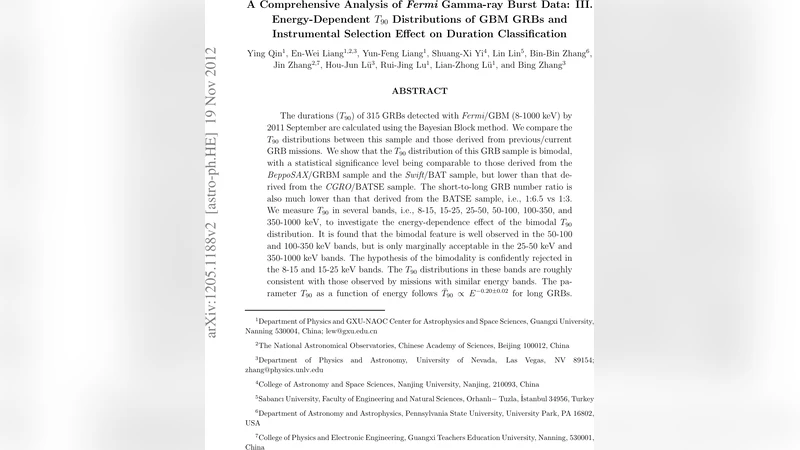
The durations (T90) of 315 GRBs detected with Fermi/GBM (8-1000 keV) by 2011 September are calculated using the Bayesian Block method. We compare the T90 distributions between this sample and those derived from previous/current GRB missions. We show that the T90 distribution of this GRB sample is bimodal, with a statistical significance level being comparable to those derived from the BeppoSAX/GRBM sample and the Swift/BAT sample, but lower than that derived from the CGRO/BATSE sample. The short-to-long GRB number ratio is also much lower than that derived from the BATSE sample, i.e., 1:6.5 vs 1:3. We measure T90 in several bands, i.e., 8-15, 15-25, 25-50, 50-100, 100-350, and 350-1000 keV, to investigate the energy-dependence effect of the bimodal T90 distribution. It is found that the bimodal feature is well observed in the 50-100 and 100-350 keV bands, but is only marginally acceptable in the 25-50 keV and 350-1000 keV bands. The hypothesis of the bimodality is confidently rejected in the 8-15 and 15-25 keV bands. The T90 distributions in these bands are roughly consistent with those observed by missions with similar energy bands. The parameter T90 as a function of energy follows \bar T90 \propto E^{-0.20\pm 0.02} for long GRBs. Considering the erratic X-ray and optical flares, the duration of a burst would be even much longer for most GRBs. Our results, together with the observed extended emission of some short GRBs, indicate that the central engine activity time scale would be much longer than T90} for both long and short GRBs and the observed bimodal T90 distribution may be due to an instrumental selection effect.
💡 Research Summary
The paper presents a systematic study of the duration (T90) distribution of gamma‑ray bursts (GRBs) detected by the Fermi Gamma‑ray Burst Monitor (GBM) up to September 2011. Using the Bayesian Block algorithm, the authors re‑measure T90 for 315 GRBs in the 8–1000 keV band and compare the resulting distribution with those obtained from earlier missions such as CGRO/BATSE, BeppoSAX/GRBM, and Swift/BAT. The overall GBM T90 distribution is bimodal, but the statistical significance of the two peaks is lower than that reported for BATSE and comparable to the BeppoSAX and Swift samples. Notably, the short‑to‑long GRB ratio in the GBM sample is 1:6.5, considerably smaller than the 1:3 ratio found in the BATSE catalog, indicating a relative deficit of short bursts in the GBM data set.
To explore the role of instrumental selection effects, the authors divide the GBM energy range into six sub‑bands (8–15, 15–25, 25–50, 50–100, 100–350, and 350–1000 keV) and recompute T90 for each band. The bimodal structure is robust in the 50–100 keV and 100–350 keV bands, marginal in the 25–50 keV and 350–1000 keV bands, and disappears entirely in the lowest two bands (8–15 keV and 15–25 keV). This pattern mirrors the energy‑dependent sensitivity of the detector: low‑energy photons are more abundant in the long‑duration tail, while high‑energy photons dominate the short, sharp spikes. Consequently, short GRBs are under‑detected at low energies, and the paucity of events at the highest energies limits statistical power.
The authors quantify the energy dependence of the average duration for long GRBs, finding ⟨T90⟩ ∝ E⁻⁰·²⁰ ± 0.02. This inverse power‑law indicates that as photon energy increases, the measured duration shortens, consistent with the notion that high‑energy emission is temporally more concentrated. They also discuss that X‑ray and optical flares, which often occur well after the prompt gamma‑ray phase, imply that the true central‑engine activity time can be substantially longer than the measured T90. Moreover, some short GRBs exhibit extended emission, further blurring the distinction between short and long categories.
Putting these results together, the paper argues that the observed bimodality in T90 is largely a product of instrumental selection rather than an intrinsic dichotomy in the GRB population. The detection thresholds, trigger algorithms, and energy bandpasses of different satellites shape which bursts are recorded and how their durations are measured. Consequently, classifying GRBs solely on the basis of T90—especially when using data from instruments with disparate energy sensitivities—can be misleading. The authors advocate for a more nuanced approach that incorporates central‑engine activity indicators, multi‑wavelength afterglow behavior, and energy‑dependent duration corrections. Such an approach would provide a more physically meaningful taxonomy of GRBs and improve our understanding of the underlying progenitor systems.