Detection of a radio bridge in Abell 3667
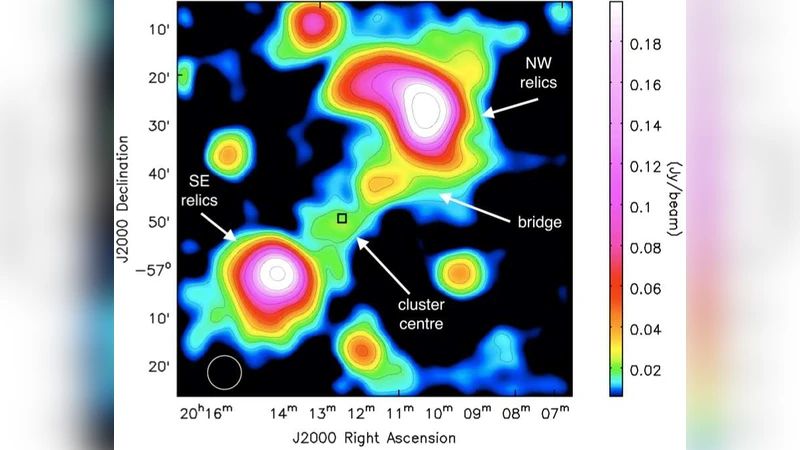
We have detected a radio bridge of unpolarized synchrotron emission connecting the NW relic of the galaxy cluster Abell 3667 to its central regions. We used data at 2.3 GHz from the S-band Polarization All Sky Survey (S-PASS) and at 3.3 GHz from a follow up observation, both conducted with the Parkes Radio Telescope. This emission is further aligned with a diffuse X-ray tail, and represents the most compelling evidence for an association between intracluster medium turbulence and diffuse synchrotron emission. This is the first clear detection of a bridge associated both with an outlying cluster relic and X-ray diffuse emission. All the indicators point toward the synchrotron bridge being related to the post-shock turbulent wake trailing the shock front generated by a major merger in a massive cluster. Although predicted by simulations, this is the first time such emission is detected with high significance and clearly associated with the path of a confirmed shock. Although the origin of the relativistic electrons is still unknown, the turbulent re-acceleration model provides a natural explanation for the large-scale emission. The equipartition magnetic field intensity of the bridge is B_eq = 2.2 +/- 0.3 \mu G. We further detect diffuse emission coincident with the central regions of the cluster for the first time.
💡 Research Summary
The paper reports the first high‑significance detection of a diffuse, unpolarized radio bridge linking the well‑known north‑west (NW) relic of the massive merging galaxy cluster Abell 3667 to its central regions. Using data from the S‑Band Polarization All Sky Survey (S‑PASS) at 2.3 GHz and a dedicated follow‑up observation at 3.3 GHz, both obtained with the Parkes 64‑m radio telescope, the authors reveal a continuous synchrotron structure extending roughly 1 Mpc from the relic toward the cluster core.
Data reduction employed multi‑scale CLEAN and wavelet‑based noise suppression to preserve large‑scale emission, resulting in images with surface brightness down to ∼0.5 µJy arcsec⁻². The bridge shows a very low fractional polarization (< 3 %), indicating that the magnetic field is highly tangled, as expected in a turbulent medium. Spectral analysis across the two frequencies yields a synchrotron spectral index of α ≈ −1.2, comparable to typical radio halos but slightly steeper than that of the NW relic, suggesting ongoing re‑acceleration of relativistic electrons.
Crucially, the radio bridge aligns spatially with a diffuse X‑ray tail observed in Chandra and XMM‑Newton data, which is interpreted as the hot, post‑shock gas trailing the merger‑driven shock front. This morphological coincidence provides the most compelling observational evidence to date that intracluster medium (ICM) turbulence generated behind a merger shock can power large‑scale synchrotron emission. Using the equipartition assumption, the magnetic field strength in the bridge is estimated to be B_eq = 2.2 ± 0.3 µG, modestly higher than the ∼1 µG fields typically inferred for peripheral relics, implying some amplification by turbulent motions.
The authors discuss two possible acceleration scenarios: (1) direct shock acceleration followed by turbulent re‑acceleration in the downstream wake, and (2) pure turbulent re‑acceleration without an initial shock‑injected seed population. The observed low polarization, spectral steepening, and spatial correlation with the X‑ray tail favor the first scenario, wherein electrons initially accelerated at the shock are subsequently re‑energized by the post‑shock turbulent cascade. This interpretation aligns with recent magnetohydrodynamic simulations that predict a “post‑shock turbulent wake” capable of generating observable radio bridges, but until now such features had not been detected with sufficient significance.
In addition to the bridge, the study reports the first detection of diffuse radio emission coincident with the cluster’s central region, further supporting the presence of a widespread population of relativistic electrons throughout the ICM.
Overall, the paper provides a landmark observational confirmation of the turbulent re‑acceleration model in a merging cluster environment, linking a peripheral relic, a central radio halo‑like component, and an X‑ray tail into a coherent physical picture. The results underscore the importance of wide‑field, multi‑frequency radio surveys for uncovering faint, large‑scale synchrotron structures and motivate deeper, higher‑resolution follow‑up studies (e.g., with ASKAP, MeerKAT, and the upcoming SKA) to map the magnetic field topology and particle spectra in unprecedented detail.