Fluid depletion in shear bands
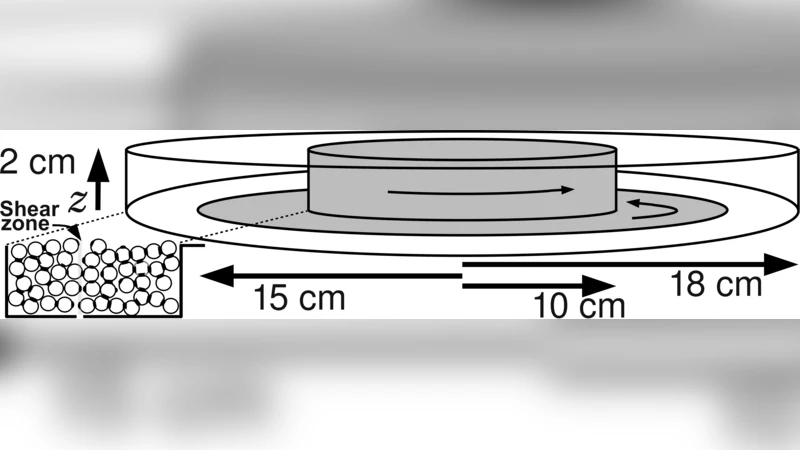
How does pore liquid reconfigure within shear bands in wet granular media? Conventional wisdom predicts that liquid is drawn into dilating granular media. We, however, find a depletion of liquid in shear bands despite increased porosity due to dilatancy. This apparent paradox is resolved by a microscale model for liquid transport at low liquid contents induced by rupture and reconfiguration of individual liquid bridges. Measured liquid content profiles show macroscopic depletion bands similar to results of numerical simulations. We derive a modified diffusion description for rupture-induced liquid migration.
💡 Research Summary
The paper investigates an unexpected phenomenon in wet granular media: despite dilatancy‑induced increase in porosity, the liquid content inside shear bands is reduced rather than enhanced. Using a combination of transparent‑particle shear experiments, X‑ray computed tomography, and discrete‑element simulations, the authors demonstrate that low‑water‑content systems (where liquid exists primarily as capillary bridges) develop macroscopic depletion zones that align with the shear band. The key insight is that shear‑induced rearrangements cause frequent rupture of individual liquid bridges. When a bridge breaks, its liquid is not drawn into the expanding void but is instead redistributed onto the surfaces of neighboring particles, effectively “spilling” the liquid out of the shear zone. This rupture‑driven transport dominates over the conventional diffusion driven by porosity gradients.
To capture this mechanism, the authors formulate a rupture‑induced diffusion equation: ∂c/∂t = ∇·