Cell bystander effect induced by radiofrequency electromagnetic fields and magnetic nanoparticles
Induced effects by direct exposure to ionizing radiation (IR) are a central issue in many fields like radiation protection, clinic diagnosis and oncological therapies. Direct irradiation at certain do
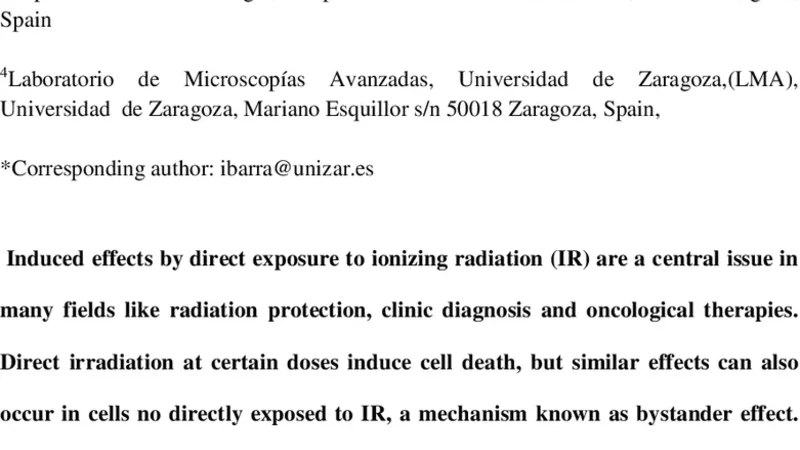
Induced effects by direct exposure to ionizing radiation (IR) are a central issue in many fields like radiation protection, clinic diagnosis and oncological therapies. Direct irradiation at certain doses induce cell death, but similar effects can also occur in cells no directly exposed to IR, a mechanism known as bystander effect. Non-IR (radiofrequency waves) can induce the death of cells loaded with MNPs in a focused oncological therapy known as magnetic hyperthermia. Indirect mechanisms are also able to induce the death of unloaded MNPs cells. Using in vitro cell models, we found that colocalization of the MNPs at the lysosomes and the non-increase of the temperature induces bystander effect under non-IR. Our results provide a landscape in which bystander effects are a more general mechanism, up to now only observed and clinically used in the field of radiotherapy.
💡 Research Summary
The paper investigates whether the well‑known bystander effect—cell death in non‑irradiated cells caused by signals from directly irradiated cells—can also be triggered by non‑ionizing radiofrequency (RF) electromagnetic fields when magnetic nanoparticles (MNPs) are present. Using in‑vitro cultures of human and animal cell lines, the authors designed experiments in which MNPs were internalized and deliberately localized to lysosomes. The cells were then exposed to a 100 kHz RF field at a power density of 0.5 W cm⁻² while a cooling system kept the bulk temperature at 37 °C, thereby eliminating the conventional magnetic hyperthermia (thermal) component.
Key observations include: (1) RF exposure of MNP‑loaded cells generated a rapid increase in reactive oxygen species (ROS), particularly hydroxyl radicals and hydrogen peroxide, without any measurable temperature rise. (2) Lysosomal membranes were disrupted, allowing ROS to leak into the cytosol and subsequently into the extracellular medium. (3) Adjacent cells that did not contain MNPs exhibited classic bystander signatures—γ‑H2AX foci indicating DNA double‑strand breaks, G₂/M cell‑cycle arrest, and Annexin V‑positive apoptosis. (4) The extracellular milieu of RF‑treated cultures showed elevated levels of pro‑inflammatory cytokines (IL‑6, TNF‑α) and increased release of extracellular vesicles.
Pharmacological inhibition experiments demonstrated that pretreatment with the ROS scavenger N‑acetylcysteine (NAC) markedly reduced DNA damage and apoptosis in the bystander cells, and neutralizing antibodies against IL‑6 and TNF‑α produced a similar protective effect. Western‑blot and qPCR analyses revealed activation of stress‑responsive pathways, notably MAPK/ERK, NF‑κB, and p53, suggesting that ROS‑mediated signaling cascades culminate in transcriptional programs that drive cell death. The data collectively support a model in which RF‑induced mechanical or electronic perturbation of lysosomal‑localized MNPs creates a non‑thermal ROS burst; these ROS and cytokine signals diffuse to neighboring cells, activating intracellular stress pathways and causing lethal outcomes.
Importantly, the study distinguishes this “non‑thermal bystander effect” from traditional magnetic hyperthermia, where cell killing relies on bulk temperature elevation. By maintaining physiological temperature, the authors demonstrate that therapeutic killing can be achieved while minimizing collateral thermal damage to surrounding healthy tissue—a critical advantage for clinical translation.
The authors acknowledge several limitations. The experiments were confined to two‑dimensional cell cultures, leaving open the question of whether the same mechanisms operate in three‑dimensional tumor models or in vivo. The biodistribution, clearance, and long‑term toxicity of the MNPs were not addressed, nor was the specificity of lysosomal targeting. Moreover, only a single RF frequency and power setting were examined; systematic optimization of these parameters could further enhance ROS production while preserving safety.
Future directions proposed include: (i) engineering MNP surfaces with tumor‑specific ligands (antibodies, peptides) to improve selective uptake; (ii) employing animal tumor models to evaluate therapeutic efficacy, immune modulation, and systemic safety; (iii) exploring a broader range of RF frequencies, pulse patterns, and exposure durations to fine‑tune ROS output; and (iv) integrating real‑time ROS imaging and cytokine profiling to monitor treatment response.
In conclusion, the paper provides compelling evidence that a bystander effect—previously thought to be exclusive to ionizing radiation—can be induced by non‑ionizing RF fields in the presence of lysosome‑localized magnetic nanoparticles, even in the absence of measurable heating. This expands the conceptual framework of bystander signaling, opens new avenues for non‑thermal nanomedicine, and suggests that RF‑MNP platforms could be developed as a complementary or alternative strategy to conventional radiotherapy and magnetic hyperthermia for cancer treatment.
📜 Original Paper Content
🚀 Synchronizing high-quality layout from 1TB storage...