A Chandra observation of the ultraluminous infrared galaxy IRAS 19254--7245 (the Superantennae): X-ray emission from the Compton-thick AGN and the diffuse starburst
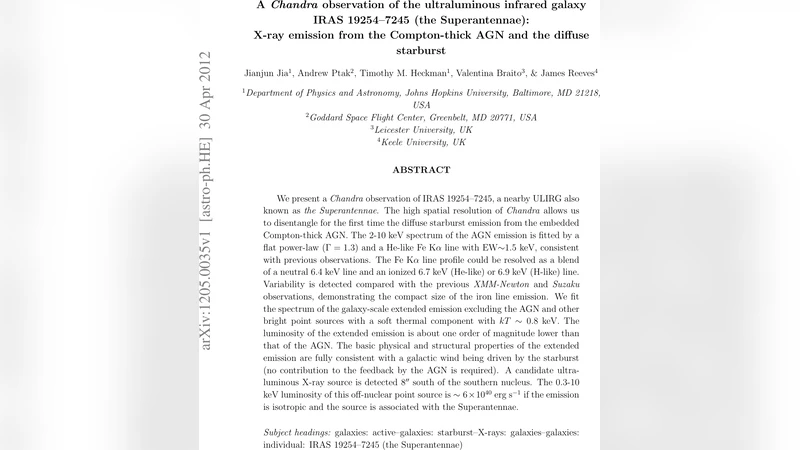
We present a {\it Chandra} observation of IRAS 19254–7245, a nearby ULIRG also known as {\it the Superantennae}. The high spatial resolution of {\it Chandra} allows us to disentangle for the first time the diffuse starburst emission from the embedded Compton-thick AGN. The 2-10 keV spectrum of the AGN emission is fitted by a flat power-law $\Gamma=1.3$) and a He-like Fe K$\alpha$ line with EW$\sim$1.5 keV, consistent with previous observations. The Fe K$\alpha$ line profile could be resolved as a blend of a neutral 6.4 keV line and an ionized 6.7 keV (He-like) or 6.9 keV (H-like) line. Variability is detected compared with the previous {\it XMM-Newton} and {\it suzaku} observations, demonstrating the compact size of the iron line emission. We fit the spectrum of the galaxy-scale extended emission excluding the AGN and other bright point sources with a soft thermal component with kT~0.8 keV. The luminosity of the extended emission is about one order of magnitude lower than that of the AGN. The basic physical and structural properties of the extended emission are fully consistent with a galactic wind being driven by the starburst (no contribution to the feedback by the AGN is required). A candidate ultra-luminous X-ray source is detected 8\arcsec\ south of the southern nucleus. The 0.3-10 keV luminosity of this off-nuclear point source is ~$6\times 10^{40}$ erg s$^{-1}$ if the emission is isotropic and the source is associated with the Superantennae.
💡 Research Summary
We present a deep Chandra ACIS‑S observation of the nearby ultra‑luminous infrared galaxy IRAS 19254‑7245, commonly called the “Superantennae”. The sub‑arcsecond imaging capability of Chandra allows, for the first time, a clean separation between the compact, heavily obscured active galactic nucleus (AGN) and the diffuse, galaxy‑wide starburst emission.
The nuclear spectrum (extracted from a 2″ radius region) is dominated by a very flat 2–10 keV continuum (photon index Γ ≈ 1.3 ± 0.2) and a strong Fe Kα line with an equivalent width of ≈1.5 keV. Detailed line fitting reveals that the profile is best described by a blend of a neutral 6.4 keV component and an ionized component at either 6.7 keV (He‑like Fe) or 6.9 keV (H‑like Fe). Compared with earlier XMM‑Newton and Suzaku observations, the 2–10 keV flux has dropped by roughly 30 % and the line intensity shows a similar decline, indicating that the iron‑line emitting region is compact (size ≲ a few light‑years) and varies on timescales of a few years. These characteristics are fully consistent with a Compton‑thick AGN whose observed hard X‑ray emission is dominated by reflected/scattered light.
When the nuclear contribution and other bright point sources are excluded, the remaining extended emission (out to ≈10–15 kpc) is well described by a single thermal plasma (APEC) with kT ≈ 0.8 keV, sub‑solar metallicity (≈0.6 Z⊙) and modest intrinsic absorption (N_H ≈ 3 × 10²¹ cm⁻²). The soft X‑ray luminosity of this component is L_0.5‑2 keV ≈ 5 × 10⁴¹ erg s⁻¹, about an order of magnitude lower than the AGN’s hard X‑ray output. The temperature, luminosity, and spatial extent match expectations for a galactic‑scale wind driven by the intense starburst, requiring no additional mechanical input from the AGN.
In addition to the nucleus, five off‑nuclear point sources are detected. One of them, located 8″ south of the southern nucleus, has a 0.3‑10 keV luminosity of ≈6 × 10⁴⁰ erg s⁻¹ (assuming isotropic emission). This luminosity exceeds that of typical supernova remnants and places the source in the ultra‑luminous X‑ray source (ULX) regime, suggesting it may be an accreting stellar‑mass black hole or neutron star in a high‑mass X‑ray binary.
The paper discusses the implications of these findings for the co‑evolution of AGN and starburst activity in ULIRGs. The flat, heavily absorbed nuclear spectrum and the strong, variable Fe Kα line confirm the presence of a buried, Compton‑thick AGN. The resolved soft thermal component demonstrates that the bulk of the galaxy‑scale X‑ray output is powered by starburst‑driven outflows, with no need to invoke AGN‑driven feedback at the current epoch. The detection of a ULX candidate adds to the growing evidence that intense star formation environments also host a population of extreme X‑ray binaries.
Overall, the Chandra observation provides a benchmark case where high‑resolution X‑ray imaging disentangles the intertwined contributions of a hidden AGN and a powerful starburst, offering valuable constraints on the energy budget, feedback processes, and evolutionary stage of a prototypical ULIRG.