The multi-messenger picture of compact object encounters: binary mergers versus dynamical collisions
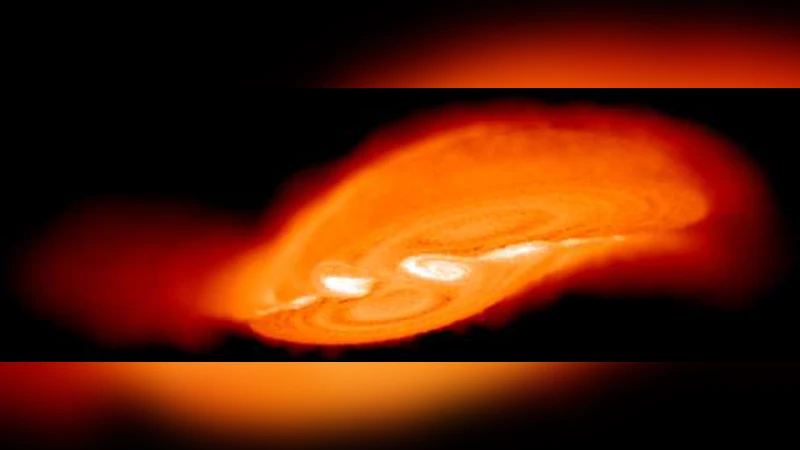
We explore the multi-messenger signatures of encounters between two neutron stars and between a neutron star and a stellar-mass black hole. We focus on the differences between gravitational wave driven binary mergers and dynamical collisions that occur, for example, in globular clusters. For both types of encounters we compare the gravitational wave and neutrino emission properties. We also calculate fallback rates and analyze the properties of the dynamically ejected matter. Last but not least we address the electromagnetic transients that accompany each type of encounter. The canonical nsns merger case ejects more than 1% of a solar mass of extremely neutron-rich ($Y_e\sim 0.03$) material, an amount that is consistent with double neutron star mergers being a major source of r-process in the galaxy. nsbh collisions eject very large amounts of matter ($\sim 0.15$ \msun) which seriously constrains their admissible occurrence rates. The compact object collision rate must therefore be less, likely much less, than 10% of the nsns merger rate. The radioactively decaying ejecta produce optical-UV “macronova” which, for the canonical merger case, peak after $\sim 0.4$ days with a luminosity of $\sim 10^{42}$ erg/s. nsns (nsbh) collisions reach up to 3 (7) times larger peak luminosities. The dynamic ejecta deposit a kinetic energy comparable to a supernova in the ambient medium. The canonical merger case releases approximately $2 \times 10^{50}$ erg, the most extreme (but likely rare) cases deposit kinetic energies of up to $10^{52}$ erg. The deceleration of this mildly relativistic material by the ambient medium produces long lasting radio flares. A canonical ns$^2$ merger at the detection horizon of advanced LIGO/Virgo produces a radio flare that peaks on a time scale of one year with a flux of $\sim$0.1 mJy at 1.4 GHz.
💡 Research Summary
This paper presents a comprehensive multi‑messenger study of compact‑object encounters, focusing on two distinct channels: (1) gravitational‑wave‑driven binary mergers of neutron‑star–neutron‑star (NS‑NS) systems and neutron‑star–black‑hole (NS‑BH) systems, and (2) dynamical collisions that can occur in dense stellar environments such as globular clusters. Using three‑dimensional hydrodynamic simulations with realistic equations of state, neutrino transport, and nuclear‑reaction networks, the authors quantify the gravitational‑wave (GW) signatures, neutrino emission, fallback accretion rates, properties of dynamically ejected matter, and the resulting electromagnetic transients (optical/UV macronovae and long‑lasting radio flares).
Key results for the canonical NS‑NS merger are as follows. About 1 % or more of a solar mass (≈0.02 M⊙) is expelled in a highly neutron‑rich outflow with an electron fraction Ye≈0.03. This composition is ideal for a robust r‑process, supporting the hypothesis that NS‑NS mergers are a major source of heavy elements in the Milky Way. The merger emits a GW chirp detectable by advanced LIGO/Virgo, and a burst of neutrinos with a total energy ≈10⁵³ erg released over ≈10 ms. The radioactive decay of the ejecta powers an optical‑UV macronova that peaks after ∼0.4 days with a bolometric luminosity of ∼10⁴² erg s⁻¹ and a temperature of a few thousand kelvin. The kinetic energy carried by the ejecta is ≈2 × 10⁵⁰ erg, comparable to a faint supernova. Interaction with the interstellar medium (ISM) generates a mildly relativistic blast wave that produces a radio flare peaking at ∼1 year post‑merger, with a flux of ≈0.1 mJy at 1.4 GHz for a source at the advanced‑detector horizon (≈200 Mpc).
In contrast, dynamical NS‑BH collisions eject dramatically larger masses, up to ≈0.15 M⊙, because the black hole’s tidal field can shred the neutron star efficiently. The ejecta remain neutron‑rich but the larger mass leads to macronovae that are 3–7 times brighter than the canonical merger case, with peak luminosities approaching a few × 10⁴² erg s⁻¹ and slightly longer rise times. The kinetic energy deposited into the ISM can reach 10⁵² erg in the most extreme (though rare) collisions, implying radio flares that may be several milli‑jansky and last for many years. However, such massive ejecta would over‑produce r‑process material if collisions were common; therefore the authors argue that the rate of compact‑object collisions must be less than ≈10 % of the NS‑NS merger rate, likely much lower.
The paper also compares neutrino emission between the two channels. Both produce ∼10⁵³ erg of neutrino energy, but collisions generate slightly higher average neutrino energies and a more sharply peaked temporal profile, offering a potential discriminant for next‑generation neutrino observatories (IceCube‑Gen2, Hyper‑Kamiokande).
Finally, the authors emphasize the power of a coordinated multi‑messenger approach. Detecting a GW signal together with a short‑timescale macronova and a year‑scale radio flare would uniquely identify a binary merger, while a brighter, longer‑lasting macronova and a more energetic, prolonged radio afterglow would point to a dynamical collision. By combining the observed rates of such transients with the GW detection statistics, one can place stringent constraints on the fraction of encounters that are dynamical collisions, thereby refining models of globular‑cluster dynamics and the contribution of compact‑object collisions to galactic chemical evolution.