Accretion flow dynamics during the evolution of timing and spectral properties of GX 339-4 during its 2010-11 outburst
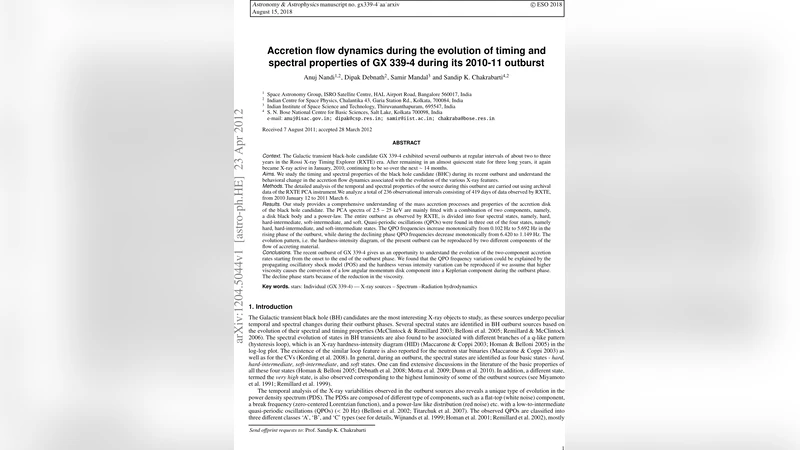
The Galactic black-hole candidate GX 339-4 exhibited several outbursts at regular intervals of \sim 2-3 years in the Rossi X-ray Timing Explorer (RXTE) era. After remaining in an almost quiescent state for 3 years, it again became X-ray active in 2010 January, continuing to be so over the next \sim 14 months. We study the timing and spectral properties of the black hole candidate (BHC) during its recent outburst using RXTE PCA data, starting from 2010 January 12 to 2011 March 6. Our study provides a comprehensive understanding of the mass accretion processes and properties of the accretion disk of the black hole candidate. The PCA spectra of 2.5-25 keV are mainly fitted with a combination of two components, namely, a disk black body and a power-law. The entire outburst as observed by RXTE, is divided into 4 spectral states, namely, hard, hard-intermediate, soft-intermediate, and soft. Quasi-periodic oscillations (QPOs) were found in 3 out of the 4 states, namely hard, hard-intermediate, and soft-intermediate. The QPO frequencies increase monotonically from 0.102 Hz to 5.692 Hz in the rising phase of the outburst, while during the declining phase QPO frequencies decrease monotonically from 6.420 to 1.149 Hz. The recent outburst of GX 339-4 gives us an opportunity to understand the evolution of the two-component accretion rates starting from the onset to the end of the outburst phase. We found that the QPO frequency variation could be explained by the propagating oscillatory shock model (POS) and the hardness versus intensity variation can be reproduced if we assume that higher viscosity causes the conversion of a low angular momentum disk component into a Keplerian component during the outburst phase. The decline phase starts because of the reduction in the viscosity.
💡 Research Summary
The authors present a comprehensive study of the 2010‑11 outburst of the Galactic black‑hole candidate GX 339‑4 using data from the Rossi X‑ray Timing Explorer (RXTE) Proportional Counter Array (PCA). The analysis covers the entire active interval from 2010 January 12 (MJD 55208) to 2011 March 6 (MJD 55630), encompassing roughly 14 months of observations. After a three‑year quiescent period, GX 339‑4 entered a bright phase that allowed the authors to track the evolution of both its timing and spectral properties in unprecedented detail.
Data reduction followed standard HEASOFT procedures. Light curves were extracted in the 2.5–25 keV band, background subtracted, and binned at 16 s resolution for timing analysis. Power density spectra (PDS) were computed via Fast Fourier Transform (FFT) techniques, and quasi‑periodic oscillations (QPOs) were identified by fitting Lorentzian components. QPOs were detected only in three of the four spectral states (hard, hard‑intermediate, and soft‑intermediate). Their centroid frequencies increased monotonically from 0.102 Hz at the onset of the rise to 5.692 Hz near the peak, and then decreased from 6.420 Hz to 1.149 Hz during the decline, displaying a characteristic hysteresis.
Spectral modeling employed XSPEC with a two‑component phenomenological model: a multicolor disk blackbody (diskbb) plus a power‑law. Additional Gaussian (Fe Kα) and smeared edge components were added when statistically required. In the hard state the power‑law photon index Γ remained low (≈1.5–1.7) and the disk temperature T_in was ≈0.2 keV, indicating a faint, truncated disk. Transition to the hard‑intermediate state saw Γ soften to ≈2.0–2.2, while T_in and the disk normalization rose sharply, implying that the Keplerian disk moved inward. In the soft‑intermediate and soft states the spectrum became disk‑dominated, with Γ≈2.4–2.6 and T_in≈0.6–0.8 keV, and the disk contributed the majority of the 2.5–25 keV flux.
To interpret the observed evolution, the authors applied the two‑component advective flow (TCAF) framework, which treats the accretion flow as a combination of a high‑angular‑momentum Keplerian disk (ṁ_d) and a low‑angular‑momentum sub‑Keplerian halo (ṁ_h). By fitting the spectral parameters across the outburst, they derived time‑dependent accretion rates for both components. During the rising phase, an increase in the effective viscosity parameter α is inferred, which converts a larger fraction of the sub‑Keplerian flow into a Keplerian disk, raising the ṁ_d/ṁ_h ratio. This conversion coincides with the rapid rise of the QPO frequency, the softening of the power‑law, and the increase of the disk temperature. In the decline phase, α diminishes, the Keplerian component recedes, and the sub‑Keplerian halo regains dominance, driving the source back to the hard state.
The evolution of the QPO frequencies was quantitatively modeled using the propagating oscillatory shock (POS) scenario. In this picture, a standing shock forms in the sub‑Keplerian flow; its radial position X_s oscillates and slowly drifts inward (outward) during the rise (decline). The QPO frequency is inversely proportional to the infall time from the shock to the event horizon, so as X_s moves from ≈150 R_g to ≈30 R_g the frequency climbs from ≈0.1 Hz to ≈6 Hz, reproducing the observed trend. The model also accounts for the observed Q‑factor and rms amplitude variations.
The paper concludes that the combined TCAF and POS frameworks provide a self‑consistent physical description of the GX 339‑4 outburst. The increase and subsequent decrease of viscosity control the conversion between sub‑Keplerian and Keplerian flows, dictating the spectral state transitions, while the dynamics of the shock front govern the QPO evolution. This work demonstrates how detailed timing‑spectral studies of a single outburst can illuminate the underlying accretion physics of black‑hole X‑ray binaries, and it highlights the need for future multi‑wavelength campaigns and numerical simulations to refine the viscosity‑shock coupling mechanisms.