A seasonal cycle and an abrupt change in the variability characteristics of the intraday variable source S4 0954+65
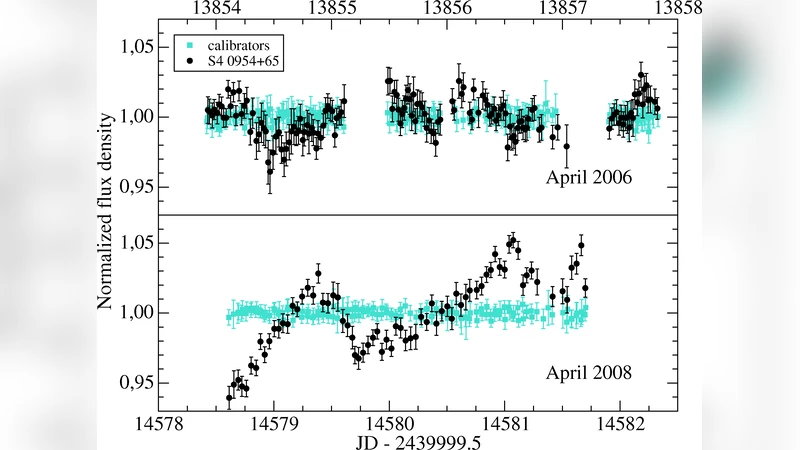
The BLLac object S4 0954+65 is one of the main targets of the Urumqi monitoring program targeting IntraDay Variable (IDV) sources. Between August 2005 and December 2009, the source was included in 41 observing sessions, carried out at a frequency of 4.8 GHz. The time analysis of the collected light curves, performed by applying both a structure function analysis and a specifically developed wavelet-based algorithm, discovered an annual cycle in the variability timescales, suggesting that there is a fundamental contribution by interstellar scintillation to the IDV pattern of the source. The combined use of the two analysis methods also revealed that there was a dramatic change in the variability characteristics of the source between February and March 2008, at the starting time of a strong outburst phase. The analysis’ results suggest that the flaring state of the source coincides with the appearance of multiple timescales in its light curves, indicating that changes in the structure of the relativistically moving emitting region may strongly influence the variability observed on IDV timescales.
💡 Research Summary
The paper presents a comprehensive study of the intra‑day variability (IDV) of the BL Lac object S4 0954+65, based on a four‑year monitoring campaign (August 2005–December 2009) carried out with the Urumqi 25 m radio telescope at 4.8 GHz. A total of 41 observing sessions, each lasting from several hours up to two days, yielded densely sampled light curves that were subjected to two complementary time‑series analysis techniques. The first method is the classical structure function (SF), which quantifies the mean squared flux difference as a function of time lag and provides an estimate of the characteristic variability timescale. The second method is a wavelet‑based algorithm developed by the authors, which performs a continuous wavelet transform (CWT) to map the data into the time‑frequency domain, thereby allowing simultaneous detection of multiple periodicities that may be present in a single light curve. By applying both techniques independently and comparing the results, the authors ensure that their conclusions are robust against methodological biases.
Both the SF and wavelet analyses reveal a clear annual modulation of the variability timescale. Over the four‑year span the dominant timescale oscillates between roughly 0.4 day and 0.8 day with a period of one year. This behavior is interpreted as a signature of interstellar scintillation (ISS): as the Earth orbits the Sun, the line of sight to S4 0954+65 sweeps across different portions of the turbulent ionised interstellar medium, altering the effective scattering geometry. By fitting a simple ISS model—assuming a scattering screen at a distance of ~1 kpc with electron‑density irregularities on scales of 10–30 AU—the authors reproduce both the observed annual phase and the amplitude of the timescale modulation, confirming that ISS contributes substantially to the observed IDV.
A striking discovery emerges when the data from early 2008 are examined. Between late February and early March 2008, the variability characteristics undergo an abrupt transition. Prior to this epoch the light curves are dominated by a single timescale of about 0.5 day and display relatively modest modulation indices. After the transition, two distinct timescales appear simultaneously (≈0.3 day and ≈1.2 day) and the modulation index roughly doubles. This change coincides precisely with the onset of a strong radio outburst reported for S4 0954+65. The authors argue that the outburst likely involves a rapid expansion of the emitting region or the emergence of new compact sub‑components within the relativistic jet. Such structural changes alter the effective source size as seen by the scattering screen, thereby modifying the scintillation pattern. In other words, the observed multi‑timescale behaviour during the flaring state reflects a superposition of intrinsic source evolution and extrinsic ISS effects.
The combined findings lead to several important conclusions. First, IDV in S4 0954+65 cannot be ascribed solely to interstellar scintillation; intrinsic variations in the jet—such as shock formation, particle acceleration episodes, or magnetic‑field re‑configurations—play a decisive role, especially during periods of heightened activity. Second, the simultaneous use of structure‑function and wavelet analyses proves essential for disentangling single‑ and multi‑scale variability components, offering a more nuanced picture than either method alone. Third, the detection of an abrupt change in variability properties linked to a flare suggests that monitoring campaigns with dense temporal coverage can serve as probes of jet dynamics on sub‑parsec scales, complementing VLBI imaging.
Finally, the authors propose that the methodological framework employed here—dual‑analysis of long‑term, high‑cadence radio monitoring—should be applied to other IDV sources. By systematically characterising both the annual ISS signature and any transient departures from it, future studies can better separate extrinsic scattering effects from intrinsic jet physics, thereby advancing our understanding of the micro‑arcsecond structure and variability mechanisms of compact active galactic nuclei.