Tilted black hole accretion disc models of Sagittarius A*: time-variable millimetre to near-infrared emission
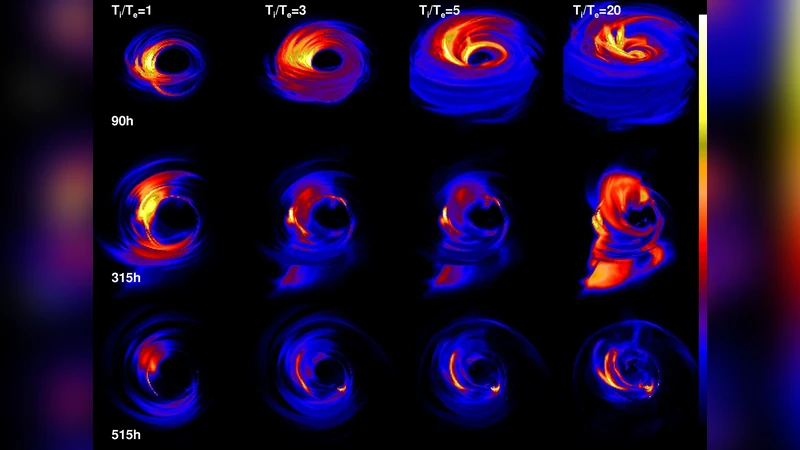
High-resolution, multi-wavelength, and time-domain observations of the Galactic centre black hole candidate, Sgr A*, allow for a direct test of contemporary accretion theory. To date, all models have assumed alignment between the accretion disc and black hole angular momentum axes, but this is unjustified for geometrically thick accretion flows like that onto Sgr A*. Instead, we calculate images and spectra from a set of simulations of accretion flows misaligned (’tilted’) by 15 degrees from the black hole spin axis and compare them with millimetre (mm) to near-infrared (NIR) observations. Non-axisymmetric standing shocks from eccentric fluid orbits dominate the emission, leading to a wide range of possible image morphologies. These effects invalidate previous parameter estimates from model fitting, including estimates of the dimensionless black hole spin, except possibly at low values of spin or tilt. At 1.3mm, the images have crescent morphologies, and the black hole shadow may still be accessible to future mm-VLBI observations. Shock heating leads to high energy electrons (T > 10^12 K), which can naturally produce the observed NIR flux, spectral index, and rapid variability (‘flaring’). This NIR emission is uncorrelated with that in the mm, which also agrees with observations. These are the first models to self-consistently explain the time-variable mm to NIR emission of Sgr A*. Predictions of the model include significant structural changes observable with mm-VLBI on both the dynamical (hour) and Lense-Thirring precession (day-year) timescales; and ~30-50 microarcsecond changes in centroid position from extreme gravitational lensing events during NIR flares, detectable with the future VLT instrument GRAVITY. If the observed NIR emission is caused by shock heating in a tilted accretion disc, then the Galactic centre black hole has a positive, non-zero spin parameter (a > 0).
💡 Research Summary
The paper presents a comprehensive study of the Galactic‑center black hole candidate Sgr A* that challenges the long‑standing assumption of alignment between the black‑hole spin axis and the angular momentum of its accretion flow. Using three‑dimensional general‑relativistic magnetohydrodynamic (GRMHD) simulations, the authors model a geometrically thick, radiatively inefficient accretion disc tilted by 15° with respect to the spin axis. This modest tilt is sufficient, in a thick flow, to generate non‑axisymmetric orbital dynamics and a permanent standing shock where eccentric fluid trajectories intersect the disc mid‑plane. The shock compresses and heats the plasma to electron temperatures exceeding 10¹² K, providing a natural source of high‑energy electrons capable of producing the observed near‑infrared (NIR) flares via synchrotron emission.
Radiative transfer calculations that incorporate full general‑relativistic ray tracing reveal several key observational consequences. At 1.3 mm the simulated images are not the classic symmetric ring but rather a crescent‑shaped brightness distribution dominated by the shock‑heated region. The black‑hole shadow remains visible as a dim silhouette within the crescent, implying that future millimetre very‑long‑baseline interferometry (mm‑VLBI) such as the Event Horizon Telescope could still detect the shadow despite the disc’s tilt. Because the tilted disc undergoes Lense‑Thirring precession, the overall morphology and brightness asymmetry evolve on timescales ranging from a few hours (dynamical) to days‑years (precessional). The authors predict that mm‑VLBI observations spaced by a few hours should already capture noticeable structural changes, while longer‑term monitoring could trace the precessional swing.
The NIR emission behaves differently. The shock‑heated electrons generate rapid, high‑amplitude flares with typical durations of tens of minutes and spectral indices consistent with observations. Importantly, the simulated NIR light curves show little or no correlation with the simultaneous mm light curves, matching the observed lack of cross‑band correlation. During a flare, strong gravitational lensing near the event horizon can shift the apparent centroid of the NIR source by 30–50 µas. This shift is within the astrometric capability of the upcoming GRAVITY instrument on the VLT, providing a direct test of the shock‑driven flare model.
By comparing the tilted‑disc models with existing mm‑to‑NIR data, the authors demonstrate that many previous parameter estimates—particularly black‑hole spin values derived from axisymmetric models—are unreliable unless the spin is very low or the tilt is negligible. The tilted‑disc scenario naturally explains both the spectral energy distribution and the variability characteristics across the entire observed band, without invoking ad‑hoc electron heating mechanisms such as magnetic reconnection.
In summary, the paper delivers the first self‑consistent framework that simultaneously accounts for the time‑variable millimetre and NIR emission of Sgr A*. It predicts observable signatures: (1) crescent‑shaped mm images with a detectable shadow, (2) hour‑scale structural variability in mm‑VLBI images, (3) day‑to‑year precessional changes, and (4) micro‑arcsecond centroid excursions during NIR flares detectable by GRAVITY. If these predictions are confirmed, they would imply that the Galactic‑center black hole possesses a positive, non‑zero spin (a > 0) and that its accretion flow is significantly tilted relative to the spin axis.
Comments & Academic Discussion
Loading comments...
Leave a Comment