Mantle Dynamics in Super-Earths: Post-Perovskite Rheology and Self-Regulation of Viscosity
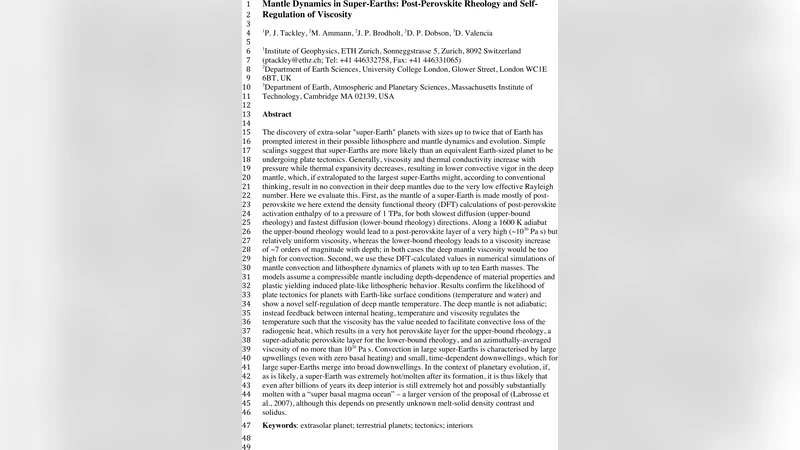
Simple scalings suggest that super-Earths are more likely than an equivalent Earth-sized planet to be undergoing plate tectonics. Generally, viscosity and thermal conductivity increase with pressure while thermal expansivity decreases, resulting in lower convective vigor in the deep mantle. According to conventional thinking, this might result in no convection in a super-Earth’s deep mantle. Here we evaluate this. First, we here extend the density functional theory (DFT) calculations of post-perovskite activation enthalpy of to a pressure of 1 TPa. The activation volume for diffusion creep becomes very low at very high pressure, but nevertheless for the largest super-Earths the viscosity along an adiabat may approach 1030 Pa s in the deep mantle. Second, we use these calculated values in numerical simulations of mantle convection and lithosphere dynamics of planets with up to ten Earth masses. The models assume a compressible mantle including depth-dependence of material properties and plastic yielding induced plate tectonics. Results confirm the likelihood of plate tectonics and show a novel self-regulation of deep mantle temperature. The deep mantle is not adiabatic; instead internal heating raises the temperature until the viscosity is low enough to facilitate convective loss of the radiogenic heat, which results in a super-adiabatic temperature profile and a viscosity increase with depth of no more than ~3 orders of magnitude, regardless of the viscosity increase that is calculated for an adiabat. Convection in large super-Earths is characterised by large upwellings and small, time-dependent downwellings. If a super-Earth was extremely hot/molten after its formation, it is thus likely that even after billions of years its deep interior is still extremely hot and possibly substantially molten with a “super basal magma ocean” - a larger version of (Labrosse et al., 2007).
💡 Research Summary
The paper investigates whether super‑Earths—planets up to ten times the mass of Earth—can sustain mantle convection and plate tectonics despite the extreme pressure‑induced changes in material properties. The authors first extend density‑functional‑theory (DFT) calculations of the activation enthalpy for diffusion creep in post‑perovskite (pPv) from the previously studied ~300 GPa range up to 1 TPa, a pressure regime relevant to the deep interiors of massive super‑Earths. The results show that while the activation volume drops sharply at ultra‑high pressure, the viscosity along an adiabat can still reach values as high as 10³⁰ Pa·s in the deepest mantle of a 10 M⊕ planet—orders of magnitude larger than Earth’s core‑mantle viscosity.
Armed with these pressure‑dependent rheological parameters, the authors construct a fully compressible, three‑dimensional mantle convection model that incorporates depth‑varying density, thermal conductivity, thermal expansivity, and a plastic yielding criterion to allow for plate‑like behavior. Radiogenic heating is distributed uniformly throughout the mantle, and the initial temperature profile is taken to be nearly adiabatic.
The numerical experiments reveal a novel “self‑regulation” of deep‑mantle temperature. Initially, the high viscosity of the deep mantle suppresses convection, but radiogenic heat continuously raises the temperature. Because viscosity depends exponentially on temperature, a modest increase in temperature dramatically reduces viscosity, eventually allowing vigorous convection to develop. Once convection is active, it efficiently transports the internally generated heat outward, establishing a super‑adiabatic temperature gradient. Consequently, the viscosity increase with depth is limited to roughly three orders of magnitude, far less than the six‑order‑of‑magnitude increase predicted for a strictly adiabatic mantle.
Convection patterns in the simulated super‑Earths are characterized by large, persistent upwellings originating near the core‑mantle boundary and comparatively small, time‑dependent downwellings that are confined to the upper mantle. The downwellings are intermittent, reflecting the episodic nature of plate yielding and subduction in the model. In the most massive cases (≈10 M⊕), downwellings become especially scarce, and the flow is dominated by broad upwellings.
Crucially, the inclusion of a plastic yielding law leads to the spontaneous formation of plate‑like lithospheric plates that undergo continuous creation, motion, and recycling. This demonstrates that, contrary to earlier simplistic scaling arguments, plate tectonics is not only plausible but likely on super‑Earths, provided that the mantle can generate sufficient stress to overcome the yield strength.
The authors also explore the thermal evolution of a super‑Earth that begins its life in an extremely hot, partially molten state. Their simulations suggest that even after several gigayears, the deep interior may remain partially molten, forming what they term a “super basal magma ocean.” This long‑lived molten layer would act as a thermal buffer, maintaining high temperatures at depth and influencing the planet’s magnetic field generation, volatile outgassing, and surface habitability.
Overall, the study overturns the conventional view that pressure‑induced viscosity increases inevitably shut down deep convection in massive terrestrial planets. Instead, internal heating and the exponential temperature dependence of viscosity produce a feedback that stabilizes mantle dynamics, supports plate tectonics, and permits a hot, possibly partially molten deep mantle over geological timescales. These findings have broad implications for the thermal and tectonic evolution of exoplanets, their capacity to recycle volatiles, and their potential to host life.
Comments & Academic Discussion
Loading comments...
Leave a Comment