Calorimetry of Active Galactic Nucleus jets: testing plasma composition in Cygnus A
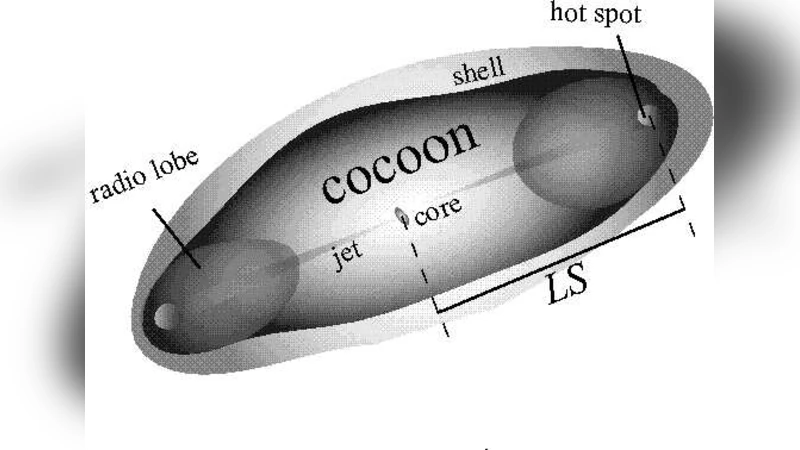
We examine plasma composition of jets in active galactic nuclei through the comparison of the total pressure ($P$) with partial pressures of electrons and protons in a cocoon. The total pressure is estimated from the analysis of an expanding cocoon dynamics. We determine the average kinetic energy per particle for several representative cases of particle energy distribution such as one- and two-temperature thermal plasmas and non-thermal electrons by evaluating the dissipation of total kinetic energy of the jet into the internal energy of cocoon plasma. The number density of the total electrons/positrons ($n_{\pm}$) in the cocoon is constrained by using the particle supply from hot spots and the absence of thermal bremsstrahlung emission from radio lobes. By inserting $P$, $n_{\pm}$ and the particle energy of each population into the equation of state, the number density ($n_{p}$) and pressure ($P_{p}$) of protons in the cocoon can be constrained. Applying this method to Cygnus A, we find that (i) electron/positron ($e^{\pm}$) pairs always dominate in terms of number density, but that (ii) either an “$e^{\pm}$-supported cocoon (i.e., $P_{\pm} >P_{p}$)” or “proton-supported one (i.e, $P_{\pm} <P_{p}$)” is possible.
💡 Research Summary
The paper presents a novel diagnostic framework for probing the plasma composition of active galactic nucleus (AGN) jets by exploiting the pressure balance within the cocoon (the inflated bubble of shocked jet material and ambient gas). Direct measurement of jet constituents is notoriously difficult; most prior work relies on spectral modeling that cannot unambiguously separate electrons, positrons, and protons. Here the authors combine a dynamical estimate of the total cocoon pressure (P) with constraints on the electron‑positron number density (n±) derived from two independent considerations: (i) the particle flux supplied by the hotspot where the jet terminates, which yields a lower bound on n±, and (ii) the non‑detection of thermal bremsstrahlung from the radio lobes, which imposes an upper bound because a denser thermal plasma would produce detectable X‑ray emission.
The methodology proceeds in four steps. First, the cocoon’s expansion speed and the external medium pressure profile (inferred from X‑ray observations) are inserted into a self‑similar cocoon dynamics model, providing an estimate of the total internal pressure. Second, the authors adopt three representative particle energy distributions to calculate the average kinetic energy per particle: (a) a single‑temperature relativistic thermal plasma, (b) a two‑temperature thermal plasma in which electrons/positrons are hot while protons are cooler, and (c) a non‑thermal power‑law electron population superimposed on a thermal background. For each case, the fraction of the jet’s bulk kinetic energy that is dissipated into internal energy of the cocoon is evaluated, yielding the mean particle energy ⟨E⟩ for each species.
Third, the electron‑positron number density is bounded. The hotspot supplies a flux of relativistic pairs; integrating this flux over the cocoon age gives a minimum n±. Conversely, the absence of detectable thermal X‑ray emission from the lobes limits the product n±² Λ(T) (where Λ is the bremsstrahlung emissivity) and thus provides a maximum n±. These two limits bracket the plausible range of pair density.
Finally, the equation of state for a relativistic plasma, P = n±⟨E±⟩ + np⟨Ep⟩, is solved for the proton number density (np) and proton pressure (Pp) using the previously obtained P, n±, and ⟨E⟩ values. This inversion directly yields the relative contribution of protons to the total pressure.
Applying the scheme to Cygnus A, a prototypical powerful radio galaxy, the authors find that electron‑positron pairs dominate the number density by at least an order of magnitude (n±/np ≳ 10). However, the pressure partition is ambiguous: depending on the assumed energy distribution, either the pair pressure P± exceeds the proton pressure Pp (an “e±‑supported cocoon”) or the opposite holds (a “proton‑supported cocoon”). Both scenarios satisfy the observed total pressure and the pair density constraints.
The study’s strengths lie in its clever use of dynamical pressure estimates and observational non‑detections to bound particle content without relying on detailed spectral decomposition. It demonstrates that, even when the total pressure is well measured, the internal composition can remain degenerate because the pressure contribution of each species scales with both its number density and average energy. The analysis also highlights the sensitivity of the results to the assumed particle energy distribution, the efficiency of energy transfer at the hotspot, and the assumption of a spatially uniform cocoon.
Limitations include the reliance on simplified, idealized particle spectra (especially the power‑law component), the neglect of possible inhomogeneities or turbulence within the cocoon, and uncertainties in the hotspot‑to‑cocoon particle injection efficiency. Future work could tighten the constraints by (1) obtaining deeper X‑ray or γ‑ray observations to lower the bremsstrahlung upper limit, (2) directly measuring the hotspot particle spectrum with high‑resolution radio or infrared polarimetry, and (3) performing relativistic magnetohydrodynamic simulations that track the conversion of jet kinetic energy into thermal and non‑thermal components under realistic conditions.
In summary, the paper provides a robust, physically motivated framework for inferring AGN jet composition from cocoon dynamics. While it cannot uniquely determine whether Cygnus A’s cocoon is pair‑ or proton‑dominated in pressure, it convincingly shows that pairs dominate the number density and that both pressure regimes are permissible within current observational uncertainties. The approach is readily extendable to other powerful radio galaxies, offering a valuable tool for advancing our understanding of jet energetics, particle acceleration, and the role of baryons versus leptons in shaping large‑scale AGN feedback.