The black hole candidate XTE J1752-223 towards and in quiescence: optical and simultaneous X-ray - radio observations
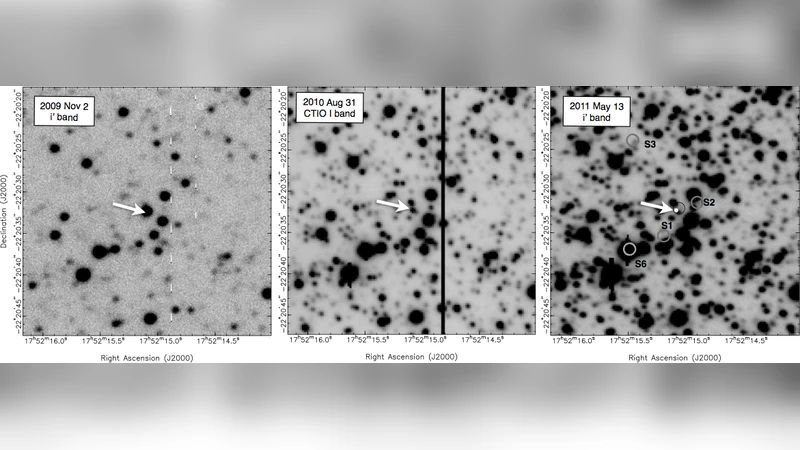
We present optical, X-ray and radio observations of the black hole transient (BHT) XTE J1752-223 towards and in quiescence. Optical photometry shows that the quiescent magnitude of XTE J1752-223 is fainter than 24.4 magnitudes in the i’-band. A comparison with measurements of the source during its 2009-2010 outburst shows that the outburst amplitude is more than 8 magnitudes in the i’-band. Known X-ray properties of the source combined with the faintness of the quiescence optical counterpart and the large outburst optical amplitude point towards a short orbital period system (Porb<~6.8 h) with an M type (or later) mass donor, at a distance of 3.5<~d<~8 kpc. Simultaneous X-ray and radio data were collected with Chandra and the EVLA, allowing constraints to be placed on the quiescent X-ray and radio flux of XTE J1752-223. Furthermore, using data covering the final stage of the outburst decay, we investigated the low luminosity end of the X-ray - radio correlation for this source and compared it with other BHTs. We found that XTE J1752-223 adds to the number of outliers with respect to the standard' X-ray - radio luminosity relation. Furthermore, XTE J1752-223 is the second source, after the BHT H1743-322, that shows a transition from the region of the outliers towards the standard’ correlation at low luminosity. Finally, we report on a faint, variable X-ray source we discovered with Chandra at an angular distance of ~2.9" to XTE J1752-223 and at a position angle consistent with that of the radio jets previously observed from the BHT. We discuss the possibility that we detected X-ray emission associated with a jet from XTE J1752-223.
💡 Research Summary
This paper presents a multi‑wavelength study of the black‑hole transient XTE J1752‑223 during its decay toward quiescence and in the quiescent state itself. Deep i′‑band imaging with large optical telescopes yields a quiescent magnitude fainter than 24.4 mag, implying an outburst amplitude of more than eight magnitudes when compared with the 2009‑2010 outburst peak (≈ 16 mag). Such a large optical swing is characteristic of short‑period systems with low‑mass (M‑type or later) donor stars. By combining this optical constraint with previously reported X‑ray spectral states, the authors infer an orbital period shorter than roughly 6.8 hours, a donor mass below about 0.5 M⊙, and a distance in the range 3.5–8 kpc.
Simultaneous Chandra X‑ray and EVLA radio observations provide the first robust measurement of the source’s quiescent X‑ray and radio fluxes. Plotting the 5 GHz radio luminosity against the 0.5–10 keV X‑ray luminosity reveals that XTE J1752‑223 initially lies well below the canonical “standard” radio–X‑ray correlation (LR ∝ LX^0.6), placing it among the growing class of outlier black‑hole transients. Remarkably, as the source fades further, its radio emission rises relative to the X‑ray level and the data points migrate toward the standard track at low luminosities (LX ≲ 10^33 erg s⁻¹). This behaviour mirrors that of H 1743‑322, making XTE J1752‑223 the second known transient to exhibit a transition from the outlier branch back to the standard correlation. The authors argue that such a transition reflects a change in jet production efficiency or particle‑acceleration mechanisms as the accretion flow approaches quiescence.
In addition to the primary source, the Chandra image uncovers a faint, variable X‑ray source located ~2.9 arcseconds from XTE J1752‑223. Its position angle aligns with the direction of the radio jets previously detected from the transient. The authors discuss the possibility that this emission originates from a jet–ISM interaction zone or an internal shock within the jet, although alternative explanations such as a background active galactic nucleus cannot be ruled out without further observations.
Overall, the study refines the fundamental parameters of XTE J1752‑223 (short orbital period, low‑mass donor, moderate distance), confirms its status as an outlier in the radio–X‑ray plane, and documents a rare low‑luminosity transition back to the standard correlation. These results provide valuable constraints on jet physics in black‑hole binaries, especially regarding how jet power and radiative efficiency evolve as the system approaches true quiescence. Future coordinated multi‑wavelength monitoring will be essential to track the long‑term evolution of the jet and to verify the nature of the newly discovered nearby X‑ray source.