Constraints on jet formation mechanisms with the most energetic giant outbursts in MS 0735+7421
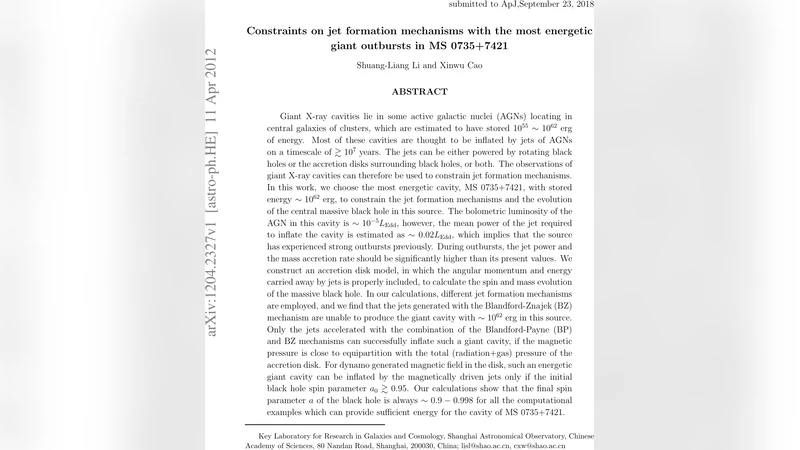
Giant X-ray cavities lie in some active galactic nuclei (AGNs) locating in central galaxies of clusters, most of these cavities are thought to be inflated by jets of AGNs. The jets can be either powered by rotating black holes or the accretion disks surrounding black holes, or both. In this work, we choose the most energetic cavity, MS 0735+7421, with stored energy ~ 10^62 erg, to constrain the jet formation mechanisms and the evolution of the central massive black hole in this source. The bolometric luminosity of the AGN in this cavity is ~ 10^(-5) L_Edd, however, the mean power of the jet required to inflate the cavity is estimated as ~ 0.02 L_Edd, which implies that the source has experienced strong outbursts previously. During outbursts, the jet power and the mass accretion rate should be significantly higher than its present values. We construct an accretion disk model, in which the angular momentum and energy carried away by jets is properly included, to calculate the spin and mass evolution of the massive black hole. In our calculations, different jet formation mechanisms are employed, and we find that the jets generated with the Blandford-Znajek (BZ) mechanism are unable to produce the giant cavity with ~ 10^62 erg in this source. Only the jets accelerated with the combination of the Blandford-Payne (BP) and BZ mechanisms can successfully inflate such a giant cavity, if the magnetic pressure is close to equipartition with the total (radiation+gas) pressure of the accretion disk. For dynamo generated magnetic field in the disk, such an energetic giant cavity can be inflated by the magnetically driven jets only if the initial black hole spin parameter a_0 > 0.95. Our calculations show that the final spin parameter a of the black hole is always ~ 0:9 - 0.998 for all the computational examples which can provide sufficient energy for the cavity of MS 0735+7421.
💡 Research Summary
This paper investigates the formation mechanisms of jets that inflated the most energetic X‑ray cavity known, the giant cavity associated with the active galactic nucleus (AGN) in the central galaxy of the cluster MS 0735+7421. Observations indicate that the cavity stores an enormous amount of mechanical energy, roughly 10^62 erg. The present bolometric luminosity of the AGN is only about 10⁻⁵ L_Edd, yet the mean jet power required to inflate the cavity is estimated at ~0.02 L_Edd. This discrepancy implies that the system experienced a much more powerful outburst in the past, with both the mass accretion rate and jet power far exceeding their current values.
To explore how such a powerful jet could have been produced, the authors construct a time‑dependent accretion‑disk model that explicitly includes the loss of angular momentum and energy to jets. The model follows the coupled evolution of the black‑hole mass M and dimensionless spin a, while allowing the mass‑accretion rate Ṁ to evolve according to a prescribed decline from an initial high‑Ṁ phase. Two classic jet‑production mechanisms are considered: the Blandford‑Znajek (BZ) process, which extracts rotational energy from a spinning black hole via magnetic fields threading the horizon, and the Blandford‑Payne (BP) process, which launches a magnetocentrifugal wind from the accretion disk itself. The authors examine three configurations: pure BZ, pure BP, and a hybrid BZ + BP model.
The calculations reveal that a jet powered solely by the BZ mechanism cannot deliver enough energy to account for the 10^62 erg cavity, regardless of the assumed magnetic field strength. In contrast, when the BP mechanism is included, the jet power increases dramatically. The hybrid BZ + BP model can supply the required energy provided that the magnetic pressure in the disk is close to equipartition with the total (radiation + gas) pressure. This condition ensures that the disk can sustain a strong, ordered magnetic field capable of driving a powerful magnetocentrifugal wind.
The authors also explore the case where the magnetic field is generated by a turbulent dynamo within the disk, which typically yields a magnetic pressure lower than equipartition. In this scenario, the only way to achieve the necessary jet power is to start with an extremely rapidly rotating black hole, with an initial spin parameter a₀ > 0.95. Under such high‑spin conditions, the BZ contribution becomes significant enough to complement the BP wind and reach the required energy budget.
Across all successful simulations, the final black‑hole spin converges to a narrow range, a ≈ 0.9–0.998, indicating that the powerful jet episode does not spin the hole down dramatically; instead, the spin remains high because the accretion of high‑angular‑momentum material during the outburst compensates for the angular‑momentum loss to the jet. The mass growth of the black hole is modest, reflecting the relatively short duration of the high‑Ṁ phase required to inflate the cavity.
In summary, the study concludes that the giant cavity in MS 0735+7421 can be explained only if (1) the accretion disk hosts a magnetic field near equipartition, (2) both BP and BZ mechanisms operate together, and (3) the black hole either starts with a very high spin (a₀ > 0.95) or maintains a high spin throughout the outburst. These constraints provide valuable insight into the interplay between disk magnetization, jet launching physics, and black‑hole spin evolution in the most energetic AGN feedback events.