Circumbinary MHD Accretion into Inspiraling Binary Black Holes
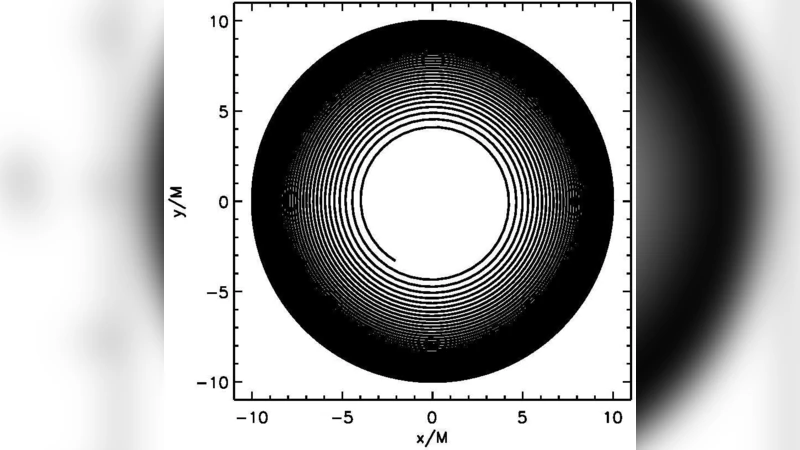
As 2 black holes bound to each other in a close binary approach merger their inspiral time becomes shorter than the characteristic inflow time of surrounding orbiting matter. Using an innovative technique in which we represent the changing spacetime in the region occupied by the orbiting matter with a 2.5PN approximation and the binary orbital evolution with 3.5PN, we have simulated the MHD evolution of a circumbinary disk surrounding an equal-mass non-spinning binary. Prior to the beginning of the inspiral, the structure of the circumbinary disk is predicted well by extrapolation from Newtonian results. The binary opens a low-density gap whose radius is roughly two binary separations, and matter piles up at the outer edge of this gap as inflow is retarded by torques exerted by the binary; nonetheless, the accretion rate is diminished relative to its value at larger radius by only about a factor of 2. During inspiral, the inner edge of the disk at first moves inward in coordination with the shrinking binary, but as the orbital evolution accelerates, the rate at which the inner edge moves toward smaller radii falls behind the rate of binary compression. In this stage, the rate of angular momentum transfer from the binary to the disk slows substantially, but the net accretion rate decreases by only 10-20%. When the binary separation is tens of gravitational radii, the rest-mass efficiency of disk radiation is a few percent, suggesting that supermassive binary black holes in galactic nuclei could be very luminous at this stage of their evolution. If the luminosity were optically thin, it would be modulated at a frequency that is a beat between the orbital frequency of the disk’s surface density maximum and the binary orbital frequency. However, a disk with sufficient surface density to be luminous should also be optically thick; as a result, the periodic modulation may be suppressed.
💡 Research Summary
This paper presents the first magnetohydrodynamic (MHD) simulation of a circumbinary accretion disk around an equal‑mass, non‑spinning binary black hole (BBH) that incorporates post‑Newtonian (PN) corrections for both the binary’s orbital evolution and the spacetime experienced by the surrounding gas. The authors use a hybrid approach: the binary’s inspiral is driven by a 3.5‑PN radiation‑reaction prescription, while the metric in the region occupied by the disk is approximated by a 2.5‑PN expansion. This allows the simulation to capture the regime in which the inspiral timescale becomes shorter than the viscous inflow time of the disk, a regime that cannot be treated accurately with purely Newtonian or fixed‑background GR simulations.
In the pre‑inspiral phase, the circumbinary disk quickly settles into a configuration that matches extrapolations from earlier Newtonian studies. The binary torques carve out a low‑density cavity whose radius is roughly twice the binary separation. Gas piles up at the cavity edge, forming a pronounced surface‑density bump. Despite this pile‑up, the mass accretion rate through the cavity is only reduced by a factor of ≈2 compared with the rate at larger radii, indicating that the binary does not completely choke off inflow.
When the binary begins its PN‑driven inspiral, the inner edge of the disk initially follows the shrinking binary, moving inward in step with the decreasing separation. As the inspiral accelerates, however, the disk’s inner edge lags behind the binary’s rapid compression. Consequently, the torque exerted by the binary on the disk drops sharply, and the angular‑momentum transfer rate declines substantially. Remarkably, the net mass accretion rate onto the binary declines by only 10–20 % during this stage, showing that the disk can continue to feed the binary even as the orbital decay speeds up.
The authors compute the radiative efficiency of the disk by assuming a standard thin‑disk cooling prescription. When the binary separation reaches a few tens of gravitational radii (GM/c²), the rest‑mass to radiation conversion efficiency rises to a few percent. This level of efficiency suggests that supermassive BBHs in galactic nuclei could be very luminous during the late inspiral, potentially outshining the host galaxy’s nuclear activity.
A further observational implication concerns periodic variability. The surface‑density maximum at the cavity edge orbits at a frequency slightly different from the binary’s orbital frequency. In an optically thin disk, the beat between these two frequencies would produce a quasi‑periodic modulation in the emitted light, offering a potential electromagnetic counterpart to the gravitational‑wave signal. However, the simulations show that a luminous disk must have sufficient surface density to be optically thick, which would smear out or suppress the modulation. Thus, while the intrinsic dynamical frequencies are present, their electromagnetic imprint may be weak or absent in realistic, thick disks.
Overall, the study demonstrates that even in the rapid‑inspiral regime, a circumbinary disk can remain an efficient conduit of mass and angular momentum, sustaining a substantial accretion luminosity. The hybrid PN‑MHD methodology provides a powerful tool for bridging the gap between Newtonian disk theory and full general‑relativistic simulations, and it offers concrete predictions for the electromagnetic signatures of merging supermassive black holes that will be probed by future multi‑messenger observations.