An Examination of the X-ray Sources in the Globular Cluster NGC 6652
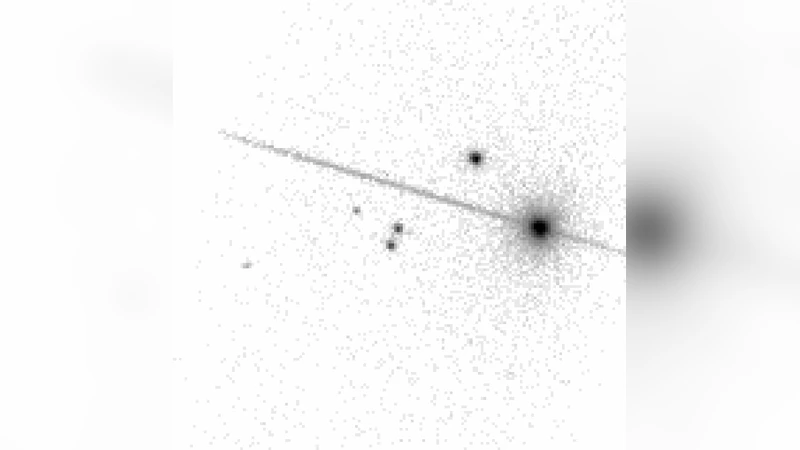
We observed the globular cluster NGC 6652 with Chandra for 47.5 ks, detecting six known X-ray sources, as well as five previously undetected X-ray sources. Source A (XB 1832-330) is a well-known bright low-mass X-ray binary (LXMB). The second brightest source, B, has a spectrum that fits well to either a power-law model (Gamma ~ 1.3) or an absorbed hot gas emission model (kT ~ 34 keV). Its unabsorbed 0.5-10 keV luminosity (L_X = 1.6+-0.110^34 erg/s) is suggestive of a neutron star primary; however, Source B exhibits unusual variability for a LMXB, varying by over an order of magnitude on timescales of ~ 100 s. Source C’s spectrum contains a strong low-energy component below 1 keV. Its spectrum is well fit to a simplified magnetic cataclysmic variable (CV) model, thus the soft component may be explained by a hot polar cap of a magnetic CV. Source D has an average L_X (0.5-10 keV) ~ 910^32 erg/s, and its spectrum is well fit to a neutron star atmosphere model. This is indicative of a quiescent neutron star LXMB, suggesting Source D may be the third known LMXB in NGC 6652. Source E has L_X (0.5-10 keV) ~ 310^32 erg/s, while Source F has L_X (0.5-10 keV) ~ 110^32 erg/s. Their relatively hard X-ray spectra are well-fit by power-law or plasma emission models. Five newly detected fainter sources have luminosities between 1-5*10^31 erg/s. NGC 6652 has an unusually flat X-ray luminosity function compared to other globular clusters, which may be connected to its extremely high central density.
💡 Research Summary
This study presents a deep Chandra ACIS‑S observation of the globular cluster NGC 6652, totaling 47.5 ks of exposure, and provides a comprehensive analysis of its X‑ray source population. Six previously known sources (designated A–F) are detected with high significance, and five additional faint sources are newly identified, bringing the total to eleven. The authors perform precise astrometry, extract spectra in the 0.5–10 keV band, and fit each with standard astrophysical models (power‑law, thermal plasma, neutron‑star atmosphere, and magnetic cataclysmic‑variable models) to infer physical properties such as luminosity, temperature, and possible source class.
Source A corresponds to the well‑studied low‑mass X‑ray binary (LMXB) XB 1832‑330. Its spectrum is consistent with a multicolor disk blackbody plus a Comptonized component, yielding an unabsorbed luminosity of ≈2 × 10^36 erg s⁻¹, confirming its status as the brightest X‑ray emitter in the cluster.
Source B is the second brightest object with L_X≈1.6 × 10^34 erg s⁻¹. Both a hard power‑law (Γ≈1.3) and a hot thermal bremsstrahlung model (kT≈34 keV) provide acceptable fits, suggesting a neutron‑star primary. However, the source exhibits dramatic variability: its count rate changes by more than an order of magnitude on timescales of ~100 s. Such rapid, high‑amplitude fluctuations are atypical for canonical LMXBs and may indicate unstable mass transfer, variable local absorption, or a transitional accretion regime possibly linked to a magnetic field.
Source C displays a pronounced soft excess below 1 keV. While a simple neutron‑star atmosphere model fails, a simplified magnetic cataclysmic‑variable (CV) model, comprising a hot polar cap plus a hard bremsstrahlung component, reproduces the data. The soft component is interpreted as thermal emission from a heated magnetic pole, supporting the classification of C as a magnetic CV (likely an intermediate polar).
Source D has an average luminosity of ≈9 × 10^32 erg s⁻¹. Its spectrum is well described by a neutron‑star hydrogen atmosphere with an effective temperature near 100 eV, characteristic of quiescent LMXBs. This makes D a strong candidate for the third LMXB in NGC 6652, adding to the known binary population.
Sources E and F are fainter (L_X≈3 × 10^32 erg s⁻¹ and ≈1 × 10^32 erg s⁻¹, respectively) and exhibit relatively hard spectra. Both are adequately fitted by either a power‑law (Γ≈1.5–2) or an APEC plasma model with kT≈5–10 keV, consistent with typical CVs or millisecond pulsars (MSPs) in globular clusters.
The five newly detected faint sources have luminosities in the 1–5 × 10^31 erg s⁻¹ range and predominantly hard spectra, suggesting they are likely low‑luminosity CVs or MSPs whose soft emission is heavily absorbed.
A key result of the paper is the shape of the X‑ray luminosity function (LF) for NGC 6652. Compared with other globular clusters, NGC 6652 shows an unusually flat LF (power‑law index α≈−0.5). The authors argue that this flatness is linked to the cluster’s extreme central density (ρ_c≈10^5 M_⊙ pc⁻³). In such a dense environment, dynamical interactions (binary encounters, tidal captures) are frequent, enhancing the formation rate of close binaries like CVs and MSPs while possibly shortening the active lifetimes of bright LMXBs. Consequently, the source population is skewed toward numerous low‑luminosity, hard X‑ray emitters, flattening the LF.
Overall, the paper provides a detailed census of NGC 6652’s X‑ray sources, identifies two new candidate LMXBs (B and D) and a magnetic CV (C), and places the cluster’s X‑ray source demographics in the broader context of dynamical evolution in dense stellar systems. The findings underscore the importance of high‑resolution X‑ray observations for disentangling the complex interplay between stellar dynamics and binary evolution in globular clusters.