Exploring the nature of the unidentified VHE gamma-ray source HESS J1507-622
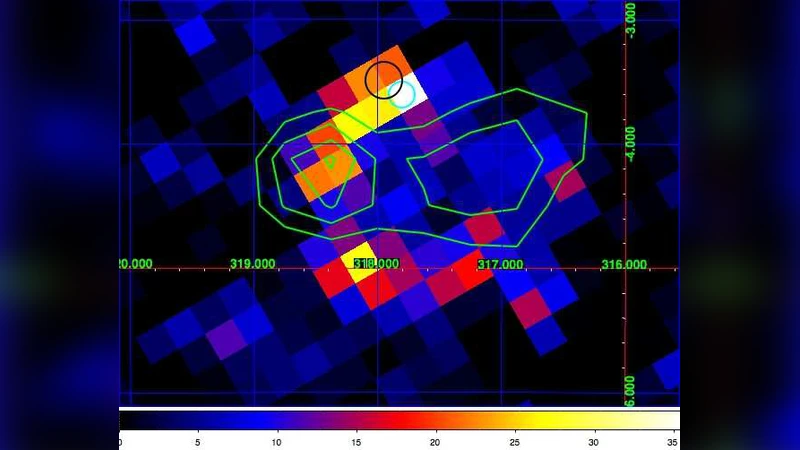
The nature of the first unidentified VHE gamma-ray source with significant angular offset from the Galactic plane of 3.5 degrees, HESS J1507-622, is explored. Fermi-LAT data in the high-energy (HE, 100 MeV < E < 100 GeV) gamma-ray range collected over 34 month are used to describe the spectral energy distribution (SED) of the source. HESS J1507-622 is detected in the Fermi energy range and its spectrum is best described by a power law in energy with Gamma=1.7 +/- 0.1 stat +/- 0.2_sys and integral flux between (0.3-300) GeV of F = (2.0 +/-0.5_stat +/- 1.0_sys) x 10^-9 cm^-2 s^-1. With the available data it is not possible to discriminate between a hadronic and a leptonic scenario for HESS J1507-622. The location and compactness of the source indicate a considerable physical offset from the Galactic plane for this object. In case of a multiple-kpc distance, this challenges a pulsar wind nebula (PWN) origin for HESS J1507-622 since the time of travel for a pulsar born in the Galactic disk to reach such a location would exceed the inverse Compton (IC) cooling time of electrons that are energetic enough to produce VHE gamma-rays. However, an origin of this gamma-ray source connected to a pulsar that was born off the Galactic plane in the explosion of a hypervelocity star cannot be excluded. The nature of HESS J1507-622 is still unknown to date, and a PWN scenario cannot be ruled out in general. On the contrary HESS J1507-622 could be the first discovered representative of a population of spatially extended VHE gamma-ray emitters with HE gamma-ray counterpart that are located at considerable offsets from the Galactic plane. Future surveys in the VHE gamma-ray range are necessary to probe the presence or absence of such a source population.(abridged)
💡 Research Summary
The paper investigates the nature of HESS J1507‑622, the first very‑high‑energy (VHE; >100 GeV) gamma‑ray source that is both unidentified and located far from the Galactic plane (offset ≈ 3.5°). Using 34 months of Fermi‑LAT data covering the high‑energy (HE; 100 MeV–100 GeV) band, the authors derive a spectrum that smoothly connects to the previously measured HESS VHE spectrum. The HE spectrum is best described by a power law with photon index Γ = 1.7 ± 0.1 (stat) ± 0.2 (sys) and an integrated flux between 0.3 and 300 GeV of (2.0 ± 0.5_stat ± 1.0_sys) × 10⁻⁹ cm⁻² s⁻¹. Spatially, the source appears moderately extended (≈ 0.15° radius) in the HESS data, yet no clear X‑ray or radio counterpart is known, making it a “dark accelerator.”
The authors explore two broad emission scenarios. In the leptonic (electron‑driven) picture, relativistic electrons up‑scatter ambient photon fields (primarily the cosmic microwave background) via inverse‑Compton (IC) scattering, producing the observed gamma rays. The required electron energies (tens of TeV) imply IC cooling times of order 10⁴–10⁵ yr for typical interstellar magnetic fields (a few µG). If the source lies at a distance of several kiloparsecs, its physical height above the plane would be |z| ≳ 300 pc. A pulsar born in the Galactic disk would need to travel this distance in less than the electron cooling time, which is unlikely for typical pulsar velocities (≈ 500 km s⁻¹). Consequently, a conventional pulsar‑wind‑nebula (PWN) origin becomes problematic at large distances.
In the hadronic (proton‑driven) scenario, high‑energy protons collide with ambient gas, producing neutral pions that decay into gamma rays. This mechanism does not suffer from electron cooling constraints, but it requires sufficient target material. The lack of detected X‑ray or radio emission makes it difficult to estimate the ambient density, leaving the hadronic model largely unconstrained.
Distance estimates are therefore pivotal. A nearby solution (≈ 1 kpc) would place the source only ~60 pc above the plane, compatible with a PWN or an old supernova remnant (SNR). However, the source’s compactness and lack of low‑energy counterparts argue against a typical young PWN. A far‑distance solution (≥ 5 kpc) would imply a true offset of several hundred parsecs, challenging any PWN scenario that assumes a pulsar originating in the disk. The authors propose an alternative: the pulsar could have been born off the plane, perhaps as the remnant of a hyper‑velocity star that exploded far from the Galactic mid‑plane. This exotic possibility cannot be ruled out with current data.
Overall, the available multi‑wavelength observations do not allow a decisive discrimination between leptonic and hadronic origins, nor between a nearby or distant placement. The paper emphasizes that HESS J1507‑622 may represent the first member of a yet‑unknown population of extended VHE gamma‑ray sources with HE counterparts that reside at significant Galactic latitudes. Detecting additional members will require deep, wide‑field surveys in the VHE regime (e.g., with the Cherenkov Telescope Array) and complementary deep X‑ray and radio observations to search for faint counterparts. Such studies will be essential to determine whether HESS J1507‑622 is an outlier or the prototype of a new class of high‑latitude Galactic accelerators.