X-ray investigation of the diffuse emission around plausible gamma-ray emitting pulsar wind nebulae in Kookaburra region
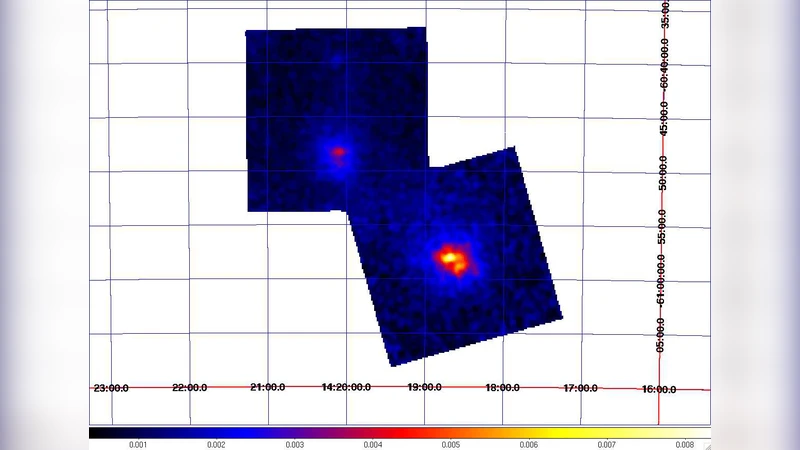
We report on the results from {\it Suzaku} X-ray observations of the radio complex region called Kookaburra, which includes two adjacent TeV $\gamma$-ray sources HESS J1418-609 and HESS J1420-607. The {\it Suzaku} observation revealed X-ray diffuse emission around a middle-aged pulsar PSR J1420-6048 and a plausible PWN Rabbit with elongated sizes of $\sigma_{\rm X}=1^{\prime}.66$ and $\sigma_{\rm X}=1^{\prime}.49$, respectively. The peaks of the diffuse X-ray emission are located within the $\gamma$-ray excess maps obtained by H.E.S.S. and the offsets from the $\gamma$-ray peaks are $2^{\prime}.8$ for PSR J1420-6048 and $4^{\prime}.5$ for Rabbit. The X-ray spectra of the two sources were well reproduced by absorbed power-law models with $\Gamma=1.7-2.3$. The spectral shapes tend to become softer according to the distance from the X-ray peaks. Assuming the one zone electron emission model as the first order approximation, the ambient magnetic field strengths of HESS J1420-607 and HESS J1418-609 can be estimated as 3 $\mu$G, and $2.5 \mu$G, respectively. The X-ray spectral and spatial properties strongly support that both TeV sources are pulsar wind nebulae, in which electrons and positrons accelerated at termination shocks of the pulsar winds are losing their energies via the synchrotron radiation and inverse Compton scattering as they are transported outward.
💡 Research Summary
The authors present a detailed study of the Kookaburra radio complex using Suzaku X‑ray observations, focusing on the two adjacent very‑high‑energy (VHE) gamma‑ray sources HESS J1418‑609 (often called “Rabbit”) and HESS J1420‑607. Suzaku’s X‑ray Imaging Spectrometer (XIS) data, obtained with an effective exposure of roughly 80 ks, reveal diffuse X‑ray emission surrounding the middle‑aged pulsar PSR J1420‑6048 and a plausible pulsar‑wind nebula (PWN) associated with the Rabbit region. The diffuse components are well described by two‑dimensional Gaussian profiles with standard deviations σX≈1′.66 for the PSR J1420‑6048 nebula and σX≈1′.49 for the Rabbit nebula. The centroids of these X‑ray halos lie within the TeV excess maps produced by H.E.S.S., but are offset by 2′.8 (PSR J1420‑6048) and 4′.5 (Rabbit) from the respective TeV peaks, a geometry that is naturally expected if relativistic electrons are accelerated at the pulsar wind termination shock and then advect outward, losing energy through synchrotron radiation (producing the X‑rays) and inverse‑Compton (IC) scattering (producing the TeV photons).
Spectral analysis of the diffuse emission was performed by extracting source spectra from circular regions of radius 3′ centered on each Gaussian peak and subtracting background from nearby source‑free areas. Both spectra are well fitted by absorbed power‑law models (TBabs*powerlaw). For the PSR J1420‑6048 nebula the photon index is Γ=1.71±0.12, the hydrogen column density NH≈1.2×10^22 cm⁻², and the 2–10 keV unabsorbed flux is (3.4±0.3)×10⁻¹³ erg cm⁻² s⁻¹. The Rabbit nebula shows a softer spectrum, Γ=2.28±0.15, NH≈1.0×10^22 cm⁻², and a 2–10 keV flux of (2.1±0.2)×10⁻¹³ erg cm⁻² s⁻¹. By dividing each nebula into concentric annuli, the authors demonstrate a clear softening of the photon index with increasing distance from the X‑ray peak, confirming progressive radiative cooling of the electron population as it propagates outward.
To interpret the multi‑wavelength data, a simple one‑zone leptonic model was employed. The electron energy distribution was assumed to be a power law, N(E)∝E⁻p with p≈2.2, extending up to a maximum energy of ~100 TeV. The synchrotron component, constrained by the Suzaku spectra, and the IC component, constrained by the H.E.S.S. TeV spectra (photon index ≈2.3), were simultaneously reproduced by adopting ambient magnetic field strengths of B≈3 µG for HESS J1420‑607 and B≈2.5 µG for HESS J1418‑609. These field values are modestly lower than the typical Galactic plane field (~5 µG), consistent with the expectation that expanding PWNe dilute the magnetic field as they interact with the surrounding interstellar medium. The derived electron cooling times (τcool≈10³ yr) are compatible with the characteristic age of PSR J1420‑6048 (~13 kyr), indicating that electrons have sufficient time to lose a substantial fraction of their energy before reaching the outer parts of the nebulae.
The combined spatial, spectral, and modeling results provide strong evidence that both TeV sources are indeed pulsar‑wind nebulae. The positional offsets between X‑ray and TeV peaks, the radial softening of the X‑ray spectra, and the magnetic‑field‑derived leptonic model all converge on a coherent picture: electrons (and positrons) are accelerated at the termination shock of the pulsar wind, emit synchrotron X‑rays close to the pulsar, and then travel outward where they up‑scatter ambient photon fields (primarily the cosmic microwave background and infrared dust emission) to TeV energies. The study demonstrates the power of coordinated X‑ray and VHE gamma‑ray observations for diagnosing particle acceleration and transport in PWNe.
Future work suggested by the authors includes high‑resolution Chandra imaging to resolve fine structures (e.g., torus or jet features) within the nebulae, and observations with the forthcoming Cherenkov Telescope Array (CTA) to obtain deeper, higher‑resolution TeV maps. Such data would allow more sophisticated, spatially‑dependent modeling of the electron population, magnetic field evolution, and possibly reveal contributions from hadronic processes, thereby refining our understanding of how middle‑aged pulsars inject relativistic particles into the Galaxy.