Stationary field-aligned MHD flows at astropauses and in astrotails. Principles of a counterflow configuration between a stellar wind and its interstellar medium wind
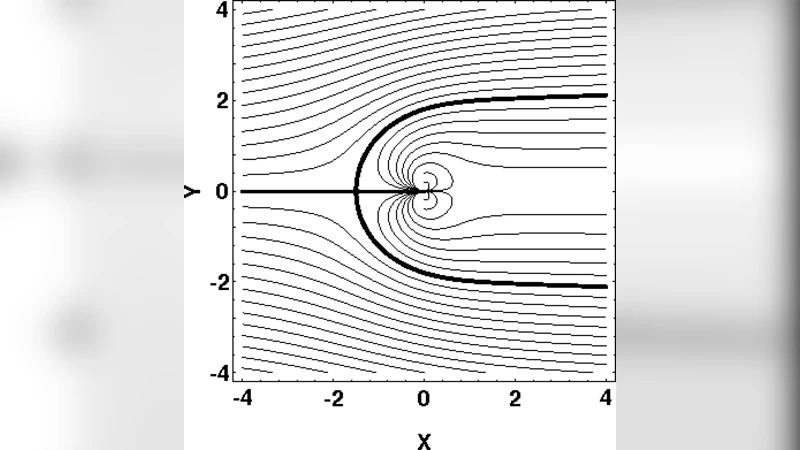
A stellar wind passing through the reverse shock is deflected into the astrospheric tail and leaves the stellar system either as a sub-Alfvenic or as a super-Alfvenic tail flow. An example is our own heliosphere and its heliotail. We present an analytical method of calculating stationary, incompressible, and field-aligned plasma flows in the astrotail of a star. We present a recipe for constructing an astrosphere with the help of only a few parameters, like the inner Alfven Mach number and the outer Alfven Mach number, the magnetic field strength within and outside the stellar wind cavity, and the distribution of singular points of the magnetic field within these flows. Within the framework of a one-fluid approximation, it is possible to obtain solutions of the MHD equations for stationary flows from corresponding static MHD equilibria, by using noncanonical mappings of the canonical variables. The canonical variables are the Euler potentials of the magnetic field of magnetohydrostatic equilibria. Thus we start from static equilibria determined by the distribution of magnetic neutral points, and assume that the Alfven Mach number for the corresponding stationary equilibria is finite. The topological structure determines the geometrical structure of the interstellar gas - stellar wind interface. Additional boundary conditions like the outer magnetic field and the jump of the magnetic field across the astropause allow determination of the noncanonical transformations. This delivers the strength of the magnetic field at every point in the astrotail region beyond the reverse shock. The mathematical technique for describing such a scenario is applied to astrospheres in general, but is also relevant for the heliosphere. It shows the restrictions of the outer and the inner magnetic field strength in comparison with the corresponding Alfven Mach numbers in the case of subalfvenic flows.
💡 Research Summary
The paper addresses the problem of modeling the plasma flow that emerges from a stellar wind after it passes through the reverse shock and is diverted into the astrotail – the elongated downstream region of an astrosphere. Under the assumptions of incompressibility, stationarity, and strict alignment of the flow velocity with the magnetic field, the authors develop an analytical framework that converts static magnetohydrostatic (MHS) equilibria into stationary magnetohydrodynamic (MHD) flow solutions. The key mathematical tool is a non‑canonical transformation of the canonical variables, namely the Euler potentials that describe the magnetic field in the static equilibrium. By prescribing a finite Alfvén Mach number (the ratio of flow speed to Alfvén speed) for the stationary configuration, the transformation yields a new set of fields that satisfy the full set of stationary MHD equations.
The construction starts from a static equilibrium characterized by a specific distribution of magnetic neutral (singular) points. These points control the topological layout of magnetic field lines and therefore the geometry of the astropause – the contact surface between the stellar wind cavity and the interstellar medium. The transformation is parameterized by a small set of physically meaningful quantities: the inner Alfvén Mach number (inside the stellar wind cavity), the outer Alfvén Mach number (in the interstellar flow), the magnetic field strength inside and outside the astropause, and the positions of the neutral points. Boundary conditions such as the external interstellar magnetic field and the jump of the magnetic field across the astropause are used to uniquely determine the transformation functions.
After the mapping, mass flux and magnetic flux are conserved, while pressure and density are modified by terms involving the Alfvén Mach numbers and the transformation Jacobian. The resulting stationary flow is field‑aligned: plasma streams along magnetic field lines in the tail region. The analysis shows that for sub‑Alfvénic tail flows (Mach number < 1) the external magnetic field must dominate the internal field, leading to a compressed astropause, whereas for super‑Alfvénic flows (Mach number > 1) the internal field can be stronger, allowing a more expanded tail. These constraints are expressed analytically and can be tested against observations.
The authors apply the method to the heliosphere as a concrete example. Using measured heliospheric tail dimensions and magnetic field data, they infer that the solar wind tail is likely sub‑Alfvénic, consistent with the observed narrowness of the heliotail and the dominance of the interstellar magnetic field in shaping it. Because the model employs a single‑fluid approximation, it does not resolve electron‑ion separation or kinetic effects, but it captures the large‑scale, average behavior of the plasma.
In summary, the paper provides a systematic recipe for building analytical models of astrospheric tails: start from a static MHS equilibrium defined by magnetic neutral points, prescribe inner and outer Alfvén Mach numbers and magnetic field strengths, perform a non‑canonical transformation of the Euler potentials, and obtain the full stationary, incompressible, field‑aligned flow solution. This approach yields explicit expressions for the magnetic field throughout the astrotail, clarifies the topological‑geometrical relationship between magnetic neutral points and the astropause shape, and delineates the permissible ranges of magnetic field strengths for sub‑ and super‑Alfvénic tail flows. The methodology is broadly applicable to any astrosphere, offering a valuable bridge between theoretical MHD equilibria and observable heliospheric or astrospheric structures.
Comments & Academic Discussion
Loading comments...
Leave a Comment