Relation between current sheets and vortex sheets in stationary incompressible MHD
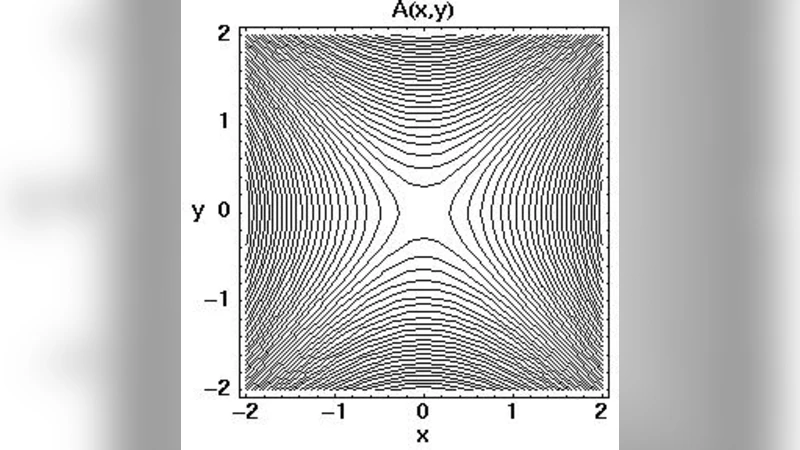
Magnetohydrodynamic configurations with strong localized current concentrations and vortices play an important role for the dissipation of energy in space and astrophysical plasma. Within this work we investigate the relation between current sheets and vortex sheets in incompressible, stationary equilibria. For this approach it is helpful that the similar mathematical structure of magnetohydrostatics and stationary incompressible hydrodynamics allows us to transform static equilibria into stationary ones. The main control function for such a transformation is the profile of the Alfven-Mach number M_A, which is always constant along magnetic field lines, but can change from one field line to another. In the case of a global constant M_A, vortices and electric current concentrations are parallel. More interesting is the nonlinear case, where M_A varies perpendicular to the field lines. This is a typical situation at boundary layers like the magnetopause, heliopause, the solar wind flowing around helmet streamers and at the boundary of solar coronal holes. The corresponding current and vortex sheets show in some cases also an alignment, but not in every case. For special density distributions in 2D it is possible to have current but no vortex sheets. In 2D vortex sheets of field aligned-flows can also exist without strong current sheets, taking the limit of small Alfven Mach numbers into account. The current sheet can vanish if the Alfven Mach number is (almost) constant and the density gradient is large across some boundary layer. It should be emphasized that the used theory is not only valid for small Alfven Mach numbers M_A«1, but also for M_A~1. Connection to other theoretical approaches and observations and physical effects in space plasmas are presented. Differences in the various aspects of theoretical investigations of current sheets and vortex sheets are given.
💡 Research Summary
This paper investigates the relationship between current sheets and vortex sheets in stationary, incompressible magnetohydrodynamic (MHD) configurations. The study focuses on how these structures interact within strong localized current concentrations and vortices that play a crucial role in energy dissipation in space and astrophysical plasmas. A key control function for transforming static equilibria into stationary ones is the profile of the Alfven-Mach number (M_A), which remains constant along magnetic field lines but can vary from one line to another. When M_A is globally constant, vortices and electric current concentrations align parallelly. However, in nonlinear cases where M_A varies perpendicular to the field lines, this alignment may not always occur. This situation is typical at boundary layers such as the magnetopause, heliopause, solar wind flowing around helmet streamers, and boundaries of solar coronal holes.
The paper also explores specific density distributions in 2D scenarios where current sheets can exist without vortex sheets, and vice versa under certain conditions. For instance, when M_A is small, vortex sheets aligned with magnetic field flows can persist even without strong current sheets. Additionally, the theory presented is not limited to small Alfven Mach numbers (M_A « 1) but also applies to cases where M_A ≈ 1.
The authors connect their theoretical approach to other existing theories and observational data in space plasmas, highlighting differences in various aspects of theoretical investigations into current sheets and vortex sheets. This comprehensive analysis provides a deeper understanding of the complex dynamics involved in these plasma configurations and their implications for energy dissipation mechanisms in astrophysical environments.
Comments & Academic Discussion
Loading comments...
Leave a Comment