The high-energy environment in the super-earth system CoRoT-7
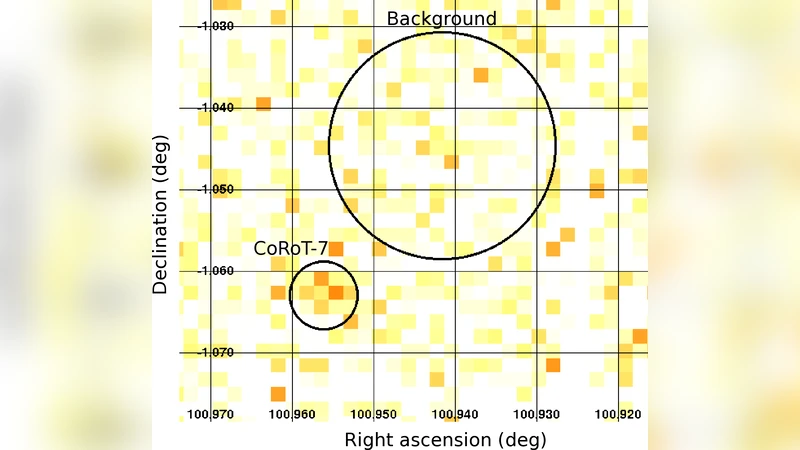
High-energy irradiation of exoplanets has been identified to be a key influence on the stability of these planets’ atmospheres. So far, irradiation-driven mass-loss has been observed only in two Hot Jupiters, and the observational data remain even more sparse in the super-earth regime. We present an investigation of the high-energy emission in the CoRoT-7 system, which hosts the first known transiting super-earth. To characterize the high-energy XUV radiation field into which the rocky planets CoRoT-7b and CoRoT-7c are immersed, we analyzed a 25 ks XMM-Newton observation of the host star. Our analysis yields the first clear (3.5 sigma) X-ray detection of CoRoT-7. We determine a coronal temperature of ca. 3 MK and an X-ray luminosity of 310^28 erg/s. The level of XUV irradiation on CoRoT-7b amounts to ca. 37000 erg/cm^2/s. Current theories for planetary evaporation can only provide an order-of-magnitude estimate for the planetary mass loss; assuming that CoRoT-7b has formed as a rocky planet, we estimate that CoRoT-7b evaporates at a rate of about 1.310^11 g/s and has lost ca. 4-10 earth masses in total.
💡 Research Summary
This paper analyzes the high-energy radiation environment in the CoRoT-7 system, which hosts two known super-Earths, CoRoT-7b and CoRoT-7c. Using data from a 25 ks XMM-Newton observation of the host star, researchers have made the first clear (3.5 sigma) X-ray detection of CoRoT-7. The analysis reveals that the stellar corona has an approximate temperature of about 3 million degrees Celsius and emits X-rays at a luminosity of approximately 310^28 erg/s. This high-energy radiation environment is critical for understanding how it influences the stability of planetary atmospheres, especially in rocky planets like CoRoT-7b. The level of XUV (X-ray and ultraviolet) irradiation on CoRoT-7b is estimated to be around 37000 erg/cm^2/s. While current theories for planetary evaporation can only provide an order-of-magnitude estimate, it’s suggested that if CoRoT-7b formed as a rocky planet, it might evaporate at a rate of about 1.310^11 g/s and has likely lost between 4 to 10 Earth masses in total. This study provides significant insights into the high-energy environment around exoplanets and its impact on their atmospheric stability.
Comments & Academic Discussion
Loading comments...
Leave a Comment