A deep X-ray observation of supernova remnant G304.6+0.1 (Kes 17) with Suzaku
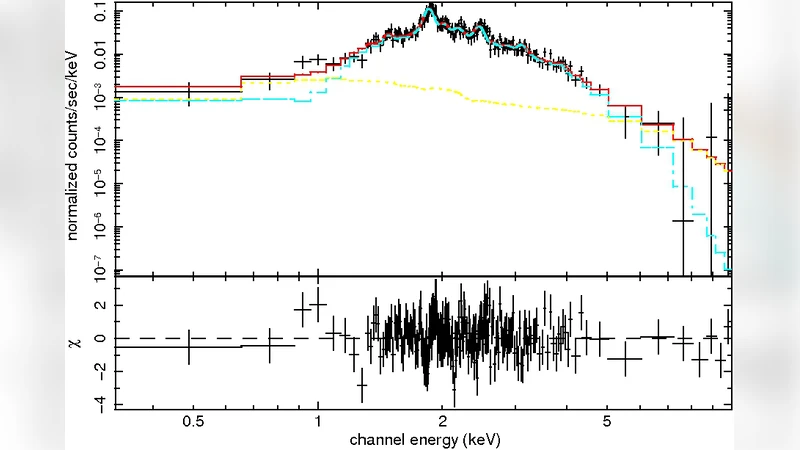
In this paper, we present the analysis of a deep (99.6 ks) observation of G304.6 + 0.1 with the X-ray Imaging Spectrometer on board {\it Suzaku} satellite. The X-ray spectral data are well-fitted with a plasma model consisting of a thermal component in collisional ionization equilibrium and a non-thermal component. The thermal emission is well fitted with VMEKAL model with an electron temperature of $kT_{\rm e}\sim 0.75$ keV, a high absorbing column density of $N_{\rm H}\sim 3.9\times10^{22}$ $\rm cm^{-2}$ and near/lower solar abundances which indicate that the X-ray emitting plasma of G304.6 + 0.1 is dominated by swept-up ambient medium. The non-thermal component is well fitted with a power-law model with photon index of $\Gamma \sim 1.4$. We found a relatively high electron density $n_{\rm e}\sim 2.3f^{-1/2}$ cm$^{-3}$, age $t$ $\sim 1.4\times10^4f^{1/2}$ yr, and X-ray emitting mass $M_{\rm x}\sim 380f^{1/2}$ {M\sun} at an adopted distance of d=10 kpc. Using the morphological and spectral X-ray data, we confirm that the remnant is a new member of mixed-morphology supernova remnants.
💡 Research Summary
This paper presents a comprehensive X‑ray study of the supernova remnant (SNR) G304.6+0.1 (also known as Kes 17) using a deep 99.6 ks observation with Suzaku’s X‑ray Imaging Spectrometer (XIS). The authors begin by situating G304.6+0.1 within the broader context of mixed‑morphology (MM) remnants, noting that previous X‑ray observations suffered from limited exposure and sensitivity, leaving the thermal and non‑thermal characteristics of the plasma poorly constrained.
The Suzaku data were processed with the latest HEASoft and CALDB releases. Standard screening criteria were applied to remove periods of high background, South Atlantic Anomaly passages, and low Earth elevation angles. Both front‑illuminated (FI) and back‑illuminated (BI) CCDs were used, providing coverage from 0.5 to 10 keV. Imaging analysis reveals a centrally peaked X‑ray morphology that is offset from the radio shell, a hallmark of MM SNRs where thermal X‑ray emission fills the interior while the radio emission outlines the outer shock.
Spectral extraction was performed from a circular region encompassing the bright central emission, with a surrounding annulus used to characterize the background. The spectrum was fitted in XSPEC using a two‑component model: a VMEKAL plasma in collisional ionization equilibrium (CIE) plus a power‑law component. The thermal component yields an electron temperature of $kT_{\rm e}=0.75\pm0.05$ keV, an absorbing column density $N_{\rm H}=3.9\times10^{22}$ cm⁻², and elemental abundances (Si, S, Fe) that are consistent with or slightly below solar values. This abundance pattern indicates that the X‑ray emitting gas is dominated by swept‑up interstellar material rather than ejecta‑rich supernova debris.
The non‑thermal component is well described by a power‑law with photon index $\Gamma=1.4\pm0.2$, suggesting a relatively flat spectrum. The authors discuss possible origins, including synchrotron radiation from shock‑accelerated electrons or bremsstrahlung from a partially ionized plasma. The presence of both components supports the classification of G304.6+0.1 as an MM SNR, where thermal and non‑thermal processes coexist.
Physical parameters were derived assuming a distance of 10 kpc and a spherical emitting volume with radius $R\approx8$ pc. Introducing a filling factor $f$ to account for clumpiness, the electron density is estimated as $n_{\rm e}=2.3,f^{-1/2}$ cm⁻³. From this density, the ionization timescale implies an age $t\approx1.4\times10^{4},f^{1/2}$ yr, and the total X‑ray emitting mass is $M_{\rm X}\approx380,f^{1/2},M_{\odot}$. These values place the remnant in the middle‑aged regime typical of MM SNRs interacting with dense ambient media.
In the discussion, the authors compare G304.6+0.1 with well‑studied MM remnants such as W44, IC 443, and G352.7‑0.1. The high column density, near‑solar abundances, and centrally filled thermal emission all align with the established characteristics of this class. The paper also acknowledges uncertainties: the distance is assumed rather than measured, and the filling factor remains unconstrained, leading to systematic errors in derived densities, ages, and masses.
The conclusion emphasizes that the deep Suzaku observation has firmly established G304.6+0.1 as a new member of the mixed‑morphology family. The detection of both a CIE thermal plasma and a hard non‑thermal tail provides valuable insight into the interplay between shock heating, particle acceleration, and ambient medium interaction in evolved SNRs. The authors recommend follow‑up observations with higher spatial resolution (e.g., Chandra) and multi‑wavelength campaigns (radio, infrared, gamma‑ray) to refine the filling factor, map the detailed shock structure, and clarify the origin of the non‑thermal emission.