Resolving the Inner Structure of QSO Discs by Fold Caustic Crossing Events
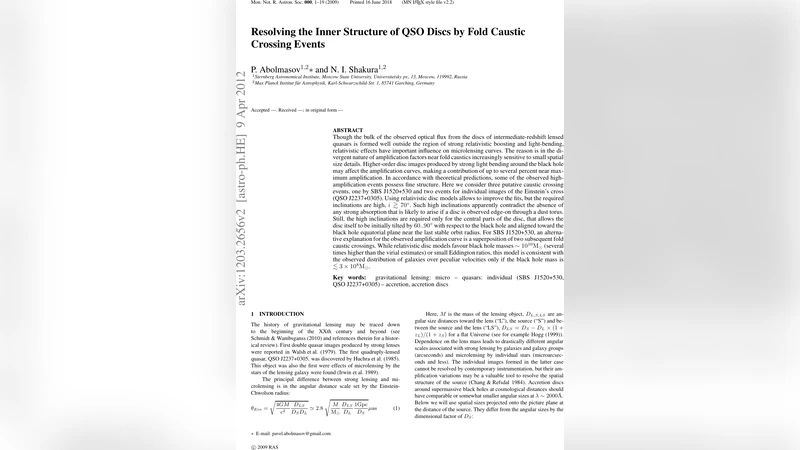
Though the bulk of the observed optical flux from the discs of intermediate-redshift lensed quasars is formed well outside the region of strong relativistic boosting and light-bending, relativistic effects have important influence on microlensing curves. The reason is in the divergent nature of amplification factors near fold caustics increasingly sensitive to small spatial size details. Higher-order disc images produced by strong light bending around the black hole may affect the amplification curves, making a contribution of up to several percent near maximum amplification. In accordance with theoretical predictions, some of the observed high-amplification events possess fine structure. Here we consider three putative caustic crossing events, one by SBS1520+530 and two events for individual images of the Einstein’s cross (QSO J2237+0305). Using relativistic disc models allows to improve the fits, but the required inclinations are high, about 70deg or larger. Such high inclinations apparently contradict the absence of any strong absorption that is likely to arise if a disc is observed edge-on through a dust torus. Still, the high inclinations are required only for the central parts of the disc, that allows the disc itself to be initially tilted by 60-90deg with respect to the black hole and aligned toward the black hole equatorial plane near the last stable orbit radius. For SBS1520+530, an alternative explanation for the observed amplification curve is a superposition of two subsequent fold caustic crossings. While relativistic disc models favour black hole masses ~10^10 solar (several times higher than the virial estimates) or small Eddington ratios, this model is consistent with the observed distribution of galaxies over peculiar velocities only if the black hole mass is about 3 10^8 solar.
💡 Research Summary
The paper investigates how microlensing events that involve a fold caustic crossing can be used to probe the inner structure of quasar accretion discs at intermediate redshifts (z ≈ 0.5–2). Although most of the observed optical/UV flux from these discs originates at radii far outside the region where relativistic boosting and light‑bending are strong, the amplification factor of a microlensing caustic diverges sharply near the caustic line, making the observed light curve extremely sensitive to the spatial details of the source on micro‑arcsecond scales. Consequently, even the modest relativistic effects that operate near the black‑hole event horizon can imprint measurable signatures on the microlensing light curves, especially when the source crosses a fold caustic.
Three high‑magnification events are examined: one in the doubly imaged system SBS 1520+530 and two separate events in the four‑image “Einstein Cross” (QSO J2237+0305). The authors first fit the data with a conventional, non‑relativistic thin‑disc model. While such a model reproduces the overall shape of the amplification curves, it fails to capture fine structures—sharp peaks, small oscillations, and asymmetric shoulders—that are present in the observed light curves.
To address these discrepancies, the authors employ a fully relativistic disc model based on the Kerr metric. The model includes the black‑hole mass (M), spin parameter (a), radiative efficiency (ε), disc inclination (i), and a standard temperature profile (T ∝ R^−3/4). Crucially, the model accounts for higher‑order images produced by strong light‑bending around the black hole, as well as Doppler boosting and gravitational redshift that depend on the disc’s orientation relative to the line of sight. These relativistic effects can enhance the caustic amplification by several percent and introduce asymmetries that match the observed fine structure.
When the relativistic model is applied, the best‑fit parameters for all three events require a disc inclination of i ≈ 70°–80°, i.e., the disc is viewed almost edge‑on. Such a high inclination appears to contradict the lack of strong absorption features that would be expected if the line of sight passed through a dusty torus surrounding an edge‑on disc. The authors resolve this tension by proposing a warped disc geometry: the outer disc may be tilted by 60°–90° relative to the black‑hole spin axis, while the inner disc (inside the last stable orbit) aligns with the black‑hole equatorial plane due to Lense–Thirring precession. In this configuration, the outer disc avoids the torus, explaining the absence of heavy absorption, while the inner, highly inclined region still produces the relativistic signatures required by the microlensing data.
For the SBS 1520+530 event, an alternative interpretation is explored. The observed amplification curve could be the superposition of two successive fold‑caustic crossings. In this “double‑crossing” scenario, a modest inclination suffices, but the model then prefers a very massive black hole, M ≈ 10^10 M⊙—several times larger than virial mass estimates derived from emission‑line widths. This high mass also implies a low Eddington ratio, which is at odds with typical quasar accretion rates. Moreover, such a mass would be inconsistent with the observed distribution of galaxy peculiar velocities unless the true mass is closer to M ≈ 3 × 10^8 M⊙, highlighting a tension between microlensing‑derived masses and independent dynamical constraints.
Overall, the study demonstrates that fold‑caustic microlensing events are exquisitely sensitive probes of quasar disc structure on scales of a few gravitational radii. Relativistic disc models can significantly improve the fit to high‑quality light curves, but they demand extreme disc tilts or unusually massive black holes—both of which raise questions about the physical plausibility of the inferred configurations. The authors suggest that future observations combining dense optical monitoring, high‑resolution infrared interferometry, and X‑ray spectroscopy could break these degeneracies, test the warped‑disc hypothesis, and provide tighter constraints on black‑hole spin, mass, and the geometry of the surrounding dusty torus.