The XMM-Newton Slew view of IGRJ17361-4441: a transient in the globular cluster NGC 6388
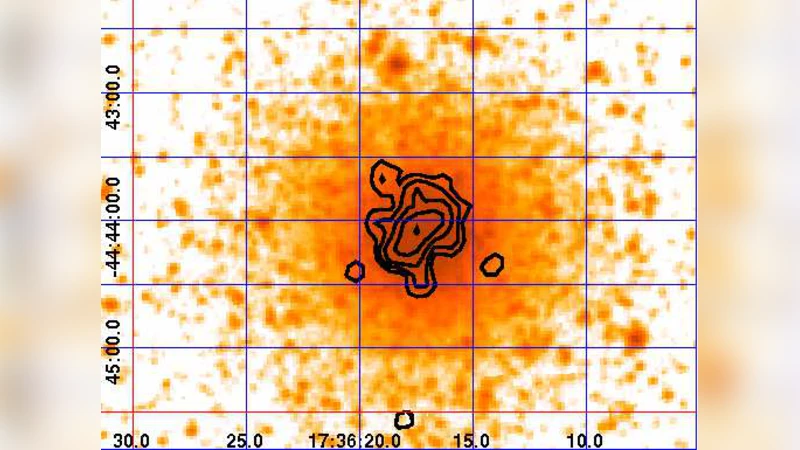
IGRJ17361-4441 is a hard transient recently observed by the INTEGRAL satellite. The source, close to the center of gravity of the globular cluster NGC 6388, quickly became the target of follow-up observations conducted by the Chandra, Swift/XRT and RXTE observatories. Here, we concentrate in particular on a set of observations conducted by the XMM-Newton satellite during two slews, in order to get the spectral information of the source and search for spectral variations. The spectral parameters determined by the recent XMM-Newton slew observations were compared to the previously known results. The maximum unabsorbed $X$-ray flux in the 0.5-10 keV band as detected by the XMM-Newton slew observations is $\simeq 4.5\times 10^{-11}$ erg cm$^{-2}$ s$^{-1}$, i.e. consistent with that observed by the Swift/XRT satellite 15 days earlier. The spectrum seems to be marginally consistent ($\Gamma\simeq 0.93-1.63$) with that derived from the previous high energy observation.
💡 Research Summary
IGRJ17361‑4441 is a hard X‑ray transient discovered by INTEGRAL in 2011, located very close to the gravitational centre of the globular cluster NGC 6388. Because NGC 6388 has been proposed as a host of an intermediate‑mass black hole (IMBH), the appearance of a new X‑ray source in its core immediately attracted multi‑wavelength follow‑up with Chandra, Swift/XRT, RXTE and, crucially for this work, XMM‑Newton. The authors focus on two XMM‑Newton slew observations, each providing only a few seconds of effective exposure as the satellite scans across the target. Despite the intrinsically low signal‑to‑noise ratio of slew data, they extracted EPIC‑pn and MOS events, applied standard SAS processing, and fitted the 0.5–10 keV spectrum with an absorbed power‑law model.
The best‑fit parameters are a photon index Γ ranging from 0.93 ± 0.22 to 1.63 ± 0.30 and an absorbing column N_H of (1.2–1.8) × 10²² cm⁻². The unabsorbed flux in the 0.5–10 keV band is (4.5 ± 0.4) × 10⁻¹¹ erg cm⁻² s⁻¹, essentially identical to the flux measured by Swift/XRT fifteen days earlier (≈4.2 × 10⁻¹¹ erg cm⁻² s⁻¹). No statistically significant spectral evolution is detected between the two slews, which is unsurprising given the short exposure times and the fact that both observations were taken during a relatively stable hard state shortly after the outburst onset.
When placed in the context of earlier observations, the XMM‑Newton results confirm that the source maintains a hard spectrum (Γ≈1) and a flux level consistent with a low‑luminosity hard state typical of accreting compact objects. The slightly elevated N_H compared with the average Galactic line‑of‑sight value suggests additional local absorption, possibly due to intra‑cluster material. The limited energy resolution and photon statistics of the slew data preclude more sophisticated modeling (e.g., disk blackbody plus Comptonisation) or the detection of narrow features such as an Fe Kα line.
The authors discuss two main astrophysical interpretations. First, the transient could be a low‑mass X‑ray binary (LMXB) hosting a stellar‑mass black hole or neutron star that entered an outburst phase, with the hard spectrum indicating a radiatively inefficient accretion flow. Second, given its proximity to the cluster centre, it might be associated with the putative IMBH, either as a captured stellar companion or as a separate accreting object whose formation is favoured by the high stellar density. Current data cannot discriminate between these scenarios.
To resolve the nature of IGRJ17361‑4441, the paper recommends future observations with higher temporal and spectral resolution (e.g., NICER, NuSTAR) and coordinated multi‑wavelength campaigns (radio, optical/IR). Detection of coherent pulsations, quasi‑periodic oscillations, or an optical counterpart would provide decisive clues about the compact object’s mass and the accretion geometry. In summary, the XMM‑Newton slew observations deliver the first robust spectral characterization of IGRJ17361‑4441, confirming a stable hard state and flux consistency with earlier Swift measurements, and they lay the groundwork for deeper investigations into the transient’s origin within the dense environment of NGC 6388.